THE CLASSIC COLLECTION✦The history of the condition of women in various ages and nationsCLASSIC FREE BOOKS
The history of the condition of women in various ages and nations
Lydia Maria Child
THE CLASSIC COLLECTION · 1831
"The Mother’s Book" by Lydia Maria Child is a parenting guide focused on child rearing and education, written in the mid-19th century. The book addresses the importance of a mother's influence on her child's development, touching on topics like emotional care, education, and the cultivation of affection and intellect. Child's work aims to provide practical advice for mothers aiming to raise well-adjusted and educated children, emphasizing the natural bond and responsibility mothers have in shaping their offspring. The opening of "The Mother’s Book" introduces the author’s intent to guide mothers through the early stages of their children's lives, highlighting the significance of a mother’s actions, attitudes, and emotions on a child's future character. It argues that early experiences profoundly shape a child's dispositions, suggesting practical approaches for engaging a child’s senses and intellect. Child emphasizes the need for gentleness, patience, and a nurturing environment, discussing strategies for encouraging curiosity and correcting negative behaviors without harshness. Through advice grounded in observations of human behavior, the text sets the stage for detailed lessons on effective parenting.
Introduction adapted from the source catalogue; source summaries may be automatically generated.
Free to read · English · 52,565 words · No account needed
MAKE TIME FOR A GOOD BOOK
On by default. Untick to stop anonymous reading totals. Each page counts after 10 seconds in view. How this works.
Anonymous counting is on unless you have switched it off.
Perhaps some parents of moderate fortune will ask if there is no danger of unfitting girls for the duties of their station, and making them discontented with their situation in life, by teaching them accomplishments merely ornamental. For myself, I do not believe that any kind of knowledge ever unfitted a person for the discharge of duty, provided that knowledge was acquired from a right motive. It is wonderful what different results the same thing will produce, when the motives are different. No matter what is learned, provided it be acquired as a means of pleasing a parent, of becoming useful to others, or of acquiring a necessary support. If you induce children to learn any particular thing for the sake of showing off, or being as grand as their neighbors, then, indeed, you will unfit them for their duties, and make them discontented with their situation. Looking to others for our standard of happiness is the sure way to be miserable. Our business is with our own hearts, and our own motives. When I say that a decided talent for any pursuit should be encouraged, I do not mean that every whim and caprice should be indulged. Mothers often talk about giving their daughters a taste for music, and a taste for painting, when in fact they only wish to excite in them a silly ambition to have as many accomplishments to show off, as other girls have. The consequence is, such families undertake to do a multitude of things, and do nothing well. A good deal of money is spent to very little purpose; for such young ladies do not really take pleasure in their employments; and if left destitute, they could not teach what they do not half understand.
My idea is this--First, be sure that children are familiar with all the duties of their present situation; at the same time, by schools, by reading, by conversation, give them as much solid knowledge as you can,--no matter how much, or of what kind,--it will come in use some time or other; and lastly, if your circumstances are easy, and you can afford to indulge your children in any matter of taste, do it fearlessly, without any idea that it will unfit them for more important duties. Neither learning nor accomplishments do any harm to man or woman if the motive for acquiring them be a proper one; on the contrary, those who know most, are apt to perform their duties best--provided the heart and the conscience have been educated as well as the understanding. I believe a variety of knowledge (acquired from such views as I have stated) would make a man a better servant, as well as a better president; and make a woman a better wife, as well as a better teacher. A selfish use of riches leads to avarice, pride, and contempt of manual exertion; a selfish use of knowledge leads to pedantry, affectation, unwillingness to conform to others, and indolence in any pursuit not particularly pleasing to ourselves. But the fault is not in the riches, or the knowledge--the difficulty lies in the selfish use of these advantages. If both were held in trust, as a means of doing good, how different would be the result! For this reason, I should never wish children to learn anything because some of their companions were learning it. I would always offer present or future usefulness as a motive. For instance, if a daughter were very desirous of learning music, I would ask her why she desired it. If she answered, or if I had reason to think, it was because some one else was learning it, I would at once discountenance it, by telling her the motive was a very poor one; but if she said she wished too learn, because she loved it very much, I would readily enter into her wishes, and promise to ask her father’s permission. If the request were granted, I would say, ‘You know we are not rich enough to have good music-masters for all of you; but your father is willing to expend more upon you than he could otherwise afford, from the idea that you will learn carefully and thoroughly, and thus be able to teach your brothers and sisters. At some future time your music may perhaps be the means of supporting yourself and doing good to others. You can likewise bring it into immediate use; for you will very soon be able to amuse your father in return for this kind indulgence.’
Your reading position is saved on this browser. Take it to another device with a library code. Reading pages adapt to text, rather than matching a printed edition.
Lydia Maria Child
Lydia Maria Child
Lydia Maria Child
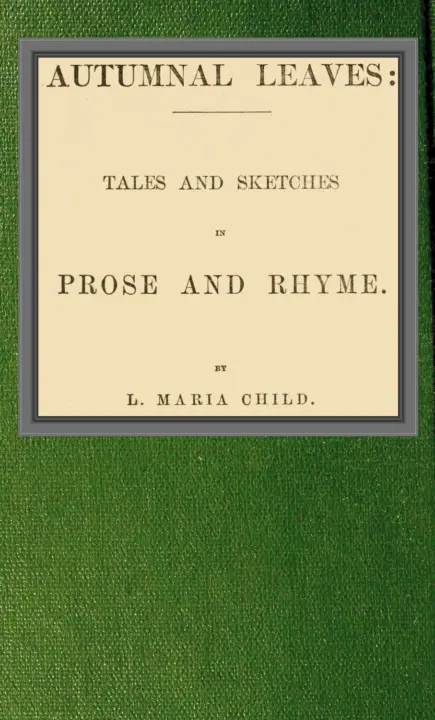
Lydia Maria Child
BEHIND THE BOOK
This eBook is for the use of anyone anywhere in the United States and most other parts of the world at no cost and with almost no restrictions whatsoever. You may copy it, give it away or re-use it under the terms of the Project Gutenberg License included with this eBook or online at www.gutenberg.org. If you are not located in the United States, you will have to check the laws of the country where you are located before using this eBook. Read the source licence.
The original source file, including credits and licence, is retained by this library. Request an original-format copy at no charge. Please include the book title and Project Gutenberg identifier #69345.
KEEP YOUR CURIOSITY GOING

Charles G. (Charles Griffith) Ross
Hannah Webster Foster

Emily Lawless
Edwin Hamlin Carr

Charles De Lano Hine
Andrew Ure