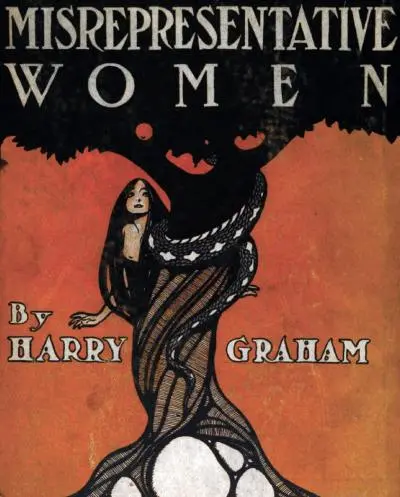
Misrepresentative Women
Harry Graham
THE CLASSIC COLLECTION · 1910
"The Mother of Parliaments" by Harry Graham is a historical account written in the early 20th century. The book provides a comprehensive exploration of the history and evolution of the English Parliament, emphasizing its significance to the country and its people. It examines the governmental structure, the dynamics between the Houses of Lords and Commons, and the historical context that shaped parliamentary procedures and responsibilities. The opening of the text introduces the author's intent behind the work: to present a detailed yet accessible narrative about the English Parliament's history and its relevance to modern governance. Graham reflects on the widespread interest in parliamentary affairs and the transformation of political representation over time. He outlines the historical roots of parliamentary governance from the ancient Witenagemot to contemporary practices, emphasizing the ongoing struggle for political power between the monarchy and the populace. Notably, he sets the stage for a deeper exploration into parliamentary structure and function in subsequent chapters.
Introduction adapted from the source catalogue; source summaries may be automatically generated.
Free to read · English · 107,358 words · No account needed
MAKE TIME FOR A GOOD BOOK
On by default. Untick to stop anonymous reading totals. Each page counts after 10 seconds in view. How this works.
Anonymous counting is on unless you have switched it off.
[455] On one occasion, in the hurry of dispatching his nightly missive, Lord Randolph Churchill accidentally enclosed a quantity of tobacco in the box which he forwarded to Queen Victoria, much to Her Majesty's amusement.
The sovereign is not supposed to enter the Lower House--Charles I. was the only monarch who broke this rule--and thus, in days before debates were published at length in the papers, the Crown had no means of ascertaining the doings of the Commons save through the medium of this letter. The need for this one-sided nightly correspondence no longer exists, but the custom still prevails, and adds one more to the already multifarious duties of the Leader of the House, though nowadays it is occasionally delegated to some other Minister, or to one of the Whips.
To-day Press and Parliament are mutually dependent. A great newspaper proprietor who was recently asked which of the two he considered to be the most powerful, found some difficulty in replying. "The Press is the voice without which Parliament could not speak," he said. "On the other hand, Parliament is the law-making machine without which the Press could not act." The question of their relative power and importance must be left to the decision of individual judgment and taste. "Give me but the liberty of the Press," said Sheridan in 1810, in answer to the Premier, Spencer Perceval, "and I will give the Minister a venal House of Peers, I will give him a corrupt and servile House of Commons, I will give him the full swing of the patronage of office, I will give him the whole host of ministerial influences, I will give him all the power that place can confer upon him to purchase submission and overawe resistance; and yet, armed with the liberty of the Press, I will go forth to meet him undismayed; I will attack the mighty fabric he has reared with that mightier engine; I will shake down from its height corruption, and lay it beneath the ruins of the abuses it was meant to shelter!"[456]
[456] Hansard's "Debates," 1st series, vol. xv.
Adams, W. H. D., English Party Leaders and Parties. 1878.
Alison, Sir A., Life of Lord Castlereagh. 1861.
Anson, Sir W. R., Law and Custom of the Constitution. 1897.
Arcana Parliamentaria, or Precedents concerning Parliament, by R. C. of the Middle Temple, Esq. 1685.
Ashley, Hon. A. E., Life of Lord Palmerston. 1876.
Ashwell, A., Life of Bishop Samuel Wilberforce. 1880.
Atlay, J. B., The Victorian Chancellors. 1908.
Bacon, N., Historical Discourse of the Laws and Government of
England. 1760.
Bagehot, W., Biographical Studies. 1881.
Bagehot, W., The English Constitution. 1872.
Bagehot, W., Literary Studies. 1879.
Barnes, T., Parliamentary Portraits. 1815.
Barrington, Sir J., Historic Memoirs of Ireland. 1833.
Your reading position is saved on this browser. Take it to another device with a library code. Reading pages adapt to text, rather than matching a printed edition.
BEHIND THE BOOK
This eBook is for the use of anyone anywhere in the United States and most other parts of the world at no cost and with almost no restrictions whatsoever. You may copy it, give it away or re-use it under the terms of the Project Gutenberg License included with this eBook or online at www.gutenberg.org. If you are not located in the United States, you will have to check the laws of the country where you are located before using this eBook. Read the source licence.
The original source file, including credits and licence, is retained by this library. Request an original-format copy at no charge. Please include the book title and Project Gutenberg identifier #41304.
KEEP YOUR CURIOSITY GOING
Cécile Tormay

Moritz Busch
John L. Ransom
Frances Wright
Cécile Tormay

Mabel Potter Daggett