
The White Kami: A Novel
Edward Alden Jewell
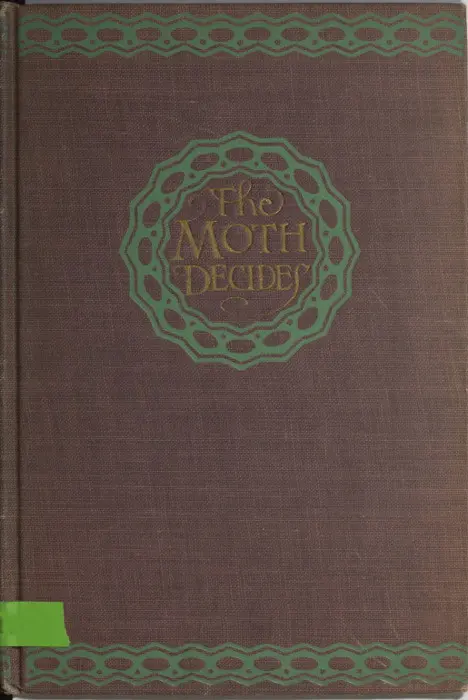
THE CLASSIC COLLECTION · 1922
"The Moth Decides: A Novel" by Edward Alden Jewell is a fiction work written in the early 20th century. The story centers around Louise Needham, a young woman navigating her feelings and relationships after a past heartbreak with a man named Richard. As she prepares to meet her new fiancé, Lynndal Barry, Louise grapples with her past experiences and the nature of love, highlighting the contrast between her former affection for Richard and her current feelings for Lynndal. The opening of the novel introduces readers to Louise as she wakes early one summer morning in her family's cottage near Lake Michigan. She reflects on her anticipation and the significance of the day ahead, as Leslie—her friend and a suitor—waits for her outside. The narrative unfolds her interactions with her younger sister, Hilda, and reveals Louise's deliberate thoughts about her relationship with both Leslie and Lynndal while hinting at the emotional scars left by Richard. As Louise prepares for her journey to meet Lynndal, she showcases her maturity and desire for independence, setting the stage for the complexities of love and fidelity that will permeate the story.
Introduction adapted from the source catalogue; source summaries may be automatically generated.
Free to read · English · 58,918 words · No account needed
MAKE TIME FOR A GOOD BOOK
On by default. Untick to stop anonymous reading totals. Each page counts after 10 seconds in view. How this works.
Anonymous counting is on unless you have switched it off.
"I suppose," observed Mrs. Needham, "you do feel kind of cooped up in those foreign places." That phrase of hers "foreign places," was in the nature of a stock term. It was expansive, elastic, comprehensive. She spoke of foreign places a little as her husband spoke of the East or of "culture." Neither had travelled any to speak of. In a sort of whimsical way it seemed to Mrs. Needham that one might expect to find Bombay and Peking supporting much the same conditions of life. Or even Dublin and Rome, for that matter. "I don't suppose," she added, "there's anything like this where you've been."
"I should emphatically say not," her sister assured her. "At Rato-muh--that's the capital, you know--we've nothing but a dirty little river. I'm dying for a glorious swim!"
"We go bathing nearly every afternoon, Aunt Marjie," Hilda announced.
"You do? Well, I'm with you!" She was just a trifle loud. "Do there happen to be any convenient islands one could swim out to?"
"Oh, no, Aunt Marjie, there aren't," replied the girl regretfully, almost with a touch of naïve apology.
"Well, no matter. You can always swim round in a circle, of course. Only I do like having a definite goal."
And then she paused a moment, even suspending her toilet; for having a goal--hadn't that been, with almost amusing steadfastness, her aim all through life? Of course, it was quite true: there had been perhaps a hundred goals, all told; but each, in its own way, and at its own time, had seemed the golden, final one. And always so incorrigibly definite. She had gone vibrantly and humorously on from one pursuit to another, determination taking multiple form. And yet there appeared now to have been, all along, just one permanent and unswerving determination: not to marry O'Donnell.
Miss Whitcom sighed briefly and went on hooking herself up.
"Speaking of swimming," she continued. "I won a gold medal once. Yep.
A very long time ago."
"A medal for swimming, Aunt Marjie?"
The aunt nodded. "I entered a five-mile endurance and time. Entered against thirteen men, and got there first!"
"Oh, how wonderful!" cried Hilda admiringly.
"Yes, it was wonderful," the other admitted; then frowned. "The only trouble was that I had my subsequent doubts of its being really fair."
Mrs. Needham, who had been standing in the doorway, a faint and musing smile on her lips, received the news of the swimming match with a hurried comment about having to go down and see how Eliza was getting on with breakfast. She was always, and especially with Alfred in mind, mildly shocked at the glib way in which her sister talked about men.
Your reading position is saved on this browser. Take it to another device with a library code. Reading pages adapt to text, rather than matching a printed edition.
Edward Alden Jewell
BEHIND THE BOOK
This eBook is for the use of anyone anywhere in the United States and most other parts of the world at no cost and with almost no restrictions whatsoever. You may copy it, give it away or re-use it under the terms of the Project Gutenberg License included with this eBook or online at www.gutenberg.org. If you are not located in the United States, you will have to check the laws of the country where you are located before using this eBook. Read the source licence.
The original source file, including credits and licence, is retained by this library. Request an original-format copy at no charge. Please include the book title and Project Gutenberg identifier #61523.
KEEP YOUR CURIOSITY GOING
Coulson Kernahan

Maurice Baring
Frances Wright
Cécile Tormay

Frederic Jesup Stimson

W. H. P. (William Henry Pope) Jarvis