
The White Kami: A Novel
Edward Alden Jewell
THE CLASSIC COLLECTION · 1922
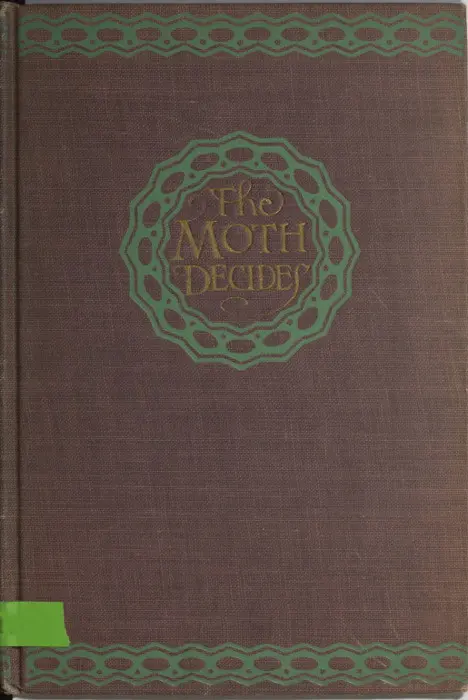
"The Moth Decides: A Novel" by Edward Alden Jewell is a fiction work written in the early 20th century. The story centers around Louise Needham, a young woman navigating her feelings and relationships after a past heartbreak with a man named Richard. As she prepares to meet her new fiancé, Lynndal Barry, Louise grapples with her past experiences and the nature of love, highlighting the contrast between her former affection for Richard and her current feelings for Lynndal. The opening of the novel introduces readers to Louise as she wakes early one summer morning in her family's cottage near Lake Michigan. She reflects on her anticipation and the significance of the day ahead, as Leslie—her friend and a suitor—waits for her outside. The narrative unfolds her interactions with her younger sister, Hilda, and reveals Louise's deliberate thoughts about her relationship with both Leslie and Lynndal while hinting at the emotional scars left by Richard. As Louise prepares for her journey to meet Lynndal, she showcases her maturity and desire for independence, setting the stage for the complexities of love and fidelity that will permeate the story.
Introduction adapted from the source catalogue; source summaries may be automatically generated.
Free to read · English · 58,918 words · No account needed
MAKE TIME FOR A GOOD BOOK
On by default. Untick to stop anonymous reading totals. Each page counts after 10 seconds in view. How this works.
Anonymous counting is on unless you have switched it off.
As a matter of fact, the bed was not a very soft one. Or rather, it was very soft in places and very hard in others. Perhaps one of the enduring charms of small resort cottage life is the amusing inequality of things. The best and the worst hobnob. Lo, here is a true democracy! And virtues utterly commonplace in your urban ménage may very easily be given a most heavenly lustre in the wilderness.
"Well, Anna," he said, in his best tone of fresh, early morning cheerfulness, "I guess it's time to get up."
"Alf, you don't mean to tell me that was seven!"
She had counted the strokes; but it was customary to have a little conversation about the time of day before arising: a sort of pleasant, innocuous tongue-limbering, a lubrication of the way to more important themes later on. Such gentle, indirect prevarications may perhaps be looked upon indulgently, even when, as in this case, they crop out in clerical families.
The Rev. Needham proceeded to dress and shave.
He was in a good, confident, substantial mood today; rose singing. The Rev. Needham was very apt to arise with song in his mouth, bravely defying the chance of his going to bed with a wail. This morning the selection was that fine old Laudes Domini which seemed peculiarly appropriate, both fitting the hour and reflecting the joyous state of the singer's heart.
"When morning gilds the skies
My heart awaking cries:
'May Jesus Christ be praised!'"
The Rev. Needham had a tenor voice of fair quality, though not altogether true of pitch. In the wilderness, so far from pipe organs, pitch however, dwindled to comparative unimportance. It was the spirit of song that counted.
Now, one might observe that in this hymn the Rev. Needham would come out very full and strong on the more purely ecstatic lines (such, for instance, as depict the spread of morning across the heavens, the awaking of a fervent heart, etc.), and that, almost invariably, those more climactic, particularly the more ecclesiastical, lines would issue a little muffled, as the singer found it urgent to immerse his head in the washbowl's morning plunge, or apply a towel vigorously, or perhaps bend suddenly over to lace up his shoes--by this movement naturally cutting down the egress of breath. They were subtly odd, these mufflings. It was almost as though Fate had determined sedulously to deny to this unfortunate man an indulgence in his very life-mission: praising his Maker! For another than he the intervals of competition might very easily have fallen less saliently. Yes, another would have found it possible to cloud over, if necessary, the heavenly gilding and would have been suffered to come out free, triumphant, on the diviner phrases. But not the Rev. Needham. No, alas, not he. It was a part of the Rev. Needham's destiny that the better and more satisfying arrangement of life must be withheld, or temporarily awarded only to be broken rudely off. Inquiry ought to pause here. Yes, it delicately and righteously and above all humanely ought. No, it ought not to lead one away, fiendishly to lure one on to a certain door in one of the three-quarters partitions, beyond which the slumber of a human being was giving place, at this stage, to the more irregular sounds signifying a return to consciousness. Ah, better to leave out altogether the thought of any mortal responsibility for the muffling; better to cling decently just to the adverseness of an obdurate Fate. And yet, the tenor of the conversation which now ensued between the Rev. Needham and his wife might favour the suspicion--let us call it by no stronger name--that the person beyond that door in the three-quarters partition had something to do, however slightly, with the matter of vocal emphasis.
Your reading position is saved on this browser. Take it to another device with a library code. Reading pages adapt to text, rather than matching a printed edition.
Edward Alden Jewell
BEHIND THE BOOK
This eBook is for the use of anyone anywhere in the United States and most other parts of the world at no cost and with almost no restrictions whatsoever. You may copy it, give it away or re-use it under the terms of the Project Gutenberg License included with this eBook or online at www.gutenberg.org. If you are not located in the United States, you will have to check the laws of the country where you are located before using this eBook. Read the source licence.
The original source file, including credits and licence, is retained by this library. Request an original-format copy at no charge. Please include the book title and Project Gutenberg identifier #61523.
KEEP YOUR CURIOSITY GOING
Coulson Kernahan

Maurice Baring
Frances Wright
Cécile Tormay

Frederic Jesup Stimson

W. H. P. (William Henry Pope) Jarvis