
The White Kami: A Novel
Edward Alden Jewell
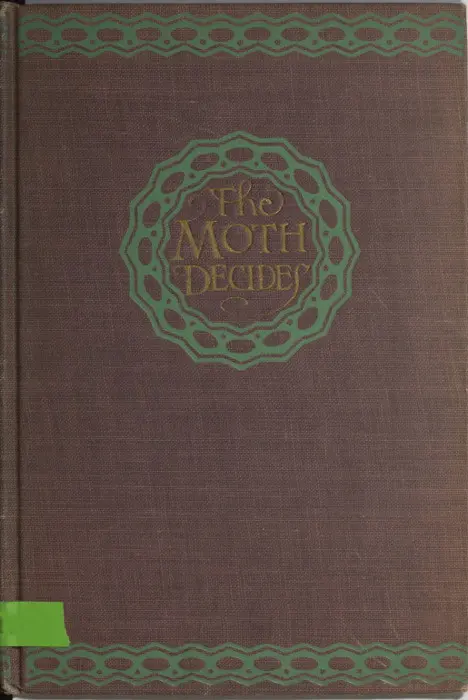
THE CLASSIC COLLECTION · 1922
"The Moth Decides: A Novel" by Edward Alden Jewell is a fiction work written in the early 20th century. The story centers around Louise Needham, a young woman navigating her feelings and relationships after a past heartbreak with a man named Richard. As she prepares to meet her new fiancé, Lynndal Barry, Louise grapples with her past experiences and the nature of love, highlighting the contrast between her former affection for Richard and her current feelings for Lynndal. The opening of the novel introduces readers to Louise as she wakes early one summer morning in her family's cottage near Lake Michigan. She reflects on her anticipation and the significance of the day ahead, as Leslie—her friend and a suitor—waits for her outside. The narrative unfolds her interactions with her younger sister, Hilda, and reveals Louise's deliberate thoughts about her relationship with both Leslie and Lynndal while hinting at the emotional scars left by Richard. As Louise prepares for her journey to meet Lynndal, she showcases her maturity and desire for independence, setting the stage for the complexities of love and fidelity that will permeate the story.
Introduction adapted from the source catalogue; source summaries may be automatically generated.
Free to read · English · 58,918 words · No account needed
MAKE TIME FOR A GOOD BOOK
On by default. Untick to stop anonymous reading totals. Each page counts after 10 seconds in view. How this works.
Anonymous counting is on unless you have switched it off.
Later the talk centred in Arizona.
Barry glanced at Louise, and found her, as it happened, gazing sadly, quizzically, and with some abstraction at him. He looked away at once, trembling a little; and he carried on the theme:
"Of course Arizona strikes people in different ways. Some find the flatness and the sand depressing."
"Is it sand all over?" asked Hilda.
"Oh, dear no!" replied Miss Whitcom, with a vehemence which served to remind them all that she had been a pioneer in the cactus candy business and knew what she was talking about.
Even the Rev. Needham contributed something to his younger daughter's enlightenment. "There are lots of trees along the irrigation ditches. Barry, what kind of trees are they? I never can seem to remember."
"Cottonwood, mostly," he answered. "The foliage is a very delicate
green."
"Oh, it must be lovely!" sighed Hilda, who romantically saw herself walking along beside Leslie beneath an everlasting row of the most beautiful trees anybody could possibly imagine. "How I should love to go out there!"
"Yes," mused Miss Whitcom, "and we mustn't forget the broad fields of alfalfa--so dark--the very greenest green in all the world."
Barry nodded slowly. "Yes, the river valleys are always quite fertile. Then comes the great Arizona desert, with cacti and mesquite and greenwood and sage. And beyond all that"--he had begun a little monotonously, but came at length to speak in a rather rapt way--"beyond all that, the dim blue of the distance, the lonely peaks of the mountains...."
"Grand old mountains!" added Miss Whitcom.
And it was odd, and no doubt sentimental, but the mountains all at once reminded her somehow of O'Donnell. Yes, O'Donnell was something like a mountain. Her heart quickened a little.
"Oh, I know I should just love it!" cried Hilda. And then she asked, in her almost breathless manner: "Are there any birds in Arizona?"
"Birds?" repeated Barry, a little abstractedly. "Birds? Oh, yes--all through the irrigated districts. There are orchards, you know. It's a fine sight to see them in full bloom. And the trees are alive with birds--meadow larks and mocking birds, mostly. And there are blackbirds, too. They sing in a wonderful chorus. And almost everywhere you'll hear the little Mexican doves."
"Oh, I remember the doves!" cried Louise suddenly, forgetting her
wretchedness.
He looked at her wistfully and solemnly. "Some people say the doves
have the sweetest song of all. There's a very plaintive note--you
remember?"
"Yes," she whispered thickly, avoiding his eyes.
The breath of Fate seemed faintly to animate her having remembered the little Mexican doves. "I think," he said, "they have the saddest song of any of the birds."
Your reading position is saved on this browser. Take it to another device with a library code. Reading pages adapt to text, rather than matching a printed edition.
Edward Alden Jewell
BEHIND THE BOOK
This eBook is for the use of anyone anywhere in the United States and most other parts of the world at no cost and with almost no restrictions whatsoever. You may copy it, give it away or re-use it under the terms of the Project Gutenberg License included with this eBook or online at www.gutenberg.org. If you are not located in the United States, you will have to check the laws of the country where you are located before using this eBook. Read the source licence.
The original source file, including credits and licence, is retained by this library. Request an original-format copy at no charge. Please include the book title and Project Gutenberg identifier #61523.
KEEP YOUR CURIOSITY GOING
Coulson Kernahan

Maurice Baring
Frances Wright
Cécile Tormay

Frederic Jesup Stimson

W. H. P. (William Henry Pope) Jarvis