
Last letters from the living dead man
David Patterson (Spirit) Hatch
THE CLASSIC COLLECTION · 1819
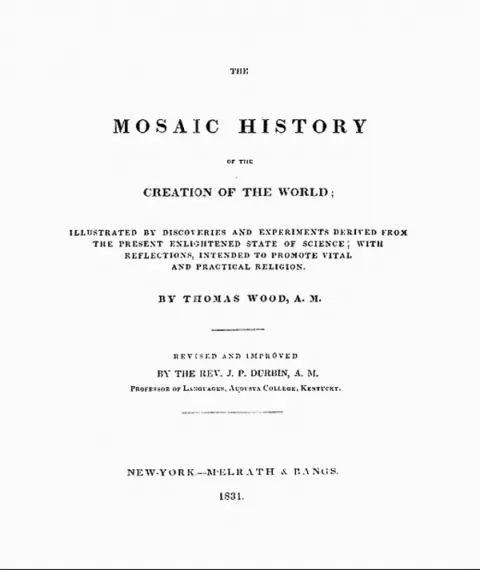
"The Mosaic History of the Creation of the World" by Thomas Wood is a theological treatise written in the early 19th century. The work seeks to illustrate the Biblical account of creation as narrated by Moses, integrating insights from contemporary science while promoting reflections on religion. The aim is to reconcile faith with scientific understanding, intending to enlighten readers on the nature of God and creation." The opening of the book delves into the character of God as revealed in the Scriptures, emphasizing His attributes such as goodness, self-existence, and the concept of the Trinity. Wood presents a discussion on the historical context of how the divine name "Jehovah" offers insights into God's nature, asserting that understanding the creation narrative requires recognizing the unity and plurality embodied within the Godhead. The author lays a theological foundation for exploring the details of creation, ultimately directing the reader to consider the manifestations of God's work in nature and their implications for religious belief and practice.
Introduction adapted from the source catalogue; source summaries may be automatically generated.
Free to read · English · 213,017 words · No account needed
MAKE TIME FOR A GOOD BOOK
On by default. Untick to stop anonymous reading totals. Each page counts after 10 seconds in view. How this works.
Anonymous counting is on unless you have switched it off.
[The present state of chemical science, and the geological discoveries of the last ten or fifteen years, seem to discountenance the theory, that volcanic action, and earthquakes result from sulphur, iron, and water, as Mr. Lemery’s experiment seems to indicate.
The vast extent of volcanic action, as indicated by extinct and active volcanos, would require a greater amount of these materials, than can be supposed to exist in the composition of the earth. Thus, according to the Newtonian test of a correct theory, the means, if true, would not be sufficient.
Again: If sulphur and iron were the principal agents in producing volcanic action, and earthquakes, volcanic products would give evidence of it, by being, principally, sulphate of iron. So far is this from being the fact, that in 100 parts, volcanic product, Dr. Kennedy found, in reference to two volcanos, not exceeding 14.25 oxide of iron, and no sulphur at all.
Volcanic products are generally, “mixtures of the earth in an oxidated and fused state, under intense ignition; water and saline substances, such as might be furnished by the sea and air, altered as might be expected from the formation of fixed oxidated matter.” URE.
These two simple considerations must set aside the theory mentioned in the text. Other valid objections might be urged.
As this theory is inadmissible, because, neither true in application to volcanic action and product, nor sufficient in force, it is proper to supply the deficiency.
By a careful inspection of the phenomena attending volcanic action, as well as an examination of its products, we are clearly convinced, the agents are aëriform; chiefly steam and the gases, and they act with an expansive force from beneath.
Mouna Roa, in the island Owhyhee, rises 15,000 feet, and has on its top a crater eight miles in circumference, containing a vast lake of molten lava. Mr. Goodrich visited it in 1824. He says, “exhalations escape from all the fissures of the lava crust, producing here and there a blast like strong vapor blowing out of a steam boiler.”
Subsequently, a party from the Blonde frigate visited it, and the Rev. Charles Stewart, who accompanied the party, has given a description of the crater. He says, “its surface had all the agitation of the ocean. Billow after billow tossed its monstrous bosom into the air, and occasionally the waves from apposite directions met with such violence, as to dash the fiery spray, in the concussion, forty or fifty feet high.” Ure’s New Syst. Geol. pp. 381-2.
Your reading position is saved on this browser. Take it to another device with a library code. Reading pages adapt to text, rather than matching a printed edition.
BEHIND THE BOOK
This eBook is for the use of anyone anywhere in the United States and most other parts of the world at no cost and with almost no restrictions whatsoever. You may copy it, give it away or re-use it under the terms of the Project Gutenberg License included with this eBook or online at www.gutenberg.org. If you are not located in the United States, you will have to check the laws of the country where you are located before using this eBook. Read the source licence.
The original source file, including credits and licence, is retained by this library. Request an original-format copy at no charge. Please include the book title and Project Gutenberg identifier #44636.
KEEP YOUR CURIOSITY GOING
David Patterson (Spirit) Hatch

David Patterson (Spirit) Hatch

David Patterson (Spirit) Hatch
Cécile Tormay

Moritz Busch
Coulson Kernahan