
Last letters from the living dead man
David Patterson (Spirit) Hatch
THE CLASSIC COLLECTION · 1819
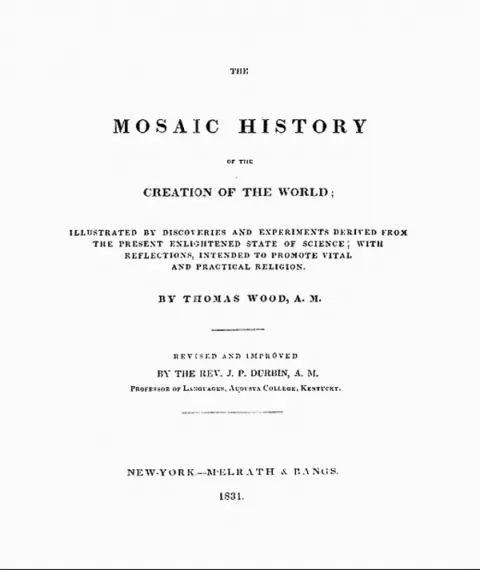
"The Mosaic History of the Creation of the World" by Thomas Wood is a theological treatise written in the early 19th century. The work seeks to illustrate the Biblical account of creation as narrated by Moses, integrating insights from contemporary science while promoting reflections on religion. The aim is to reconcile faith with scientific understanding, intending to enlighten readers on the nature of God and creation." The opening of the book delves into the character of God as revealed in the Scriptures, emphasizing His attributes such as goodness, self-existence, and the concept of the Trinity. Wood presents a discussion on the historical context of how the divine name "Jehovah" offers insights into God's nature, asserting that understanding the creation narrative requires recognizing the unity and plurality embodied within the Godhead. The author lays a theological foundation for exploring the details of creation, ultimately directing the reader to consider the manifestations of God's work in nature and their implications for religious belief and practice.
Introduction adapted from the source catalogue; source summaries may be automatically generated.
Free to read · English · 213,017 words · No account needed
MAKE TIME FOR A GOOD BOOK
On by default. Untick to stop anonymous reading totals. Each page counts after 10 seconds in view. How this works.
Anonymous counting is on unless you have switched it off.
[4] “On the front of the famous temple of Apollo, at Delphos, was graven the Greek word Ει (which signifies thou art, being the second person singular of the verb εἰμὶ.) The learned among the Philosophers labored long to discover its meaning, each giving his own opinion; but could not find it out, until Plutarch (who travelled into Egypt and Greece for instruction in ancient sciences and other things) meeting with that passage in the writings of Moses, where God manifested himself by saying, I AM THAT I AM; he was struck with it, and having it explained to him, he then conceived the true and exalted sense of the word Ει, engraved on the front of the temple. It implied, as it were, an admonition to those who were about to enter the temple, to worship God, who is the only self-existent Being in the universe.” Creighton’s Enquiry into the Origin of True Religion, p. 21. Second Edition.
On a temple dedicated to Neitha, at Sais, the chief town in Lower Egypt, was this inscription: “I am whatever is, or has been, or will be, and no mortal has hitherto drawn aside my veil; my offspring is the sun.” It appears highly probable that the ancient Egyptians acknowledged an active as well as a passive principle in nature, and, as Plutarch asserts, worshipped τῳ πρώτῳ Θεῳ, the supreme Deity. Enfield’s History of Philosophy, vol. i. p. 76, 77.
[5] Norris on Reason and Religion. Contemp. i.
[6] Allix’s Judgment of the Jewish Church against the Unitarians, p. 116. Edit. 1699. See also p. 119. Simpson’s Apology for the Doctrine of the Trinity, p. 379, 380.
[7] Rabbi Simeon Ben Jochai, in Zoar, on the sixth section of Leviticus. See Ainsworth’s Annotations on the place.
[8] Demonstration of the Messias, Part iii. p, 170, 171.
Edit. 1700.
[9] Jones on the Trinity, chap. iii. sect. 1.
[10] Allix. p. 132.
[11] Gen. i, 26; iii, 22; xi, 7; xx, 13; xxxi, 53; xxxv, 7; Deut. iv, 7; v, 23; Josh. xxiv, 19; 1 Sam. iv, 8; 2 Sam. vii, 23; Psal. lviii, 12; Isai. vi, 8; Jer. x, 10; xxiii, 36; See Prov. ix, 10; xxx, 3; Psal. cxlix, 2; Eccl. v, 7; xii, 1: Job v, 1; Isai. vi, 3; liv, 5; Hos. xi, 12, or xii, 1; Mal. i,6; Dan. vii, 18, 22, 25; Hebrew Lexicon, p. 19. Edit. 1811. See also Mr. Parkhurst’s pamphlet against Dr. Priestly and Mr. Wakefield, p. 3-9, and p. 148, &c.
[12] Ridley’s Eight Discourses, p. 79.
[13] See Allix’s Judgment of the Jewish Church, p. 118.
[14] Professor Kidd’s Essay on the Doctrine of the Trinity,
p. 452.
[15] Jones on the Trinity.
[16] Ganganelli’s Letters.
[17] Rev. Hugh Knox’s Sermons.
[18] Gray’s Key to the Old Testament.
[19] M. Pascal’s Thoughts.
[20] See Gray’s Key, Notes, p. 82-83.
[21] See Sturm. vol. iv. p. 266.
[22] Christian’s Magazine, vol. ii, p. 97, 98.
Your reading position is saved on this browser. Take it to another device with a library code. Reading pages adapt to text, rather than matching a printed edition.
BEHIND THE BOOK
This eBook is for the use of anyone anywhere in the United States and most other parts of the world at no cost and with almost no restrictions whatsoever. You may copy it, give it away or re-use it under the terms of the Project Gutenberg License included with this eBook or online at www.gutenberg.org. If you are not located in the United States, you will have to check the laws of the country where you are located before using this eBook. Read the source licence.
The original source file, including credits and licence, is retained by this library. Request an original-format copy at no charge. Please include the book title and Project Gutenberg identifier #44636.
KEEP YOUR CURIOSITY GOING
David Patterson (Spirit) Hatch

David Patterson (Spirit) Hatch

David Patterson (Spirit) Hatch
Cécile Tormay

Moritz Busch
Coulson Kernahan