
Last letters from the living dead man
David Patterson (Spirit) Hatch
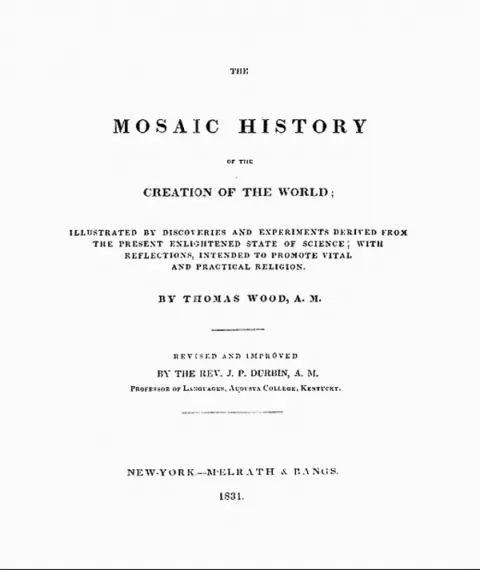
THE CLASSIC COLLECTION · 1819
"The Mosaic History of the Creation of the World" by Thomas Wood is a theological treatise written in the early 19th century. The work seeks to illustrate the Biblical account of creation as narrated by Moses, integrating insights from contemporary science while promoting reflections on religion. The aim is to reconcile faith with scientific understanding, intending to enlighten readers on the nature of God and creation." The opening of the book delves into the character of God as revealed in the Scriptures, emphasizing His attributes such as goodness, self-existence, and the concept of the Trinity. Wood presents a discussion on the historical context of how the divine name "Jehovah" offers insights into God's nature, asserting that understanding the creation narrative requires recognizing the unity and plurality embodied within the Godhead. The author lays a theological foundation for exploring the details of creation, ultimately directing the reader to consider the manifestations of God's work in nature and their implications for religious belief and practice.
Introduction adapted from the source catalogue; source summaries may be automatically generated.
Free to read · English · 213,017 words · No account needed
MAKE TIME FOR A GOOD BOOK
On by default. Untick to stop anonymous reading totals. Each page counts after 10 seconds in view. How this works.
Anonymous counting is on unless you have switched it off.
How happy must such a state be, where the parties married come up to the design of this sacred institution! Dr. Hunter observes, “What an important era in the life of Adam! What a new display of the Creator’s power, skill, and goodness! How must the spirit of devotion be heightened, now that man could join in social worship! What additional satisfaction in contemplating the frame, order, and course of nature, now that he possessed the most exalted of human joys, that of conveying knowledge to a beloved object! Now he could instruct Eve in the wonders of creation, and unfold to her their Maker’s nature, perfections, and will!” Oh happy state! They are happy in the constitution of their nature,--being innocent, upright creatures; and in having their pure minds perfectly united in love and kindness to each other. They were happy in all their united acts of adoration and praise to their Creator,--exact harmony, unmixed delight, and untainted piety, residing in each breast! They lived in communion with God, enjoyed a transporting sense of his favor, walked in the light of his countenance, and were raptured in their meditations on the Divine glory!
We have here the first institution of marriage, and we see in it several things worthy of peculiar attention and regard. 1. God pronounces the state of celibacy not a good one: and the Lord God said, “It is not good that man should be alone,” לבדו lebaddo only himself. It was neither for his comfort, who was formed for society, nor for the accomplishment of God’s purpose in the increase of mankind. Though he was created in the image of God, and enjoyed delightful intercourse with him, his solitary condition required a suitable companion. 2. God made the woman for the man; he was not made for her, but she was made for him, and derived, under God, her being from him. The apostle says, “Neither was the man created for the woman: but the woman for the man,” to be a suitable helper and comfort to him. And thus God has shown us, that every son of Adam should be united to a daughter of Eve to the end of the world. 3. God made the woman out of the man: as Adam was immediately from God, so Eve was immediately from Adam; “the man is not of the woman, but the woman of the man:” made of a part of his body, taken out, not of his head, to show that she was not to exercise dominion over him; nor of his foot, to indicate that she must not be his slave; but of his side, to intimate that she needs his counsel and direction; from under his arm, to teach him that he must protect her; and near his heart, to tell him that he must love her as himself. The closest union, and the most affectionate attachment, should subsist in the matrimonial connection. The man should ever consider and treat the woman as a part of himself; and as no one ever hated his own flesh, but nourishes and supports it, so should a husband evince the greatest tenderness and affection for his wife: and on the other hand, considering that the woman derived her being from man, and was made for him, therefore the wife should “see that she reverence her husband.” “For as man is the image and glory of God; so the woman is the glory of the man.” 4. God himself instituted the marriage union, and being appointed and established by him, it must be an honorable state. “Marriage is honorable in all,” being a Divine institution; and consequently suitable for persons of any rank, or employment, either civil or sacred. The corruption of manners has strangely perverted this original purpose and institution of God. However, he will never accommodate his morality to the times, nor to the inclinations of men. What was settled at the beginning, he judged most worthy of his glory, most profitable for man, and most suitable to his nature. 5. Marriage was instituted immediately on the creation of man and formation of the woman; whence it is evident that God never designed that mankind should be preserved, and the earth peopled any other way. And as the marriage union took place while man was in a state of innocence, upright and pure, just such as his Creator made him, it is therefore suitable to the greatest purity both of heart and life. 6. The design of this institution was, that man and woman might be mutually helpful to each other, in all the necessities and uses of life partaking of the cares and labors of each other, reciprocally sharing in each other’s delights and pleasures, and combining together to love, serve, and please God.
Your reading position is saved on this browser. Take it to another device with a library code. Reading pages adapt to text, rather than matching a printed edition.
BEHIND THE BOOK
This eBook is for the use of anyone anywhere in the United States and most other parts of the world at no cost and with almost no restrictions whatsoever. You may copy it, give it away or re-use it under the terms of the Project Gutenberg License included with this eBook or online at www.gutenberg.org. If you are not located in the United States, you will have to check the laws of the country where you are located before using this eBook. Read the source licence.
The original source file, including credits and licence, is retained by this library. Request an original-format copy at no charge. Please include the book title and Project Gutenberg identifier #44636.
KEEP YOUR CURIOSITY GOING
David Patterson (Spirit) Hatch

David Patterson (Spirit) Hatch

David Patterson (Spirit) Hatch
Cécile Tormay

Moritz Busch
Coulson Kernahan