
Last letters from the living dead man
David Patterson (Spirit) Hatch
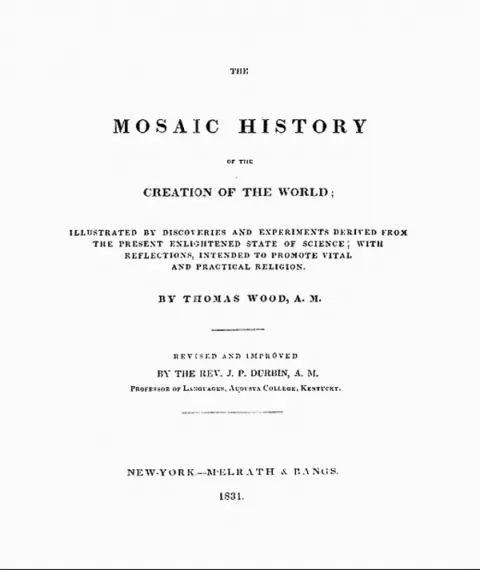
THE CLASSIC COLLECTION · 1819
"The Mosaic History of the Creation of the World" by Thomas Wood is a theological treatise written in the early 19th century. The work seeks to illustrate the Biblical account of creation as narrated by Moses, integrating insights from contemporary science while promoting reflections on religion. The aim is to reconcile faith with scientific understanding, intending to enlighten readers on the nature of God and creation." The opening of the book delves into the character of God as revealed in the Scriptures, emphasizing His attributes such as goodness, self-existence, and the concept of the Trinity. Wood presents a discussion on the historical context of how the divine name "Jehovah" offers insights into God's nature, asserting that understanding the creation narrative requires recognizing the unity and plurality embodied within the Godhead. The author lays a theological foundation for exploring the details of creation, ultimately directing the reader to consider the manifestations of God's work in nature and their implications for religious belief and practice.
Introduction adapted from the source catalogue; source summaries may be automatically generated.
Free to read · English · 213,017 words · No account needed
MAKE TIME FOR A GOOD BOOK
On by default. Untick to stop anonymous reading totals. Each page counts after 10 seconds in view. How this works.
Anonymous counting is on unless you have switched it off.
God did not approve of this state of solitude: he said, “It is not good that man should be alone,” or only himself. The Creator had not yet finished his works. He saw it necessary to relieve man in his solitary situation; and his goodness and power were ready to concur with the dictates of his wisdom. He said, “I will make him a help-meet for him;” i.e. his counterpart, one like himself in shape, constitution, and disposition; exactly adapted to both his body and mind, the very image of himself, a second self.
“Must the fair creature promis’d to be giv’n,
Be sent to earth from the abode of heav’n?
Angelic nature could not well supply
The craving void, remote, and far too high.
Will God select amongst the brutal race,
One, and refine it for his fond embrace?
Nay, that would be too mean for his respect,
Beneath his nature, void of intellect.
The wise Creator, to complete his plan,
Resolves to make a help-meet from the Man,
Procure the stamina from him alone,
Thus constitute her “bone of his own bone.”
From Man! but where? what part can he forego,
From head majestic to the servile toe?
The head imperial would be much too high,
Lest she, perchance, should for the mast’ry try.
The toilsome feet are base, of low renown,
Lest he should trample the fair creature down.
In Man’s organic structure, mark! the part
Is that which lies contiguous to the heart;
Main spring of life, whence all the frame looks gay,
Centre, where all the lovely passions play;
Under the shield of the protecting arm,
Which can defend her from impending harm.”
Accordingly, God proceeded in his work: not as before, when he made man, and formed his body of the dust of the earth; but he took of the substance of man, and of that formed an associate for him. The process is mentioned by Moses, “And the Lord God caused a deep sleep to fall upon Adam, and he slept: and he took one of his ribs, and closed up the flesh instead thereof; and the rib, which the Lord God had taken from man, made he a woman.” The word תרדמה translated a deep sleep, signifies such a sleep as renders a man insensible of any thing done to him; which was not natural but an extraordinary sleep; not occasioned by any act of violence done to nature, but the immediate effect of the hand of God upon him. Sleep, says a German author, is one of the most remarkable effects of the Divine goodness. It is certainly a proof of the wisdom of our Creator, that we fall asleep imperceptibly. Sleep comes unsummoned: it is the only change in our manner of existence in which reflection bears no part; and is alike independent of the understanding and the will. Our situation, indeed, during the time of sleep, is wonderful. We live, but without knowing or perceiving it! The palpitations of the heart, the circulation of the blood, the process of digestion, and, in a word, all the animal functions continue to be performed without interruption. The mind appears, as it were, to suspend its activity, for a time: by degrees, it looses all sensation, every distinct idea. The senses are deadened, and stop their wonted operations. The muscles, by degrees, are moved more slowly, till all voluntary motion ceases. This change begins in the forehead: then the muscles of the eye-lids, and of the neck, arms, and feet, are so much deprived of their activity, that the man seems to be metamorphosed into a plant. The situation of the brain becomes such, that it cannot transmit to the soul the same ideas as when we are awake. The soul perceives no object, though the nerve of vision is not altered; and it would see nothing, were the eyes to be even open. The ears are not shut, and yet they hear nothing. In a word, we find an unceasing source of admiration, in the wonderful preparations, and the tender care, which the Divine Being has employed, to procure us the blessings of sleep. The following epigram, translated from the Latin by Dr. Wolcott, is beautiful:--
Your reading position is saved on this browser. Take it to another device with a library code. Reading pages adapt to text, rather than matching a printed edition.
BEHIND THE BOOK
This eBook is for the use of anyone anywhere in the United States and most other parts of the world at no cost and with almost no restrictions whatsoever. You may copy it, give it away or re-use it under the terms of the Project Gutenberg License included with this eBook or online at www.gutenberg.org. If you are not located in the United States, you will have to check the laws of the country where you are located before using this eBook. Read the source licence.
The original source file, including credits and licence, is retained by this library. Request an original-format copy at no charge. Please include the book title and Project Gutenberg identifier #44636.
KEEP YOUR CURIOSITY GOING
David Patterson (Spirit) Hatch

David Patterson (Spirit) Hatch

David Patterson (Spirit) Hatch
Cécile Tormay

Moritz Busch
Coulson Kernahan