
Last letters from the living dead man
David Patterson (Spirit) Hatch
THE CLASSIC COLLECTION · 1819
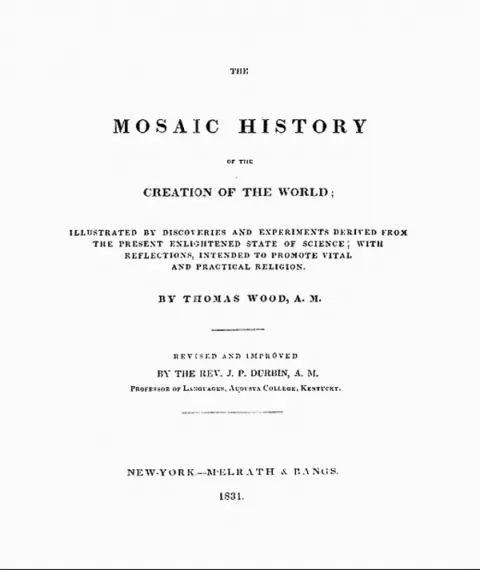
"The Mosaic History of the Creation of the World" by Thomas Wood is a theological treatise written in the early 19th century. The work seeks to illustrate the Biblical account of creation as narrated by Moses, integrating insights from contemporary science while promoting reflections on religion. The aim is to reconcile faith with scientific understanding, intending to enlighten readers on the nature of God and creation." The opening of the book delves into the character of God as revealed in the Scriptures, emphasizing His attributes such as goodness, self-existence, and the concept of the Trinity. Wood presents a discussion on the historical context of how the divine name "Jehovah" offers insights into God's nature, asserting that understanding the creation narrative requires recognizing the unity and plurality embodied within the Godhead. The author lays a theological foundation for exploring the details of creation, ultimately directing the reader to consider the manifestations of God's work in nature and their implications for religious belief and practice.
Introduction adapted from the source catalogue; source summaries may be automatically generated.
Free to read · English · 213,017 words · No account needed
MAKE TIME FOR A GOOD BOOK
On by default. Untick to stop anonymous reading totals. Each page counts after 10 seconds in view. How this works.
Anonymous counting is on unless you have switched it off.
But still none of our senses can reach beyond the bounds of this visible world. They supply us with such knowledge of the material world, as answers all the purposes of life. But as this was the design for which they were given, beyond this they cannot go. They furnish us with no information at all, concerning the invisible world. But the wise and gracious Governor of the worlds, both visible and invisible, has prepared a remedy for this defect. He has favored us with a revelation, concerning himself, his existence, perfections, and will; and another world, its nature, certainty, and duration: and this revelation is contained in the Scriptures. And he has appointed faith to supply the defect of sense; to take us up where sense sets us down, and help us over the great gulf. Its office begins where that of sense ends. Sense is the evidence of things that are seen; of the visible, the material world, and the several parts of it. Faith, on the other hand, is the “evidence of things not seen,” of the invisible world: of all these invisible things, which are revealed in the Oracles of God.[201] Though eternal things come not within the reach of sense, yet, by faith, they are as present to the mind, in their reality, excellence, and continuance, as if they were seen with the eye of the body. The testimony of the God of truth, is the foundation and reason of this faith; for what he says must be true, because he cannot lie: this is a principle concerning which all agree who own his existence.
The soul has a vast intellectual capacity; for the knowledge of God, nature, providence, the original and present state of man, the visible world, sublime speculations, and useful discoveries, come within its comprehension. It can reason, infer, reflect, and carry on a chain of thoughts, with perspicuity and close connection, concerning things. Its powers take in objects of all dimensions; yet they are not situated as bodies in a material place, where the greater occupy more space than the less: for the thought of a mile, or ten thousand miles, does no more fill or stretch the soul, than that of a foot, an inch, or a mathematical point. And whereas all matter has its parts, and those extended, one without another, into length, breadth, and thickness, and so is measurable by inches, yards, or solid measures; there is nothing of measurable extension in any thing belonging to the soul, neither length, breadth, nor thickness; nor is it possible to form an idea of a foot of thought, a yard of reason, a pound of wisdom, or a quart of virtue.[202] The soul is capable of abstract notions, mathematical and metaphysical conceptions. Its powers are so great, that we can explore nature, span the surface of the earth, dive into its capacious seas, and there discover the numerous inhabitants of the watery world. We can travel to the sun, continue our journey through our own spherical system, from planet to planet, tell their dimensions, measure their distances, and accompany them through their various revolutions. We can pass the boundaries of our own, and enter into other systems; and from thence, into eternity itself: ascending from region to region, from world to world, from the creature till we reach the abode of the great Creator, who is the first cause of all things; and then, with ravished eyes, gaze on that glorious Luminary of the moral world, till we are amazed, delighted, and overpowered, with the splendor of his infinite perfections.
Your reading position is saved on this browser. Take it to another device with a library code. Reading pages adapt to text, rather than matching a printed edition.
BEHIND THE BOOK
This eBook is for the use of anyone anywhere in the United States and most other parts of the world at no cost and with almost no restrictions whatsoever. You may copy it, give it away or re-use it under the terms of the Project Gutenberg License included with this eBook or online at www.gutenberg.org. If you are not located in the United States, you will have to check the laws of the country where you are located before using this eBook. Read the source licence.
The original source file, including credits and licence, is retained by this library. Request an original-format copy at no charge. Please include the book title and Project Gutenberg identifier #44636.
KEEP YOUR CURIOSITY GOING
David Patterson (Spirit) Hatch

David Patterson (Spirit) Hatch

David Patterson (Spirit) Hatch
Cécile Tormay

Moritz Busch
Coulson Kernahan