
Last letters from the living dead man
David Patterson (Spirit) Hatch
THE CLASSIC COLLECTION · 1819
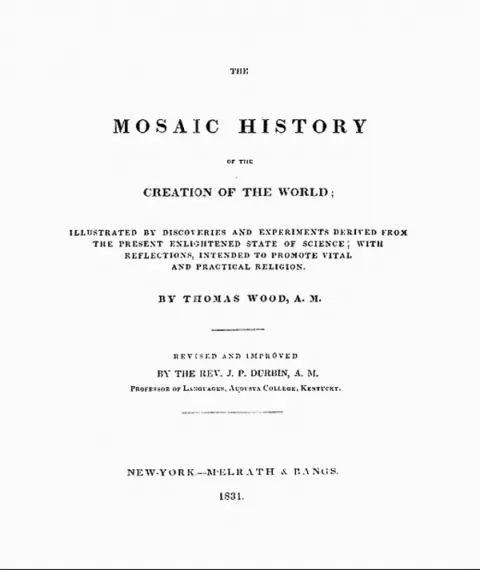
"The Mosaic History of the Creation of the World" by Thomas Wood is a theological treatise written in the early 19th century. The work seeks to illustrate the Biblical account of creation as narrated by Moses, integrating insights from contemporary science while promoting reflections on religion. The aim is to reconcile faith with scientific understanding, intending to enlighten readers on the nature of God and creation." The opening of the book delves into the character of God as revealed in the Scriptures, emphasizing His attributes such as goodness, self-existence, and the concept of the Trinity. Wood presents a discussion on the historical context of how the divine name "Jehovah" offers insights into God's nature, asserting that understanding the creation narrative requires recognizing the unity and plurality embodied within the Godhead. The author lays a theological foundation for exploring the details of creation, ultimately directing the reader to consider the manifestations of God's work in nature and their implications for religious belief and practice.
Introduction adapted from the source catalogue; source summaries may be automatically generated.
Free to read · English · 213,017 words · No account needed
MAKE TIME FOR A GOOD BOOK
On by default. Untick to stop anonymous reading totals. Each page counts after 10 seconds in view. How this works.
Anonymous counting is on unless you have switched it off.
The unclean Fowls persecute and devour those of a more gentle nature. The Eagle, נשר nesher, is from nasher to lacerate, cut, or tear to pieces; hence the Eagle, a most rapacious bird of prey, has its name from tearing the flesh of animals it feeds on: and for this purpose, birds of prey have, in general, strong crooked talons and a hooked beak. The Eagle is a cruel bird, exceedingly ravenous, and almost insatiable. This propensity in birds of prey to seize, tear, and devour, is expressive of the violent and malevolent dispositions of some persons, who hate and endeavor to injure those who live in the fear of God, and keep his commandments. Such were the heathens, whom St. Paul has described as “cruel” and “unmerciful, full of envy, murder, and debate,” given up to the vilest passions, and all the uncleanness of “dead works.”
The want of natural affection, and a right understanding of Divine things, among ungodly persons, is strikingly exhibited in the character of the Ostrich. This foolish bird, though it has wings, is not able to raise itself from the earth, and is void of that instinctive tenderness, which other creatures feel for their offspring: “which leaveth her eggs in the earth, and warmeth them in the dust, and forgetteth that the foot may crash them, or that the wild beast, may break them. She is hardened against her young ones, as though they were not hers; her labor is in vain without fear; because God hath deprived her of wisdom, neither hath he imparted to her understanding.” The Ostrich lays from thirty to fifty eggs, not placed, like those of some other birds, upon trees, or in the clefts of rocks, but in the sand, forgetting the danger to which they are exposed from the feet of travellers or wild beasts. On the most trivial occasion, she forsakes her eggs, or her young ones, to which, perhaps, she never returns; or, if she does, it may be too late, either to restore life to the one, or preserve the lives of the other. The prophet, applying this want of affection, says, “The daughter of my people is cruel, like the Ostriches in the wilderness.” She is likewise inconsiderate and foolish in her private capacity, says Dr. Shaw, particularly in her choice of food, which is frequently highly detrimental and pernicious to her; for she swallows every thing greedily and indiscriminately, whether it be pieces of rags, leather, wood, stone, or even iron. To secure herself, she will thrust her head into the shrubs, though her body, which, when standing upright, is from six to eight feet in height, from the top of the head to the ground, be exposed. She has a little head, and scarcely any brain: hence historians tell us, that the emperor Heliogabalus, to gratify his luxurious taste, together with other delicacies, such as the combs of Cocks, the tongues of Pheasants and Nightingales, the eggs of Partridges, the heads of Parrots and Peacocks, the brains of Thrushes, had likewise served up to him, at one entertainment, the heads of six hundred Ostriches for the sake of the brains; because, being so very small, a less number would not have been sufficient to make a dish. What an affecting emblematical representation is this singular bird of the moral qualifications and habits of ignorant and wicked men! not to mention the superstitious practice of offering children to Moloch and other diabolical deities; the custom of exposing new-born infants in the woods to perish with hunger, or be devoured by wild beasts; a practice still tolerated among the idolaters of China.
Your reading position is saved on this browser. Take it to another device with a library code. Reading pages adapt to text, rather than matching a printed edition.
BEHIND THE BOOK
This eBook is for the use of anyone anywhere in the United States and most other parts of the world at no cost and with almost no restrictions whatsoever. You may copy it, give it away or re-use it under the terms of the Project Gutenberg License included with this eBook or online at www.gutenberg.org. If you are not located in the United States, you will have to check the laws of the country where you are located before using this eBook. Read the source licence.
The original source file, including credits and licence, is retained by this library. Request an original-format copy at no charge. Please include the book title and Project Gutenberg identifier #44636.
KEEP YOUR CURIOSITY GOING
David Patterson (Spirit) Hatch

David Patterson (Spirit) Hatch

David Patterson (Spirit) Hatch
Cécile Tormay

Moritz Busch
Coulson Kernahan