
Last letters from the living dead man
David Patterson (Spirit) Hatch
THE CLASSIC COLLECTION · 1819
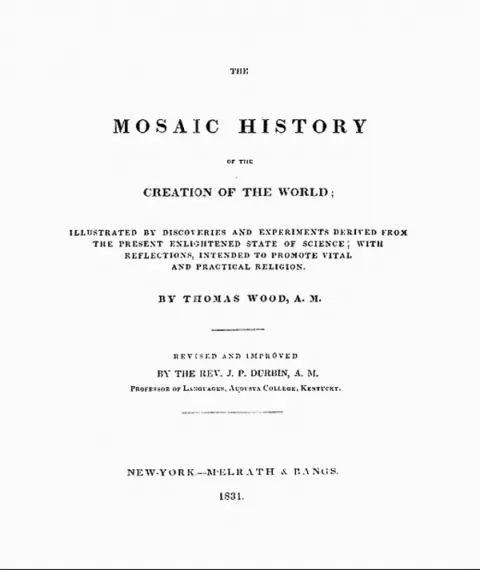
"The Mosaic History of the Creation of the World" by Thomas Wood is a theological treatise written in the early 19th century. The work seeks to illustrate the Biblical account of creation as narrated by Moses, integrating insights from contemporary science while promoting reflections on religion. The aim is to reconcile faith with scientific understanding, intending to enlighten readers on the nature of God and creation." The opening of the book delves into the character of God as revealed in the Scriptures, emphasizing His attributes such as goodness, self-existence, and the concept of the Trinity. Wood presents a discussion on the historical context of how the divine name "Jehovah" offers insights into God's nature, asserting that understanding the creation narrative requires recognizing the unity and plurality embodied within the Godhead. The author lays a theological foundation for exploring the details of creation, ultimately directing the reader to consider the manifestations of God's work in nature and their implications for religious belief and practice.
Introduction adapted from the source catalogue; source summaries may be automatically generated.
Free to read · English · 213,017 words · No account needed
MAKE TIME FOR A GOOD BOOK
On by default. Untick to stop anonymous reading totals. Each page counts after 10 seconds in view. How this works.
Anonymous counting is on unless you have switched it off.
The existence of a being, or the possession, or exercise of any principle, passion or attribute, implies personality, or individual identity, which is the same thing. The mind cannot conceive of existence, passion, principle, or action, without conceiving of them inhering in actually existing Essence, which must assume in the mind the idea of personality. Therefore, personality is strictly, and properly applicable to the Divine Essence. But the doctrine of a plural personality is to be established at present.
It will be easily conceived, and readily granted, that a being which exists necessarily, eternally, immensely, and immutably, as a Living, Intelligent, Rational, Moral, Benevolent, and Spiritual Essence, must have exercised Himself, and his perfections, necessarily, eternally, immensely, and immutably. This then is granted. But the mind will readily and easily perceive, that the Divine Being could not have exercised Himself THUS, in the works of Creation and Providence. Because, it is readily admitted, there was a time when Creation and Providence began: during a whole eternity beyond this period, there was no existence except God Himself. Consequently, He cannot have been exercised according to his own nature and perfections, eternally, in reference to Creation and Providence.
Again: He cannot have exercised his perfections immensely, in reference to Creation and Providence: because, however extensive we may conceive the empire of Creation and Providence to be, it is not immense; it is actually limited, and, therefore, could not admit of an immense exercise of his nature and perfections.
It is readily granted, that the Divine Being was as necessarily, and perfectly happy before Creation and Providence as since; and if Creation and Providence should cease, his happiness would continue the same: hence, it follows, necessarily, that the happiness of the Divine Being was, is, and ever will be entirely independent of Creation and Providence.
But the happiness of any being consists, essentially, in the exercise of its powers and perfections according to the law of its own nature. And as it has been shown, that the happiness of the Divine Being is eternal, immense, and immutable, it follows, He must have exercised Himself eternally, immensely, and immutably.
As it has been granted, That from the very nature of the Divine Being, He must have been eternally, immensely, and immutably active and happy, according to the law of his own nature: and it has been proven, That He could not have been eternally, immensely, and immutably active and happy, in reference to Creation and Providence, it follows, necessarily, that the means and principles of these eternal, immense, and immutable activity and happiness, must exist IN HIS OWN CONSTITUTION, and be exercised entirely WITHIN Himself.
Your reading position is saved on this browser. Take it to another device with a library code. Reading pages adapt to text, rather than matching a printed edition.
BEHIND THE BOOK
This eBook is for the use of anyone anywhere in the United States and most other parts of the world at no cost and with almost no restrictions whatsoever. You may copy it, give it away or re-use it under the terms of the Project Gutenberg License included with this eBook or online at www.gutenberg.org. If you are not located in the United States, you will have to check the laws of the country where you are located before using this eBook. Read the source licence.
The original source file, including credits and licence, is retained by this library. Request an original-format copy at no charge. Please include the book title and Project Gutenberg identifier #44636.
KEEP YOUR CURIOSITY GOING
David Patterson (Spirit) Hatch

David Patterson (Spirit) Hatch

David Patterson (Spirit) Hatch
Cécile Tormay

Moritz Busch
Coulson Kernahan