
Last letters from the living dead man
David Patterson (Spirit) Hatch
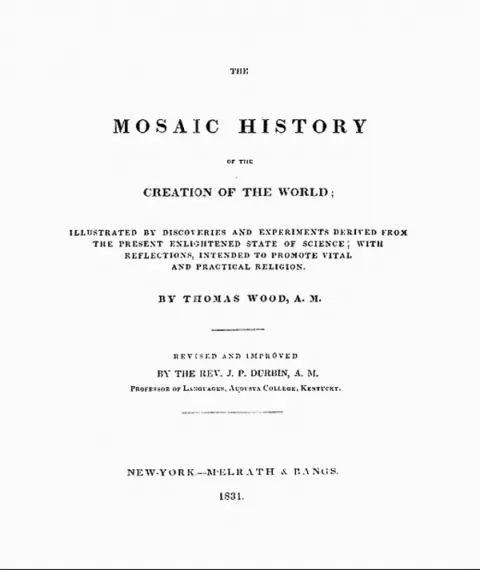
THE CLASSIC COLLECTION · 1819
"The Mosaic History of the Creation of the World" by Thomas Wood is a theological treatise written in the early 19th century. The work seeks to illustrate the Biblical account of creation as narrated by Moses, integrating insights from contemporary science while promoting reflections on religion. The aim is to reconcile faith with scientific understanding, intending to enlighten readers on the nature of God and creation." The opening of the book delves into the character of God as revealed in the Scriptures, emphasizing His attributes such as goodness, self-existence, and the concept of the Trinity. Wood presents a discussion on the historical context of how the divine name "Jehovah" offers insights into God's nature, asserting that understanding the creation narrative requires recognizing the unity and plurality embodied within the Godhead. The author lays a theological foundation for exploring the details of creation, ultimately directing the reader to consider the manifestations of God's work in nature and their implications for religious belief and practice.
Introduction adapted from the source catalogue; source summaries may be automatically generated.
Free to read · English · 213,017 words · No account needed
MAKE TIME FOR A GOOD BOOK
On by default. Untick to stop anonymous reading totals. Each page counts after 10 seconds in view. How this works.
Anonymous counting is on unless you have switched it off.
The number of species in this order of animals is very numerous, amounting to above eight hundred. As some degree of classification appears necessary, they have therefore been arranged into eight orders. The 1st is the Struthious, or Ostrich order, or those which never rise from the earth. This includes the Ostrich, the Cassowary, the Dodo, the Solitary, and the Nazarene. The 2d is the Rapacious order. This includes the Eagle, the Condor, the Vulture, the Falcon, the Shrike, or Butcher-Bird, and the Owl. The 3d is the Gallinaceous, or Poultry order, which is without both the talons and the hooked bill of the rapacious kind. This includes the Bustard, the Cock, the Turkey, the Pintada, or Guinea-Hen, the Grous, the Peacock, the Pheasant, the Curassow, the Partridge, and the Quail. The 4th is what some authors have termed the Columbine order. This includes the Dove, or Pigeon, with its varieties. The 5th is the order of Pies. This includes the Crow, the Roller, the King-Fisher, the Cuckoo, the Wood-Pecker, the Oriole, the Nuthatch, the Bee-Eater, the Wryneck, the Creeper, the Hornbill, the Parrot, the Ani, the Wattle Bird, the Grackel, the Bird of Paradise, the Beef-Eater, the Curucui, the Barbets, the Jacamer, the Tody, and the Humming Bird. The 6th is the Passerine, or Sparrow kind. This includes the Starling, the Thrush, the Chatterers, the Grosbeaks, the Bunting, the Finch, the Fly-Catchers, the Lark, the Wagtail, the Warblers,[151] the Titmouse, the Swallow, the Goatsucker, the Coly, the Tanager, and the Manakins. The 7th is the Cloven-footed Water-Fowl, including those with pinnated feet. This includes the Heron, the Ibis, the Curlow, the Snipe, the Sandpiper, the Plover, the Oyster-Catcher, the Pratincole, the Rail, the Gallinule, the Boatbill, the Umbre, the Jacana, the Sheathbill; and with pinnated, or finned feet, the Phalarope, the Coot, and the Grebe. And the 8th is the Web-footed Water-Fowl. This includes the Avoset, the Courier, the Flamingo, the Auk, the Guillemot, the Diver, the Tern, the Petrels, the Gull, the Mersanger, the Duck, the Pelican, the Albatross, the Skimmer, the Penguin, the Tropic Bird, and the Darter. These eight orders take in the several species belonging to each, some of which are very numerous; the Duck genus alone embraces one hundred species, differing much both in size and plumage. Thus we see in birds also, that God has shown his wisdom and his power, in the gradation from the vast Ostrich, and Cassowary, to the Humming-Bird, which, in size is not much larger than the Bee.
“The ourissia, bee-like in its size,
Humming from flower to flower delighted flies,
And in a wondrous living rainbow drest,
Shifts all its colors on its wings and breast.”
Your reading position is saved on this browser. Take it to another device with a library code. Reading pages adapt to text, rather than matching a printed edition.
BEHIND THE BOOK
This eBook is for the use of anyone anywhere in the United States and most other parts of the world at no cost and with almost no restrictions whatsoever. You may copy it, give it away or re-use it under the terms of the Project Gutenberg License included with this eBook or online at www.gutenberg.org. If you are not located in the United States, you will have to check the laws of the country where you are located before using this eBook. Read the source licence.
The original source file, including credits and licence, is retained by this library. Request an original-format copy at no charge. Please include the book title and Project Gutenberg identifier #44636.
KEEP YOUR CURIOSITY GOING
David Patterson (Spirit) Hatch

David Patterson (Spirit) Hatch

David Patterson (Spirit) Hatch
Cécile Tormay

Moritz Busch
Coulson Kernahan