
Last letters from the living dead man
David Patterson (Spirit) Hatch
THE CLASSIC COLLECTION · 1819
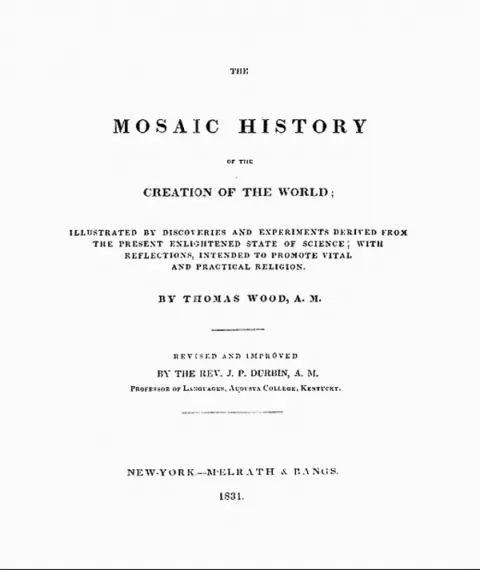
"The Mosaic History of the Creation of the World" by Thomas Wood is a theological treatise written in the early 19th century. The work seeks to illustrate the Biblical account of creation as narrated by Moses, integrating insights from contemporary science while promoting reflections on religion. The aim is to reconcile faith with scientific understanding, intending to enlighten readers on the nature of God and creation." The opening of the book delves into the character of God as revealed in the Scriptures, emphasizing His attributes such as goodness, self-existence, and the concept of the Trinity. Wood presents a discussion on the historical context of how the divine name "Jehovah" offers insights into God's nature, asserting that understanding the creation narrative requires recognizing the unity and plurality embodied within the Godhead. The author lays a theological foundation for exploring the details of creation, ultimately directing the reader to consider the manifestations of God's work in nature and their implications for religious belief and practice.
Introduction adapted from the source catalogue; source summaries may be automatically generated.
Free to read · English · 213,017 words · No account needed
MAKE TIME FOR A GOOD BOOK
On by default. Untick to stop anonymous reading totals. Each page counts after 10 seconds in view. How this works.
Anonymous counting is on unless you have switched it off.
This distinction then being founded upon the moral principles of good and evil, no doubt the peculiarities of the animals themselves will serve to furnish instruction. A celebrated writer on this subject remarks:--The progressive motion of fishes is owing to the tail: for so may a boat be driven forward by the agitation of a single oar from the stern. The fins serve to keep a fish upright, and support it while it is stationary in any part of the water. The centre of gravity being above the middle region of the body, a fish floats unnaturally with its back downwards, when the fins are taken off. The scales of fishes, which are very hard, bright, and radiated, compose a sort of armor, which serves for their defence, and adds at the same time an appearance of light and purity. The fishes thus distinguished differ as much in their way of life from the smooth and slimy inhabitants of the waters, as in their color and appearance; for they are generally disposed to raise themselves from the bottom, and swim about with agility in the superior regions of the water; while the Eel buries itself in the mire, and all the crustaceous tribe lie scrabbling upon the ground. Fishes of the Eel or snake kind are disturbed by thunder and storms, and swim about when the waters are thick and turbulent: but as soon as the elements are at rest again, they presently slide down to their native mud.
Thus the mind, when polluted with impiety, and bowed down with unbelief, cannot be raised to the contemplation of evangelical truth, unless it is alarmed by the fear of Divine judgments; on which occasion profligate sinners are sometimes most violently agitated, hurrying themselves as fast as they can into a state of repentance. But as this is a temporary repentance, excited merely by a fear of suffering, the effect abides no longer than the cause continues to operate; and so their terrors and their penitence vanish together. When there was alarming thunder and destructive hail in the land of Egypt, and fire from the Lord ran along the ground, even Pharaoh could recollect himself, and say, “I have sinned this time: the Lord is righteous, and I and my people are wicked. But when he saw that the rain, and the hail, and the thunders were ceased, he sinned yet more, and hardened his heart, he and his servants.” Such is the fruitless issue of that involuntary repentance, which has no principle of Divine grace to support it. The moral of this distinction is obvious: the whole being a figurative monition, that a sordid and groveling way of life was to be abhorred by those who professed to serve God; whose mind being under the direction of revealed truth, and influence of the Holy Spirit, their affections were to be raised from vice to virtue, from pollution to purity, from things temporal to things eternal. There are many persons who bury themselves in the mud like the Eel, drown their senses in eating and drinking, or waste their precious time in sleep and idleness;[150] utterly disregarding all serious reflection, devotional elevation, holy rectitude, and spiritual enjoyment. Our Saviour, who spake many things to the Jews in parables, says, “The kingdom of heaven is like unto a net that was cast into the sea, and gathered of every kind: which, when it was full, they drew to shore, and sat down, and gathered the good into vessels, but cast the bad away.” This was spoken to fishermen, who had been called from their employment by our Lord, and to whom he said, “I will make you fishers of men.” They had hitherto been laboring to catch fish, but hereafter they were to catch men: thus their secular calling is turned into a spiritual channel. The word σωγηνη is said to mean a drag-net, the particular use of which is to drag fishes up from the bottom of the water. The similitude between that occupation from which, and that employment to which our Saviour called them, consists in these particulars:--the sea in which they were now to fish is the world, the fishes they were to catch are Jews and Gentiles, the net with which they were to catch them is the Gospel, and they themselves were to be fishermen. Or thus:--by the net may be understood the Gospel; by the sea into which it is cast, the unconverted world; by casting the net into the sea, the preaching of the Gospel; by those that cast the net into the sea, ministers; by the fishes enclosed, the hearers; by the net gathering of every kind of fishes, profane persons as well as sincere Christians; by the net being full and drawn to shore, a set time coming when the Gospel shall have fulfilled that for which it was sent, the mystery of God being finished; by the good being gathered into vessels as valuable and precious, and the bad cast away as vile and contemptible, that separation which shall be made at the final close of time between merely nominal and real Christians, casting the former into hell, and bringing the latter to heaven.
Your reading position is saved on this browser. Take it to another device with a library code. Reading pages adapt to text, rather than matching a printed edition.
BEHIND THE BOOK
This eBook is for the use of anyone anywhere in the United States and most other parts of the world at no cost and with almost no restrictions whatsoever. You may copy it, give it away or re-use it under the terms of the Project Gutenberg License included with this eBook or online at www.gutenberg.org. If you are not located in the United States, you will have to check the laws of the country where you are located before using this eBook. Read the source licence.
The original source file, including credits and licence, is retained by this library. Request an original-format copy at no charge. Please include the book title and Project Gutenberg identifier #44636.
KEEP YOUR CURIOSITY GOING
David Patterson (Spirit) Hatch

David Patterson (Spirit) Hatch

David Patterson (Spirit) Hatch
Cécile Tormay

Moritz Busch
Coulson Kernahan