
Last letters from the living dead man
David Patterson (Spirit) Hatch
THE CLASSIC COLLECTION · 1819
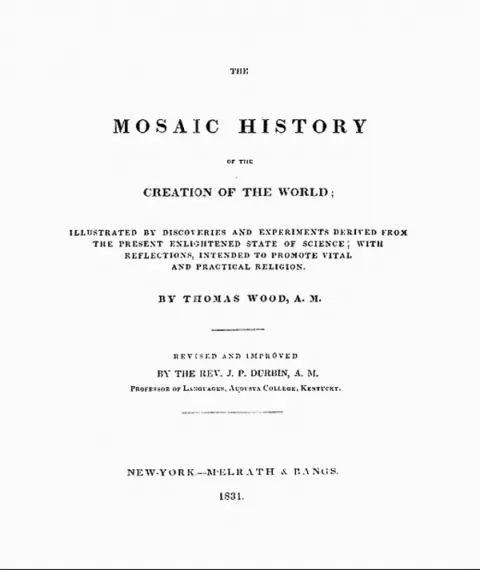
"The Mosaic History of the Creation of the World" by Thomas Wood is a theological treatise written in the early 19th century. The work seeks to illustrate the Biblical account of creation as narrated by Moses, integrating insights from contemporary science while promoting reflections on religion. The aim is to reconcile faith with scientific understanding, intending to enlighten readers on the nature of God and creation." The opening of the book delves into the character of God as revealed in the Scriptures, emphasizing His attributes such as goodness, self-existence, and the concept of the Trinity. Wood presents a discussion on the historical context of how the divine name "Jehovah" offers insights into God's nature, asserting that understanding the creation narrative requires recognizing the unity and plurality embodied within the Godhead. The author lays a theological foundation for exploring the details of creation, ultimately directing the reader to consider the manifestations of God's work in nature and their implications for religious belief and practice.
Introduction adapted from the source catalogue; source summaries may be automatically generated.
Free to read · English · 213,017 words · No account needed
MAKE TIME FOR A GOOD BOOK
On by default. Untick to stop anonymous reading totals. Each page counts after 10 seconds in view. How this works.
Anonymous counting is on unless you have switched it off.
[116] Aristotle de Cœl. lib. ii, cap. 13.
[117] Macrob. Sat. lib. i, cap. 21.
[118] Macrob. in Somn. Scip. lib. i, cap. 20.
[119] That is, in adoration; from ad ore, to the mouth,
i.e. hand to the mouth.
[120] Baseley’s Glory of the Heavens, pp. 73-76.
[121] The new moon is often styled a crescent; a word formed from the Latin crescere, to grow; and though it is used from the same figure of the moon in her wane or decrease, when her horns are turned towards the west, yet these horns always point to the east in the just crescent.
[122] M. Schroëter, of the Royal Society of Gottingen, has recently published a very curious and elaborate work in German, entitled, Selenotographische Fragmente, &c, or Selenotopographical Fragments, intended to promote a more accurate knowledge of the moon’s surface: a valuable extract from which may be seen in the Pantologia, article Moon.
[123] See Mr. Howard’s valuable paper on the Philosophical Transactions for 1802, Dr. Hutton’s Dissertation in the New Abridgment, part xxi, and Dr. Adam Clarke on Josh. x, 11.
[124] The principal eclipse of the sun, for the present century, has been already calculated, and it is fully determined that it will take place in the year 1847. It will be annular in this country, and several other places. Time’s Telescope for 1815.
The Athenians, according to Plutarch, entertained very terrific ideas of eclipses of the moon. Nicias and his army, when they were on the point of withdrawing secretly from Sicily, without being observed or suspected by the enemy, refused to embark, because the moon became suddenly eclipsed; this ignorant and superstitious conduct proved fatal, for they were all, shortly after, either slain or taken prisoners.
[125] A valuable correspondent writing from Matura, in Ceylon, May 7, 1817, says, “A festival was lately celebrated here, principally on the river. A large boat was rigged for the purpose, somewhat after the manner of a ship, which carried a number of dancers and other persons in disguise, accompanied with the music of pipes and drums. I particularly inquired into the meaning of the ceremonies; and, as far as I could learn, it was a celebration of the birth of the sun and moon. The world is believed to have been once inhabited by holy brahmins, whose bodies were transparent, and afforded sufficient light. When these fell into sin, they lost their splendor, and other lights became necessary.”
Your reading position is saved on this browser. Take it to another device with a library code. Reading pages adapt to text, rather than matching a printed edition.
BEHIND THE BOOK
This eBook is for the use of anyone anywhere in the United States and most other parts of the world at no cost and with almost no restrictions whatsoever. You may copy it, give it away or re-use it under the terms of the Project Gutenberg License included with this eBook or online at www.gutenberg.org. If you are not located in the United States, you will have to check the laws of the country where you are located before using this eBook. Read the source licence.
The original source file, including credits and licence, is retained by this library. Request an original-format copy at no charge. Please include the book title and Project Gutenberg identifier #44636.
KEEP YOUR CURIOSITY GOING
David Patterson (Spirit) Hatch

David Patterson (Spirit) Hatch

David Patterson (Spirit) Hatch
Cécile Tormay

Moritz Busch
Coulson Kernahan