
Last letters from the living dead man
David Patterson (Spirit) Hatch
THE CLASSIC COLLECTION · 1819
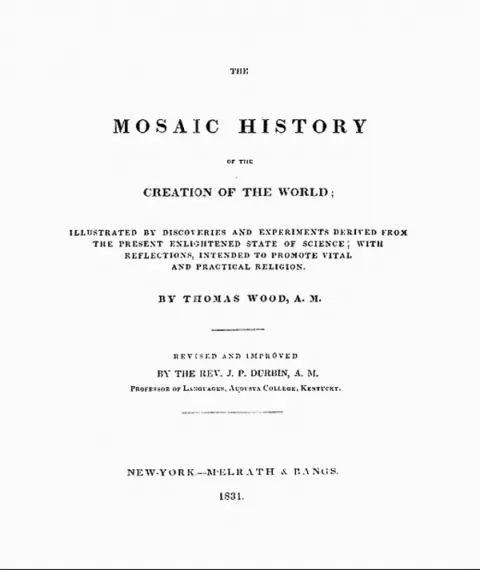
"The Mosaic History of the Creation of the World" by Thomas Wood is a theological treatise written in the early 19th century. The work seeks to illustrate the Biblical account of creation as narrated by Moses, integrating insights from contemporary science while promoting reflections on religion. The aim is to reconcile faith with scientific understanding, intending to enlighten readers on the nature of God and creation." The opening of the book delves into the character of God as revealed in the Scriptures, emphasizing His attributes such as goodness, self-existence, and the concept of the Trinity. Wood presents a discussion on the historical context of how the divine name "Jehovah" offers insights into God's nature, asserting that understanding the creation narrative requires recognizing the unity and plurality embodied within the Godhead. The author lays a theological foundation for exploring the details of creation, ultimately directing the reader to consider the manifestations of God's work in nature and their implications for religious belief and practice.
Introduction adapted from the source catalogue; source summaries may be automatically generated.
Free to read · English · 213,017 words · No account needed
MAKE TIME FOR A GOOD BOOK
On by default. Untick to stop anonymous reading totals. Each page counts after 10 seconds in view. How this works.
Anonymous counting is on unless you have switched it off.
Our earth is at so great a distance from the sun, that if seen from thence, it would appear no bigger than a point, although its diameter is 7,954 miles. Yet that distance is so small, compared with the earth’s remote situation from the fixed stars, that if the orbit in which the earth moves round the sun were the circumference of a globe, that globe, seen from the nearest star, would likewise appear no bigger than a point, although, it is at least 190,000,000 miles in diameter. For the earth in going round the sun is 190,000,000 miles nearer to some of the stars at one time of the year than at another, and yet their apparent magnitudes, situations, and distances from one another still remain the same; and being viewed through a telescope which magnifies above 200 times, they still appear as mere points: which proves them to be at least 400,000 times further from us than we are from the sun.
It is not to be imagined, that all the stars are placed in one concave surface, so as to be equally distant from us; but that they are scattered at immense distances from one another through unlimited space. So that there may be as great a distance between any two neighboring stars, as between our sun and those which are nearest to him. Therefore an observer, who is nearest any fixed star, will look on it alone as a real sun; and consider the rest as so many shining points, placed apparently at equal distances from him in the firmament. The star nearest to us, or the largest in appearance, is Sirius, or the Dog Star, and astronomers have calculated from indubitable principles, that its distance from us is considerably more than two millions of millions of miles! The apparent magnitude of Sirius has been computed at 27,000 times less than the sun, and, therefore, supposing their magnitudes equal, is 27,000 times more distant. If so, as our earth is ninety-five millions of miles from the sun, that multiplied by twenty-seven thousand, will give two millions of millions, and an addition of 565 thousand millions, for the distance of this star from the sun.[136] Our earth, in moving round the sun, is 195,000,000 miles nearer to this star in one part of its orbit, than in the opposite one; and yet the magnitude of the star appears not to be in the least altered or affected by it. A cannon-ball flying from thence at the rate of 400 miles in an hour, would not reach us in 732,000 years! The distance of the star γ Draconis appears, by Dr. Bradley’s observations, to be at least 400,000 times that of the sun, and the distance of the nearest fixed star not less than 80,000 diameters of the earth’s annual orbit; that is, the distance of the earth from the former is = to 400,000 × 95,000,000 = 38,000,000,000,000, and the latter not less than 7,600,000,000,000. As these distances are much too great to be comprehended by the human imagination, we shall, perhaps, obtain a better idea of them by comparing them with the velocity of some moving body, by which they may, in some way, be estimated. The swiftest motion we know of is that of light, which passes from the sun to the earth in about eight minutes, or, at the rate of 200,000 miles nearly in a second of time: and yet even light would be more than six years in traversing the first space, and a year and a quarter nearly, in passing from the nearest fixed star to the earth. Again, a cannon ball, moving with its initial or greatest velocity of about ten miles in a minute, would be more than seven millions of years in passing from the star γ Draconis to the earth. The celebrated M. Huygens carried his thoughts so far upon this subject, as to believe that there might be stars at such inconceivable distances from our earth, that their light, though it is known to travel at the rate of 12,000,000 miles in a minute, has not yet reached us, since the creation of the world!
Your reading position is saved on this browser. Take it to another device with a library code. Reading pages adapt to text, rather than matching a printed edition.
BEHIND THE BOOK
This eBook is for the use of anyone anywhere in the United States and most other parts of the world at no cost and with almost no restrictions whatsoever. You may copy it, give it away or re-use it under the terms of the Project Gutenberg License included with this eBook or online at www.gutenberg.org. If you are not located in the United States, you will have to check the laws of the country where you are located before using this eBook. Read the source licence.
The original source file, including credits and licence, is retained by this library. Request an original-format copy at no charge. Please include the book title and Project Gutenberg identifier #44636.
KEEP YOUR CURIOSITY GOING
David Patterson (Spirit) Hatch

David Patterson (Spirit) Hatch

David Patterson (Spirit) Hatch
Cécile Tormay

Moritz Busch
Coulson Kernahan