
Last letters from the living dead man
David Patterson (Spirit) Hatch
THE CLASSIC COLLECTION · 1819
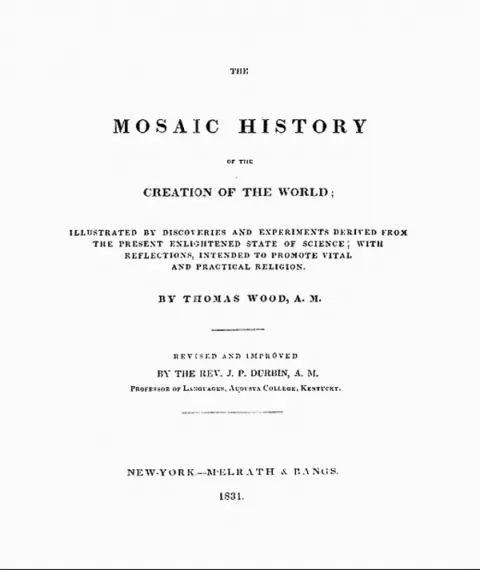
"The Mosaic History of the Creation of the World" by Thomas Wood is a theological treatise written in the early 19th century. The work seeks to illustrate the Biblical account of creation as narrated by Moses, integrating insights from contemporary science while promoting reflections on religion. The aim is to reconcile faith with scientific understanding, intending to enlighten readers on the nature of God and creation." The opening of the book delves into the character of God as revealed in the Scriptures, emphasizing His attributes such as goodness, self-existence, and the concept of the Trinity. Wood presents a discussion on the historical context of how the divine name "Jehovah" offers insights into God's nature, asserting that understanding the creation narrative requires recognizing the unity and plurality embodied within the Godhead. The author lays a theological foundation for exploring the details of creation, ultimately directing the reader to consider the manifestations of God's work in nature and their implications for religious belief and practice.
Introduction adapted from the source catalogue; source summaries may be automatically generated.
Free to read · English · 213,017 words · No account needed
MAKE TIME FOR A GOOD BOOK
On by default. Untick to stop anonymous reading totals. Each page counts after 10 seconds in view. How this works.
Anonymous counting is on unless you have switched it off.
Astronomy produces calculations concerning the magnitudes, distances, and revolutions of the planets, and their respective satellites, which, to the uninformed, appear absurd, chimerical, and presumptuous; while, probably, they laugh at such notions as were received among men, when even the wisest of them were weak enough to believe, that the earth was an immense plain, situated in the centre of the universe; that the vault of heaven was of crystal; and that the sun was no other than a plate of red hot iron, about as large as the Peloponnessus. The following thoughts, communicated by my much esteemed friend Thomas Exley, A. M. may assist such persons to entertain more favorable sentiments of the science of astronomy, and also serve to enlarge their views of the Supreme Being.
“Many persons who have not had the advantages of proper instruction in mathematical science, cannot be persuaded that it is in the power of man to ascertain the distances of the sun, moon, and planets, and, of course, pay little regard to the assertions of astronomers on this subject. Sometimes, they are bold enough to say the thing is impossible, because no one has ever been to any of those bodies. Let such persons consider, that it is not necessary to go to a remote object in order to measure its distance; for that purpose, it will be sufficient to know the length of a line at the place of the spectator, and the inclination of this line to two others directed from its extremities to the object; for, on the length of this line, and the position of the two others, depends the distance of the object from the ends of that line.
“Thus, if I wish to know the distance of a neighboring tower, or other object beyond a river, or in some other way inaccessible; I measure any convenient line terminating in my station, and by some instrument proper for measuring angles, I ascertain the position of my measured line to the lines connecting its extreme points and the object. On these data depends the distance, and from this line and these angles accurately measured, the exact distance may be with great ease truly found. It is on similar principles that astronomers investigate the distances of the heavenly bodies. They take as the given or measured line, which may be called the base, some line on the earth, the semi-diameter for instance, as being the most convenient. The angle formed, or rather contained by two lines drawn from the sun or planet to the ends of the semi-diameter of the earth, is called the parallax, because it shows the difference of the apparent situation of the object as seen from the extremities of the semi-diameter, that is, it measures the arc of a great circle in the heavens contained between its two apparent places. Hence to ascertain its parallax, or difference of the apparent place when the object is viewed from the other end of the semi-diameter, becomes a problem of great importance in astronomy; for this being truly discovered, the distance of the planet will be obtained with the utmost exactitude. If any other line besides the semi-diameter of the earth, whose length and position are known, be used as a base, and the parallax in respect of this line be found, the same conclusions will follow. The chief difficulty in this affair arises from the smallness of the angle to be measured, which is a consequence of the greatness of the distance in respect of the earth’s semi-diameter. Several ingenious methods have been proposed and employed by astronomers to discover the distances of the sun and planets, but nothing serves this purpose so well as the transits of Venus over the sun’s disk. At certain periods, which can be foretold by astronomers, this planet passes exactly between us and the sun, and is seen as a dark round spot for some hours, moving in a line across the sun’s face or disk. The observer should be furnished with a good chronometer, or pendulum clock with seconds, to note the time of the transit; and good instruments, to take the apparent diameters of the sun and Venus, and her greatest distance from the sun’s limb while passing over his disk: from these observations, and the known phenomena of the motions of the earth and Venus, the parallax may be found. But if two observers, at very distant places of the earth properly chosen, make these observations, the parallax may be obtained with much greater ease and nicety; because the distance of the apparent tracks of Venus across the sun as seen from the two places, and also the difference of the time of the passage, arises from the parallax of Venus and that of the sun. The two last transits, which happened in the years 1761 and 1769, were carefully observed for this purpose; and it is to the results of these observations that the present astronomers are indebted for their more accurate knowledge of the distances of the planets, and the dimensions of the solar system.
Your reading position is saved on this browser. Take it to another device with a library code. Reading pages adapt to text, rather than matching a printed edition.
BEHIND THE BOOK
This eBook is for the use of anyone anywhere in the United States and most other parts of the world at no cost and with almost no restrictions whatsoever. You may copy it, give it away or re-use it under the terms of the Project Gutenberg License included with this eBook or online at www.gutenberg.org. If you are not located in the United States, you will have to check the laws of the country where you are located before using this eBook. Read the source licence.
The original source file, including credits and licence, is retained by this library. Request an original-format copy at no charge. Please include the book title and Project Gutenberg identifier #44636.
KEEP YOUR CURIOSITY GOING
David Patterson (Spirit) Hatch

David Patterson (Spirit) Hatch

David Patterson (Spirit) Hatch
Cécile Tormay

Moritz Busch
Coulson Kernahan