
Last letters from the living dead man
David Patterson (Spirit) Hatch
THE CLASSIC COLLECTION · 1819
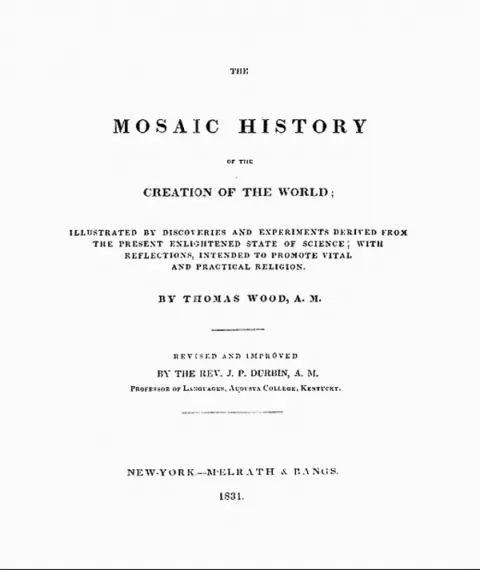
"The Mosaic History of the Creation of the World" by Thomas Wood is a theological treatise written in the early 19th century. The work seeks to illustrate the Biblical account of creation as narrated by Moses, integrating insights from contemporary science while promoting reflections on religion. The aim is to reconcile faith with scientific understanding, intending to enlighten readers on the nature of God and creation." The opening of the book delves into the character of God as revealed in the Scriptures, emphasizing His attributes such as goodness, self-existence, and the concept of the Trinity. Wood presents a discussion on the historical context of how the divine name "Jehovah" offers insights into God's nature, asserting that understanding the creation narrative requires recognizing the unity and plurality embodied within the Godhead. The author lays a theological foundation for exploring the details of creation, ultimately directing the reader to consider the manifestations of God's work in nature and their implications for religious belief and practice.
Introduction adapted from the source catalogue; source summaries may be automatically generated.
Free to read · English · 213,017 words · No account needed
MAKE TIME FOR A GOOD BOOK
On by default. Untick to stop anonymous reading totals. Each page counts after 10 seconds in view. How this works.
Anonymous counting is on unless you have switched it off.
These satellites were first discovered on the 7th of January, 1610, by the celebrated Galileo, who called them Medician Stars, in honor of the family of the Medici, dukes of Tuscany, his patrons. These satellites, revolving about Jupiter at different distances, from west to east, when viewed through a telescope, make a beautiful appearance. As our moon revolves round the earth, enlightening the nights, by reflecting the light she receives from the sun; so these satellites, revolving round Jupiter, may also be supposed to enlighten the nights of that planet.
Saturn is a very conspicuous planet, though he shines with a pale and feeble light, very unlike that of Jupiter and the other planets. He was called by the Greeks φαινων. “From the account given by Diodorus Siculus,” says Costard, “it seems as if the Chaldeans called this planet by some name not widely different from this of the Greeks. In the language of Chaldea, the verb פנא phana, or פנה phanah, signifies convertere se, divertere se, declinare. And whatever vanishes, or disappears, very properly declines, or turns aside, from our view. This planet, therefore, was most probably called פן phen, or פין phain, and, with a Greek termination, φαινων, on account of his withdrawing himself, by reason of his distance. And this conjecture is yet further confirmed from his name in another dialect, or among another people. For from סתר sater, latuit, abscondit se, with the paragogic ן nun which is not unusual in the formation of Eastern words, comes the word סתרן Saturn, and with the Latin termination us, Saturnus.”
His mean distance from the sun is 900,000,000 miles, consequently his motion in his orbit is proportionably slow; and his annual revolution round the sun, from west to east, being so much longer likewise than that of the other planets, he takes 29 years, 164 days, 7 hours, 21 minutes, 50 seconds, which is almost thirty of our years, to accomplish it, in his orbit travelling with a velocity of 22,000 miles an hour. His diameter is 79,000 miles; and his magnitude is about 1,000 times that of the earth. The time of rotation upon his axis is 10 hours, 17 minutes.
“Still further off, scarce warm’d by Phœbus’ ray, Through his wide orbit, Saturn wheels away; How great the change, could we be wafted there! How slow the seasons! and how long the year!”
There is a singular and curious appendage to Saturn, namely, a thin, broad, opake ring, encompassing the body of the planet, without touching it; like the horizon of an artificial globe; it appears to be suspended round the planet, and to keep its place without any immediate connection with it. The distance of this prodigious circle from the body of the planet is usually stated to be about 21,000 miles.
Your reading position is saved on this browser. Take it to another device with a library code. Reading pages adapt to text, rather than matching a printed edition.
BEHIND THE BOOK
This eBook is for the use of anyone anywhere in the United States and most other parts of the world at no cost and with almost no restrictions whatsoever. You may copy it, give it away or re-use it under the terms of the Project Gutenberg License included with this eBook or online at www.gutenberg.org. If you are not located in the United States, you will have to check the laws of the country where you are located before using this eBook. Read the source licence.
The original source file, including credits and licence, is retained by this library. Request an original-format copy at no charge. Please include the book title and Project Gutenberg identifier #44636.
KEEP YOUR CURIOSITY GOING
David Patterson (Spirit) Hatch

David Patterson (Spirit) Hatch

David Patterson (Spirit) Hatch
Cécile Tormay

Moritz Busch
Coulson Kernahan