
Last letters from the living dead man
David Patterson (Spirit) Hatch
THE CLASSIC COLLECTION · 1819
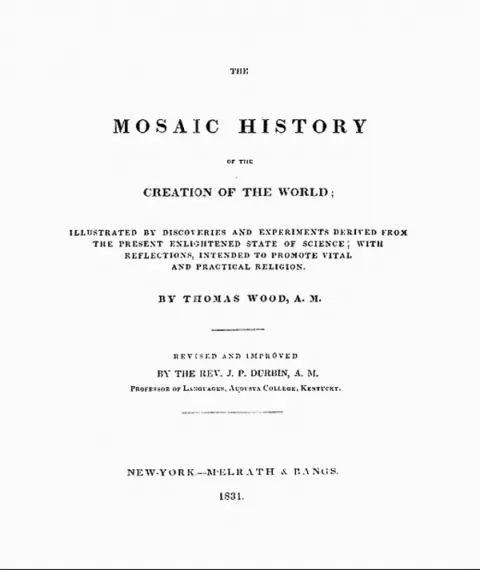
"The Mosaic History of the Creation of the World" by Thomas Wood is a theological treatise written in the early 19th century. The work seeks to illustrate the Biblical account of creation as narrated by Moses, integrating insights from contemporary science while promoting reflections on religion. The aim is to reconcile faith with scientific understanding, intending to enlighten readers on the nature of God and creation." The opening of the book delves into the character of God as revealed in the Scriptures, emphasizing His attributes such as goodness, self-existence, and the concept of the Trinity. Wood presents a discussion on the historical context of how the divine name "Jehovah" offers insights into God's nature, asserting that understanding the creation narrative requires recognizing the unity and plurality embodied within the Godhead. The author lays a theological foundation for exploring the details of creation, ultimately directing the reader to consider the manifestations of God's work in nature and their implications for religious belief and practice.
Introduction adapted from the source catalogue; source summaries may be automatically generated.
Free to read · English · 213,017 words · No account needed
MAKE TIME FOR A GOOD BOOK
On by default. Untick to stop anonymous reading totals. Each page counts after 10 seconds in view. How this works.
Anonymous counting is on unless you have switched it off.
{Aries ♈, the Ram, part of March and April. Spring. {Taurus ♉, the Bull, April and May. {Gemini ♊, the Twins, May and June.
{Cancer ♋, the Crab, June and July. Summer. {Leo ♌, the Lion, July and August. {Virgo ♍, the Virgin, August and September.
Southern Signs; so called as being south of the Equator.
{Libra ♎, the Balance, September and October. Autumn. {Scorpio ♏, the Scorpion, October and November. {Sagittarius ♐, the Archer, November and December.
{Capricornus ♑, the Goat, December and January. Winter. {Aquarius ♒, the Water-bearer, January and February. {Pisces ♓, the Fishes, February and March.
The order of the signs is thus poetically described by Dr. Watts.
“The Ram, the Bull, the heavenly Twins,
And next the Crab the Lion shines,
The Virgin and the Scales:
The Scorpion, Archer, and Sea-goat,
The Man that holds the Water-pot,
And Fish with glittering tails.”
Dr. Long observes, that ♈ represents the horns of the ram; ♉ the head and horns of the bull; ♊ the figure of gemini, the twins joining hands and feet; the character cancer ♋ represents the changes of the sun’s declination from north to south, by two lines or figures drawn so as to point two contrary ways; ♌ is the tail of the lion; ♍ was originally the three ears of corn which Virgo held; ♎ is the beam of the balance; ♏ was at first the picture of the scorpion; ♐ the arrow of the Archer; ♑ represents capricorn, the goat-fish; ♒ is a natural representation of the water’s undulating surface; ♓ is the picture of two fishes tied together back to back.
The figures of the twelve signs are supposed by Dr. Jennings, and other astronomers, to be Egyptian hieroglyphics, by which they designed to exhibit some remarkable natural occurrence in each month, as the sun passed through these signs. Thus the first three months, beginning from the vernal equinox, were remarkable for the production of those animals which they most valued, namely, sheep, kine, and goats. The lambs came first, which are represented by their parent, the Ram; next the calves, represented by the Bull; and the kids, which commonly come in pairs, and which, therefore, gave the name to Gemini, the third constellation; which was not at first represented by Two Boys, but by Two Beasts; as referring to the fruitfulness of goats, in producing twin kids about the time when the sun was in that constellation. When, in the fourth month, the sun is arrived at the summer solstice, he discontinues his progress towards the north pole, and begins to go back again to the southward; this retrograde motion the Egyptians expressed by the Crab, which is said to go backwards. The excessive heat that usually follows in the next month, is signified by the Lion; an animal remarkable for his strength and fierceness; or, as others observe, when that animal, driven by thirst from the desert, made his appearance on the banks of the Nile. Nothing could be more proper than the symbol for the harvest: namely, the Virgin reaper or gleaner with an ear of corn in her hand. The seventh constellation, when the sun arrives at the autumnal equinox, is expressed by the Balance or Scales, in equilibrio, because the days and nights, being then of the same length, seemed to indicate an equilibrium like that instrument. October is often a sickly season, when the surfeits acquired in the hot months of the summer produce their fatal effects; the symbol is therefore the Scorpion, who wounds with a sting in his tail, as he recedes; or, according to others, when certain regular winds brought forth a burning vapor like the poison of the scorpion. The diversion of hunting, which is chiefly followed after the fall of the leaf, is designated by Sagittarius, or the archer. The Goat, which is an animal that delights to browse up hill and to climb the highest rocks, is the emblem of the winter solstice, when the sun begins to ascend from the southern tropic, and is continually mounting higher and higher for the ensuing half year. Aquarius, or the Water-bearer, fitly represents the rains, or snows, of the winter. And the Two Fishes in a band, had, it is imagined, reference to the prime fishing season, which began in February.
Your reading position is saved on this browser. Take it to another device with a library code. Reading pages adapt to text, rather than matching a printed edition.
BEHIND THE BOOK
This eBook is for the use of anyone anywhere in the United States and most other parts of the world at no cost and with almost no restrictions whatsoever. You may copy it, give it away or re-use it under the terms of the Project Gutenberg License included with this eBook or online at www.gutenberg.org. If you are not located in the United States, you will have to check the laws of the country where you are located before using this eBook. Read the source licence.
The original source file, including credits and licence, is retained by this library. Request an original-format copy at no charge. Please include the book title and Project Gutenberg identifier #44636.
KEEP YOUR CURIOSITY GOING
David Patterson (Spirit) Hatch

David Patterson (Spirit) Hatch

David Patterson (Spirit) Hatch
Cécile Tormay

Moritz Busch
Coulson Kernahan