
Last letters from the living dead man
David Patterson (Spirit) Hatch
THE CLASSIC COLLECTION · 1819
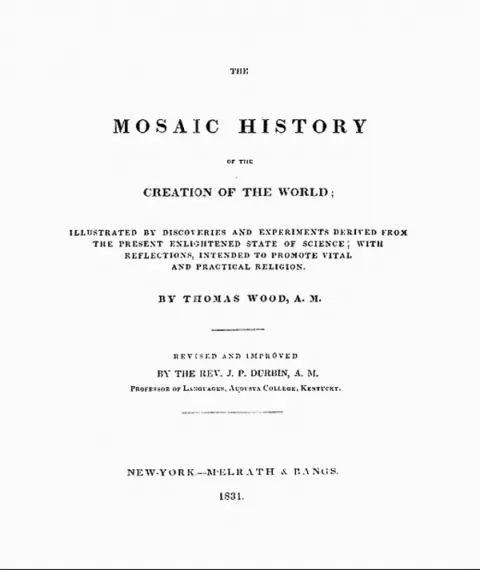
"The Mosaic History of the Creation of the World" by Thomas Wood is a theological treatise written in the early 19th century. The work seeks to illustrate the Biblical account of creation as narrated by Moses, integrating insights from contemporary science while promoting reflections on religion. The aim is to reconcile faith with scientific understanding, intending to enlighten readers on the nature of God and creation." The opening of the book delves into the character of God as revealed in the Scriptures, emphasizing His attributes such as goodness, self-existence, and the concept of the Trinity. Wood presents a discussion on the historical context of how the divine name "Jehovah" offers insights into God's nature, asserting that understanding the creation narrative requires recognizing the unity and plurality embodied within the Godhead. The author lays a theological foundation for exploring the details of creation, ultimately directing the reader to consider the manifestations of God's work in nature and their implications for religious belief and practice.
Introduction adapted from the source catalogue; source summaries may be automatically generated.
Free to read · English · 213,017 words · No account needed
MAKE TIME FOR A GOOD BOOK
On by default. Untick to stop anonymous reading totals. Each page counts after 10 seconds in view. How this works.
Anonymous counting is on unless you have switched it off.
The Earth is the next planet in order; called by the Greeks Γη, and by the poets Γαια, from γαω to generate, produce, which, says Parkhurst, is from the Hebrew, גאה to grow as a plant, because it produces, or is the mother of all terrestrial things; or in the poetic language of the Orphic hymn to the earth,
“---- Brings forth her various fruits,
With throes maternal.”
The word used by Moses is הארץ haarets, translated earth, whence in the Anglo-Saxon, eard and eord; Danish jord, jorden; Dutch erd and aerd; and Teutonic erd, erde.
The distance of the earth from the sun is about 95,000,000 miles: her orbit round the sun is 597,000,000 miles, and she performs her revolution round the sun, from any equinox or solstice to the same point again, in 365 days, 5 hours, 49 minutes, 57 seconds; of course, her hourly motion in her orbit is 68,000 miles. Her diameter is 7,964 miles, her circumference is 25,000 miles, and the time of rotation upon her axis, from west to east, is 23 hours, 56 minutes, 4 seconds: by which the inhabitants upon the equator are carried after the rate of 1,042 miles an hour, and those upon the parallel of London, 580 miles, as we have already noticed. The annual and diurnal motion of the earth is thus described by Milton:
“She from the West her silent course advances
With inoffensive pace, that spinning sleeps
On her soft axle, while she paces even,
And bears us soft with the smooth air along.”
From this circumstance arises the apparent diurnal revolution of all the heavenly bodies from east to west.
“The motion of the earth,” says an intelligent writer, “has so long ceased to be a disputed question, that the arguments on each side are nearly forgotten; and those who do not scruple to adopt the hypothesis of the earth’s motions, are often less acquainted with the arguments on which it is supported, than they would have been in former times, when their opinions must have been the subjects of fierce contention.” La Place observes, “that if the earth be at rest, and the stars move, the velocity of these latter must be immense; and yet all the purposes thereof might have been answered by a moderate motion of the earth alone. The moon’s distance from the earth is 240,000 miles; of course, the length of the tract which it traverses, if it moves round the earth in 24 hours, is about 1,500,000; that is, at the rate of 62,500 miles an hour, instead of 2,290 miles, which is really the case: consequently, in each second of time, the moon, known to be the slowest of all the heavenly bodies, must move more than seventeen miles. Again, the sun’s mean distance from the earth is about 95,000,000 miles; consequently, the diurnal path of that luminary, if it revolve about our globe in twenty-four hours, must be 580,000,000: and therefore, in a single second, the beat of a clock, he must move nearly 7,000 miles. Upon the same principle; that is, supposing the earth to be the centre of the system, and not the sun, the planet Mars, in a second of time, must travel at the rate of more than 10,000 miles, Jupiter 36,000, and Saturn 62,000. And, lastly, the fixed stars being yet indefinitely more remote from the earth than the sun or Saturn, their motion in or near the equator must be vastly swifter than this. If the earth does not move round the sun, the sun must move with the moon round the earth; now; the distance of the sun to that of the moon is nearly 400 to 1, and the period of the moon being about twenty-eight days, the sun’s period should be, by the law above mentioned, full 600 years, whereas, it is, in fact, but a single year. This consideration was, of itself, thought of weight enough to determine the controversy between the two opinions, and to establish the motion of the earth in its orbit for ever.”
Your reading position is saved on this browser. Take it to another device with a library code. Reading pages adapt to text, rather than matching a printed edition.
BEHIND THE BOOK
This eBook is for the use of anyone anywhere in the United States and most other parts of the world at no cost and with almost no restrictions whatsoever. You may copy it, give it away or re-use it under the terms of the Project Gutenberg License included with this eBook or online at www.gutenberg.org. If you are not located in the United States, you will have to check the laws of the country where you are located before using this eBook. Read the source licence.
The original source file, including credits and licence, is retained by this library. Request an original-format copy at no charge. Please include the book title and Project Gutenberg identifier #44636.
KEEP YOUR CURIOSITY GOING
David Patterson (Spirit) Hatch

David Patterson (Spirit) Hatch

David Patterson (Spirit) Hatch
Cécile Tormay

Moritz Busch
Coulson Kernahan