
Last letters from the living dead man
David Patterson (Spirit) Hatch
THE CLASSIC COLLECTION · 1819
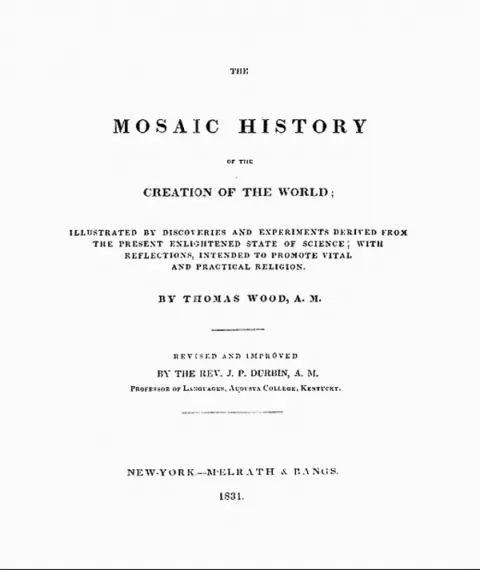
"The Mosaic History of the Creation of the World" by Thomas Wood is a theological treatise written in the early 19th century. The work seeks to illustrate the Biblical account of creation as narrated by Moses, integrating insights from contemporary science while promoting reflections on religion. The aim is to reconcile faith with scientific understanding, intending to enlighten readers on the nature of God and creation." The opening of the book delves into the character of God as revealed in the Scriptures, emphasizing His attributes such as goodness, self-existence, and the concept of the Trinity. Wood presents a discussion on the historical context of how the divine name "Jehovah" offers insights into God's nature, asserting that understanding the creation narrative requires recognizing the unity and plurality embodied within the Godhead. The author lays a theological foundation for exploring the details of creation, ultimately directing the reader to consider the manifestations of God's work in nature and their implications for religious belief and practice.
Introduction adapted from the source catalogue; source summaries may be automatically generated.
Free to read · English · 213,017 words · No account needed
MAKE TIME FOR A GOOD BOOK
On by default. Untick to stop anonymous reading totals. Each page counts after 10 seconds in view. How this works.
Anonymous counting is on unless you have switched it off.
It is ascribed also to the SON of God. The evangelist John asserts in very express terms the Divinity of Jesus Christ, of the truth of which he designed his whole Gospel should be a proof. “In the beginning was the Λογος Word.” By the εν αρχη beginning, here, we are to understand the beginning of the creation, not the beginning of the gospel state, as the Socinians say. We have the authority of Grotius, that εν αρχη is taken from בראשית Bereshith, Gen. i, 1, translated by the Septuagint εν αρχη, and consequently must signify, from the beginning of the creation of God. It is not said, that he was made in the beginning, but that he was in the beginning, did exist when the world began, which is of the same import as if he said, he was from eternity; for he that did exist in the beginning, never did himself begin to be. The personal Wisdom of God says, “The Lord possessed me in the beginning of his way, before his works of old.”--“And the Logos,” or “Word, was with God.” He could be with no creature, because there was no creature in being; and therefore it is very properly said, that he “was with God,” the Father; and his being with him shows, that he is a distinct person or subsistence from the Father.--“And the Logos,” or “Word was God.” Though he is a person distinct from that of the Father, yet he is of the very same essence with him. He that was with God, was God; and if he was God in the beginning, that is from eternity, he is the same still, he cannot cease to be what he was. Here then the evangelist asserts the eternal existence of Christ, his personal co-existence with the Father, and that he is of the very same undivided nature and essence with him. Though he is a person distinct from the Father, yet he is of the same substance, equal with him in all divine perfections; not a secondary God, inferior to the Father, as the Arians assert. “All things were made by him.” All things, from the highest angel to the meanest worm, were made by him, not as a subordinate instrument, but as a co-ordinate agent, as a joint efficient cause, co-operating with the Father in this work. ‘To say that Christ made all things by a delegated power from God, is absurd; because the thing is impossible. Creation means, causing that to exist that had no previous being: this is evidently a work which can be effected only by omnipotence. Now God cannot delegate his omnipotence to another: were this possible, he to whom this omnipotence was delegated, would, in consequence, become God; and he from whom it was delegated, would cease to be such: for it is impossible that there should be two omnipotent beings.’ “And without him was not any thing made that was made.” This is added for the more certainty, it being usual with the Hebrews, when they would affirm that a thing is so indeed, to confirm by a particular negative what they had before affirmed. Our Lord said to the Jews, “My Father worketh hitherto, and I work.” The phrase ὡς αρτι signifies “to this time,” “to the present,” that is, in all works whatever. Hence he is no creature, or he must have created himself; and if he created himself, he must have been in existence and not in existence at the very same time, which is both contradictory and absurd. And if every work performed by the Father was equally performed by the Son, the Son must, in all respects, be equal to the Father, in nature and perfections. This our Lord’s words signify and imply, and in this sense the Jews understood him--as “making himself equal with God.”[14] “He is the image of God,” the πρωτοτοχος “FIRST PRODUCER of every creature: for by him were all things created, that are in heaven, and that are in earth, visible and invisible, whether they be thrones, or dominions, or principalities, or powers:” all the angels, however diversified in rank or employment in the heavenly world; and all the rational, animal, vegetable, and inanimate creatures, belonging to this terrestrial abode: “all things were made by him,” as the efficient cause, “and for him,” as the last end.--“God hath in these last days spoken unto us by his Son, whom he hath appointed heir of all things, by whom also he made the worlds,” i.e. the heavens and the earth. The Father does all by the Son, and the Son does all from the Father. Whatsoever the Father does, that also does the Son likewise. “Unto the Son he saith, Thy throne, oh God, is for ever and ever; a sceptre of righteousness is the sceptre of thy kingdom. Thou, Lord, in the beginning hast laid the foundation of the earth; and the heavens are the works of thy hands.” In these passages the Divinity of Christ is plainly asserted, and the operations of his power are proofs of his Godhead. He that is the Creator of all things is God: but Christ is the Creator of all things; therefore Christ is God. He calls himself “the Beginning of the creation of God,” where the word αρχη means the Creator, the efficient Cause of all things, he by whose power the creation had its beginning and perfection. And “he that built all things is God.”
Your reading position is saved on this browser. Take it to another device with a library code. Reading pages adapt to text, rather than matching a printed edition.
BEHIND THE BOOK
This eBook is for the use of anyone anywhere in the United States and most other parts of the world at no cost and with almost no restrictions whatsoever. You may copy it, give it away or re-use it under the terms of the Project Gutenberg License included with this eBook or online at www.gutenberg.org. If you are not located in the United States, you will have to check the laws of the country where you are located before using this eBook. Read the source licence.
The original source file, including credits and licence, is retained by this library. Request an original-format copy at no charge. Please include the book title and Project Gutenberg identifier #44636.
KEEP YOUR CURIOSITY GOING
David Patterson (Spirit) Hatch

David Patterson (Spirit) Hatch

David Patterson (Spirit) Hatch
Cécile Tormay

Moritz Busch
Coulson Kernahan