
Last letters from the living dead man
David Patterson (Spirit) Hatch
THE CLASSIC COLLECTION · 1819
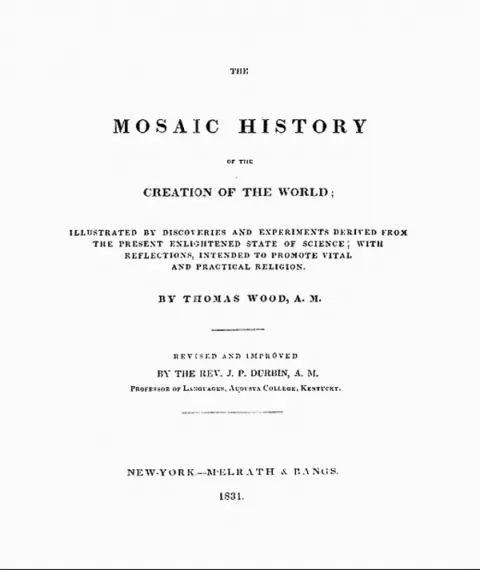
"The Mosaic History of the Creation of the World" by Thomas Wood is a theological treatise written in the early 19th century. The work seeks to illustrate the Biblical account of creation as narrated by Moses, integrating insights from contemporary science while promoting reflections on religion. The aim is to reconcile faith with scientific understanding, intending to enlighten readers on the nature of God and creation." The opening of the book delves into the character of God as revealed in the Scriptures, emphasizing His attributes such as goodness, self-existence, and the concept of the Trinity. Wood presents a discussion on the historical context of how the divine name "Jehovah" offers insights into God's nature, asserting that understanding the creation narrative requires recognizing the unity and plurality embodied within the Godhead. The author lays a theological foundation for exploring the details of creation, ultimately directing the reader to consider the manifestations of God's work in nature and their implications for religious belief and practice.
Introduction adapted from the source catalogue; source summaries may be automatically generated.
Free to read · English · 213,017 words · No account needed
MAKE TIME FOR A GOOD BOOK
On by default. Untick to stop anonymous reading totals. Each page counts after 10 seconds in view. How this works.
Anonymous counting is on unless you have switched it off.
Mercury is the smallest of the seven primary planets, and nearest to the sun; he appears as a small star, and emits a very vivid white light. He was called by the Greeks Στιλβων, plainly alluding to his brightness. Costard observes, “ברק אור Bark-oor, ברק אורי Bark-oori, or, changing the letter ב into מ as letters of the same organ frequently are, מרק אורי Mark-oori, we have in another dialect, with a Latin termination us, another name of this planet, Mercurius; and from whence comes Mercury, as he is called by us.” This planet never goes to a greater distance from the sun than about 27° 50ʹ; so that he appears only a little after sunset, and again a little before sunrise; he is never longer in setting after the sun than an hour and fifty minutes nor does he ever rise more than an hour and fifty minutes before that luminary: he is then about as far as the moon appears to be from the sun on the second day after the change. His mean distance from the sun says Dr. O. Gregory, is to that of the earth from the sun as 387 to 1,000: hence his distance is about thirty-seven millions of miles. To an inhabitant of Mercury, the sun appears almost three times broader than we see him from the earth; because the planet is almost three times nearer to the sun than the earth. Whence also the solar disk, seen from Mercury, is seven times greater than the disk as it appears to us, and Mercury has seven times more light than the earth.
“---- Mercury the first,
Near bordering on the day, with speedy wheel
Flies swifter on, inflaming where he comes
With seven-fold splendor.”
The diameter of this planet is more than one-third of the diameter of the earth, or 3,180 miles. Hence his surface is about 1/7th; and his magnitude 1/16th of that of the earth. His period of revolution round the sun is 87 days, 23 hours, 14 minutes, 33 seconds, which is his year, and falls short of three of our months: hence he moves in his orbit round the sun at the rate of more than 95,000 miles in an hour. According to some astronomers, it has not been ascertained by observation, whether Mercury turns upon his own axis, and therefore it cannot be certainly affirmed that he has the vicissitude of day and night, neither the return of summer and winter: because they depend upon the inclination of the axis of his rotation, which is unknown, to the plane of the orbit which he describes about the sun; though there is very little doubt entertained on the subject. But Schroëter affirms that he “has distinguished spots and mountains, which he has assiduously followed, till he has arrived at the subsequent conclusions: that the apparent diameter of the planet is about 6ʺ; that it does not present any sensible ellipticity; that the mountains it contains are proportionably larger than those of Venus and the Earth; that the highest are, as in these two bodies, in the southern hemisphere; that the angle which the equator makes with its orbit is very considerable; that the difference of days and seasons ought to be much greater in Mercury than it is on the earth; that its atmosphere, like that of Venus, is very dense; and lastly, that its rotation about its axis is 24 hours, 5 minutes, 30 seconds.” When examined by means of a telescope magnifying about 200 or 300 times, he appears equally luminous throughout his whole surface, without the least dark spot. He exhibits the same difference of phases with the moon, being alternately horned, gibbous, and shining almost with a round face, though not entirely full because his enlightened side is never turned directly toward us; but at all times perfectly well defined without any ragged edge, and completely bright; and, like the moon, the crescent is always turned toward the sun. Mercury has no inferior planet known to us, and if that be actually the case, a spectator on his body will want the argument taken from the horned phases of the planets, to establish the true system of the world. But though we do not see any planets inferior to Mercury, it does by no means follow that there are none: for we seldom see Mercury himself, he being buried in the rays of the sun; and a planet much nearer the sun could never be seen from the earth. The first observation that was ever made of a transit, was by Gassendi, who saw Mercury on the sun, A.M. November 7, 1631. Since his time there have occurred seventeen other transits of this planet, the last of which was at his ascending node on the 9th of November, 1802. The ascending and descending nodes are in the 16° of Taurus, and 16° of Scorpio. Other transits are expected in the years 1822, 1832, 1835, 1845, and 1848.
Your reading position is saved on this browser. Take it to another device with a library code. Reading pages adapt to text, rather than matching a printed edition.
BEHIND THE BOOK
This eBook is for the use of anyone anywhere in the United States and most other parts of the world at no cost and with almost no restrictions whatsoever. You may copy it, give it away or re-use it under the terms of the Project Gutenberg License included with this eBook or online at www.gutenberg.org. If you are not located in the United States, you will have to check the laws of the country where you are located before using this eBook. Read the source licence.
The original source file, including credits and licence, is retained by this library. Request an original-format copy at no charge. Please include the book title and Project Gutenberg identifier #44636.
KEEP YOUR CURIOSITY GOING
David Patterson (Spirit) Hatch

David Patterson (Spirit) Hatch

David Patterson (Spirit) Hatch
Cécile Tormay

Moritz Busch
Coulson Kernahan