
Last letters from the living dead man
David Patterson (Spirit) Hatch
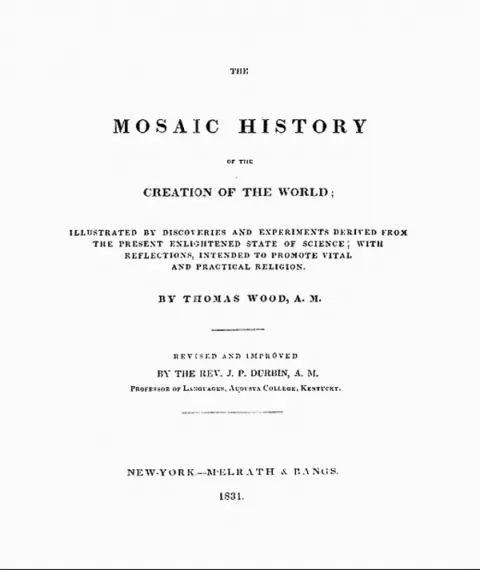
THE CLASSIC COLLECTION · 1819
"The Mosaic History of the Creation of the World" by Thomas Wood is a theological treatise written in the early 19th century. The work seeks to illustrate the Biblical account of creation as narrated by Moses, integrating insights from contemporary science while promoting reflections on religion. The aim is to reconcile faith with scientific understanding, intending to enlighten readers on the nature of God and creation." The opening of the book delves into the character of God as revealed in the Scriptures, emphasizing His attributes such as goodness, self-existence, and the concept of the Trinity. Wood presents a discussion on the historical context of how the divine name "Jehovah" offers insights into God's nature, asserting that understanding the creation narrative requires recognizing the unity and plurality embodied within the Godhead. The author lays a theological foundation for exploring the details of creation, ultimately directing the reader to consider the manifestations of God's work in nature and their implications for religious belief and practice.
Introduction adapted from the source catalogue; source summaries may be automatically generated.
Free to read · English · 213,017 words · No account needed
MAKE TIME FOR A GOOD BOOK
On by default. Untick to stop anonymous reading totals. Each page counts after 10 seconds in view. How this works.
Anonymous counting is on unless you have switched it off.
Among the ancients, observes Mr. Butler, the moon was an object of prime respect. By the Hebrews, she was more regarded than the sun, and they were more inclined to worship her as a deity. The new moons, or first days of every month, were observed as festivals among them, which were celebrated with sound of trumpets, entertainments, and sacrifice. The moon was the goddess of the Phœnicians, whom they worshipped under the name Ashtoreth, or Astarte. The moon is sometimes in Scripture styled, the “queen of heaven.” She is likewise styled, “the goddess of the Zidonians,” and “the abomination of the Zidonians,” as she was worshipped very much in Zidon, or Sidon, a famous city of the Phœnicians, situated upon the eastern coast of the Mediterranean. Solomon, who had many wives that were foreigners, was prevailed upon by them to introduce the worship of this goddess into Israel, and he built her a temple on the mount of Olives, which, on account of this and other idols, is called “the mount of corruption.”[125] Milton says,
“There stood
Her temple on th’ offensive mountain, built
By that uxorious king, whose heart, though large,
Beguil’d by fair idolatresses, fell,
To idols foul.”
The full moon was held favorable for any undertaking by the Spartans; and no motives could induce them to enter upon an expedition, march an army, or attack an enemy, till the full of the moon. It is usual with the modern Arabians to begin their journeys at the new moon; a practice which, indeed, appears to be very ancient. When the Shunammite proposed going to Elisha, her husband dissuaded her by observing that it was neither new moon nor sabbath.
1. The moon is an emblem of the church of God, which receives its light from Christ as the moon does from the sun. Especially, of the Jewish dispensation, which consisted much in the observation of new moons, its solemn feasts being governed by them. The Jewish dispensation was a veiled and shadowy one: Christ and the blessings of the covenant of grace were revealed in dark promises, obscure prophecies, types and ceremonies, which were all significant figures of that grace which should be displayed, with fulness and evidence, under the Christian dispensation. The Jewish economy exhibits such marks of imperfection, as show the necessity of some new revelation to supply its defects. Its rites and precepts seem to be particularly suited to the condition, capacity, temper and genius of that particular people, for whom they were first formed, but not to be calculated for general use. It consisted chiefly of external performances, such as washings, sacrifices, and oblations, which could not purify the conscience, nor, indeed, satisfy the reason of man. The provision for sin, by way of atonement, was partial, and not thoroughly effectual: for some sins no sacrifice was admitted; and though sacrifice, where it was appointed, might atone for ceremonial impurity, yet the inward guilt and defilement still remained, and the justice of God was not satisfied. Yet the observance of these was enjoined in a very awful manner. The omission of what was prescribed by these laws, or even a defect in observing the minute circumstances of them, was made a capital crime, or rendered the delinquents liable to be cut off from the congregation. The Apostle styles the whole code of these laws, “a yoke of bondage;” and says, that, previous to the coming of Christ, the Jews were in bondage under what he terms “the beggarly elements of the world.”
Your reading position is saved on this browser. Take it to another device with a library code. Reading pages adapt to text, rather than matching a printed edition.
BEHIND THE BOOK
This eBook is for the use of anyone anywhere in the United States and most other parts of the world at no cost and with almost no restrictions whatsoever. You may copy it, give it away or re-use it under the terms of the Project Gutenberg License included with this eBook or online at www.gutenberg.org. If you are not located in the United States, you will have to check the laws of the country where you are located before using this eBook. Read the source licence.
The original source file, including credits and licence, is retained by this library. Request an original-format copy at no charge. Please include the book title and Project Gutenberg identifier #44636.
KEEP YOUR CURIOSITY GOING
David Patterson (Spirit) Hatch

David Patterson (Spirit) Hatch

David Patterson (Spirit) Hatch
Cécile Tormay

Moritz Busch
Coulson Kernahan