
Last letters from the living dead man
David Patterson (Spirit) Hatch
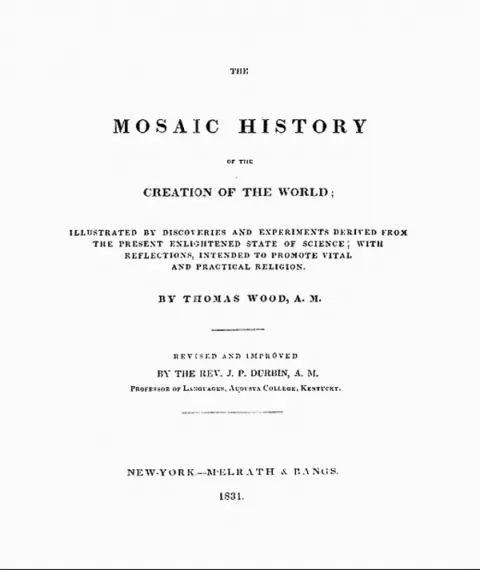
THE CLASSIC COLLECTION · 1819
"The Mosaic History of the Creation of the World" by Thomas Wood is a theological treatise written in the early 19th century. The work seeks to illustrate the Biblical account of creation as narrated by Moses, integrating insights from contemporary science while promoting reflections on religion. The aim is to reconcile faith with scientific understanding, intending to enlighten readers on the nature of God and creation." The opening of the book delves into the character of God as revealed in the Scriptures, emphasizing His attributes such as goodness, self-existence, and the concept of the Trinity. Wood presents a discussion on the historical context of how the divine name "Jehovah" offers insights into God's nature, asserting that understanding the creation narrative requires recognizing the unity and plurality embodied within the Godhead. The author lays a theological foundation for exploring the details of creation, ultimately directing the reader to consider the manifestations of God's work in nature and their implications for religious belief and practice.
Introduction adapted from the source catalogue; source summaries may be automatically generated.
Free to read · English · 213,017 words · No account needed
MAKE TIME FOR A GOOD BOOK
On by default. Untick to stop anonymous reading totals. Each page counts after 10 seconds in view. How this works.
Anonymous counting is on unless you have switched it off.
[94] Savary, Newcomen, Cawley, Watt, and Boulton, Englishmen; and Betancourt and the brothers Perrier, Frenchmen; are names well known in the history of steam-engines. And those persons who wish to acquaint themselves with the principles and manner of operation of this most important class of machines, says Dr. O. Gregory, may be referred to the following work:--The Repertory of Arts and Manufactures, the Philosophical Journal, and the Philosophical Magazine, in various places; the second volume of Mr. Brewster’s edition of Ferguson’s Select Lectures, the second volume of Gregory’s Mechanics, and the second volume of Prony’s treatise entitled Nouvelle Architecture Hydraulique.
[95] Plymouth Chronicle.
[96] Whitehurst’s Inquiry into the Original State and
Formation of the Earth.
[97] Examination of Dr. Burnet’s Theory of the Earth, pp.
92, 93.
[98] The substances of which vegetables are composed, now amount to fifteen in number; but almost the whole of vegetable substances are composed of four ingredients, namely, carbon, hydrogen, oxygen, and azote. Of these, the last, namely, azote, forms but a small proportion even of those vegetable substances of which it is a constituent part, while, into many, it does not enter at all.--Contemplative Philosopher, vol. i. p. 150.
[99] Of the efficacy of water in vegetation, we have on record some remarkable instances. That vegetables will grow in woollen cloth, moss, and in other insoluble media, besides soils provided they be supplied with water, has been repeatedly shown since the days of Van Helmont and Boyle: but the experiments of a modern author, says Mr. Parkes, from their apparent correctness, seem more highly interesting and conclusive.
Seeds of plants were sown in pure river-sand, in litharge, in flowers of sulphur, and even among metal, or common leaden shot; and in every instance nothing employed for their nourishment but distilled water. The plants throve, and passed through all the usual gradations of growth to perfect maturity. The author then proceeded to gather the entire produce, the roots, stems, leaves, pods, seeds, &c. These were accurately weighed, dried, and again weighed, then submitted to distillation, incineration, lixivation, and the other ordinary means used in a careful analysis. Thus he obtained from these vegetables all the materials peculiar to each individual species, precisely as if it had been cultivated in a natural soil--viz. the various earths, the alkalies, acids, metals, carbon, sulphur, phosphorus, nitrogen, &c. He concludes this very important paper nearly in these extraordinary words: “Oxygen and hydrogen, with the assistance of solar light, appear to be the only elementary substances employed in the constitution of the whole universe; and Nature, in her simple progress works the most infinitely diversified effects by the slightest modifications in the means she employs.”--See Recherches sur la Force assimilatrice dans les Végétaux, par M. Henri Braconnot, Annales de Chimie, Fev. et Mars, 1808.
Your reading position is saved on this browser. Take it to another device with a library code. Reading pages adapt to text, rather than matching a printed edition.
BEHIND THE BOOK
This eBook is for the use of anyone anywhere in the United States and most other parts of the world at no cost and with almost no restrictions whatsoever. You may copy it, give it away or re-use it under the terms of the Project Gutenberg License included with this eBook or online at www.gutenberg.org. If you are not located in the United States, you will have to check the laws of the country where you are located before using this eBook. Read the source licence.
The original source file, including credits and licence, is retained by this library. Request an original-format copy at no charge. Please include the book title and Project Gutenberg identifier #44636.
KEEP YOUR CURIOSITY GOING
David Patterson (Spirit) Hatch

David Patterson (Spirit) Hatch

David Patterson (Spirit) Hatch
Cécile Tormay

Moritz Busch
Coulson Kernahan