
Last letters from the living dead man
David Patterson (Spirit) Hatch
THE CLASSIC COLLECTION · 1819
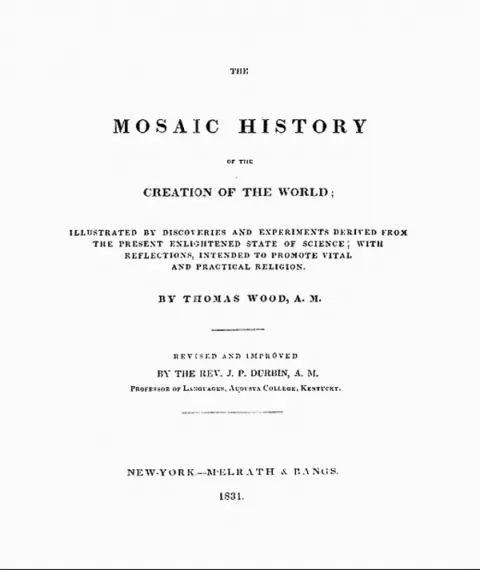
"The Mosaic History of the Creation of the World" by Thomas Wood is a theological treatise written in the early 19th century. The work seeks to illustrate the Biblical account of creation as narrated by Moses, integrating insights from contemporary science while promoting reflections on religion. The aim is to reconcile faith with scientific understanding, intending to enlighten readers on the nature of God and creation." The opening of the book delves into the character of God as revealed in the Scriptures, emphasizing His attributes such as goodness, self-existence, and the concept of the Trinity. Wood presents a discussion on the historical context of how the divine name "Jehovah" offers insights into God's nature, asserting that understanding the creation narrative requires recognizing the unity and plurality embodied within the Godhead. The author lays a theological foundation for exploring the details of creation, ultimately directing the reader to consider the manifestations of God's work in nature and their implications for religious belief and practice.
Introduction adapted from the source catalogue; source summaries may be automatically generated.
Free to read · English · 213,017 words · No account needed
MAKE TIME FOR A GOOD BOOK
On by default. Untick to stop anonymous reading totals. Each page counts after 10 seconds in view. How this works.
Anonymous counting is on unless you have switched it off.
If, by any concussion, or by percolation, water, or air should reach these metals in the interior, or these fused masses of matter, the consequence would be decomposition, and the production of a great amount of gas, and heat, which operating conjointly, first produce earthquakes by struggling to escape from the caverns in which they are generated; and when they find a passage, they would break forth into volcanos. This is the only true and satisfactory theory of earthquakes and volcanos.
It may be added, that this action would naturally bring to its aid the astonishing powers of electricity and galvanism.
The forty metals mentioned above, may be classed
scientifically into two classes.
1. The bases of the alkalis, alkaline earths, and earths. These are twelve: potasium, sodium, and lithium; bases of the alkalis--barium, strontium, calcium, and magnesia; bases of the alkaline earths--aluminium, glucinium, yttrium, zirconium, and silicium; bases of the earths.
2. Metals, the oxides of which are neither alkalis, or earths. These are twenty-eight in number, and may be set down in the following order: gold, silver, iron, copper, mercury, lead, tin, antimony, zinc, bismuth, arsenic, cobalt, platinum, nickel, manganese, tungsten, tellurium, molybdenum, uranium, titanium, chromium, columbium, palladium, rhodium, iridium, osmium, cereum, and cadmium.
Not only the first class of metals are combustible, but the last also. All the metals are now well known to be combustible bodies, and may be made to burn as really as wood.]
Gems are of a higher order than metals, of a more refined nature, and consist of two classes, the pellucid and semi-pellucid. Those of the first class are bright, elegant, and beautiful fossils, naturally and essentially compound, ever found in small detached masses, extremely hard, and of great lustre. Those composing the second class are stones naturally and essentially compound, not inflammable nor soluble in water, found in detached masses, and composed of crystalline matter debased by earth: however, they are but slightly debased, are of great beauty and brightness, of a moderate degree of transparency, and usually found in small masses.
Your reading position is saved on this browser. Take it to another device with a library code. Reading pages adapt to text, rather than matching a printed edition.
BEHIND THE BOOK
This eBook is for the use of anyone anywhere in the United States and most other parts of the world at no cost and with almost no restrictions whatsoever. You may copy it, give it away or re-use it under the terms of the Project Gutenberg License included with this eBook or online at www.gutenberg.org. If you are not located in the United States, you will have to check the laws of the country where you are located before using this eBook. Read the source licence.
The original source file, including credits and licence, is retained by this library. Request an original-format copy at no charge. Please include the book title and Project Gutenberg identifier #44636.
KEEP YOUR CURIOSITY GOING
David Patterson (Spirit) Hatch

David Patterson (Spirit) Hatch

David Patterson (Spirit) Hatch
Cécile Tormay

Moritz Busch
Coulson Kernahan