
Last letters from the living dead man
David Patterson (Spirit) Hatch
THE CLASSIC COLLECTION · 1819
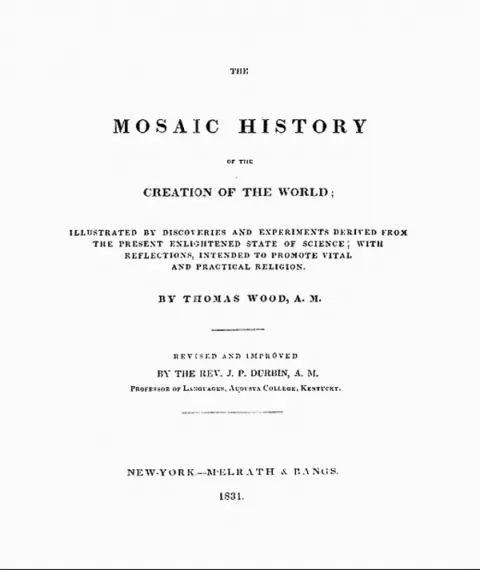
"The Mosaic History of the Creation of the World" by Thomas Wood is a theological treatise written in the early 19th century. The work seeks to illustrate the Biblical account of creation as narrated by Moses, integrating insights from contemporary science while promoting reflections on religion. The aim is to reconcile faith with scientific understanding, intending to enlighten readers on the nature of God and creation." The opening of the book delves into the character of God as revealed in the Scriptures, emphasizing His attributes such as goodness, self-existence, and the concept of the Trinity. Wood presents a discussion on the historical context of how the divine name "Jehovah" offers insights into God's nature, asserting that understanding the creation narrative requires recognizing the unity and plurality embodied within the Godhead. The author lays a theological foundation for exploring the details of creation, ultimately directing the reader to consider the manifestations of God's work in nature and their implications for religious belief and practice.
Introduction adapted from the source catalogue; source summaries may be automatically generated.
Free to read · English · 213,017 words · No account needed
MAKE TIME FOR A GOOD BOOK
On by default. Untick to stop anonymous reading totals. Each page counts after 10 seconds in view. How this works.
Anonymous counting is on unless you have switched it off.
It will readily occur to the reader that there are some other earths, and other substances also, as the acids, and gases, which enter into the composition of the earth’s crust, though in small proportions, and, therefore, are not considered principal ingredients, and hence not noticed in this general sketch.
The rocky, or stony substances, composed of the above elements, under the influence of chemical affinities, and other principles, are found in crystalline, stratified, amorphous, and aggregate masses. The position, structure, and contents of these masses will develope the natural history of the solid crust of our Earth.
In order to facilitate this development, the rocks have been divided, according to their age into,
1. Primitive Rocks. These were deposited first, as is evident from their position, being the lowest of all the rocks. Their name indicates their relative age.
2. Transition Rocks. These rocks are deposited immediately above the primitive, of course subsequently to them. They are called transition rocks, because they were deposited as the earth was passing from an uninhabitable to a habitable state, as is evident from the fact that they contain the first traces of organized being imbedded in them.
3. Secondary Rocks. These are deposited next in succession to the transition rocks, and mark a third grand geological epoch, by being almost altogether a mechanical deposition, and lie horizontally when in situ, and contain an increase of organic remains, both in quantity and variety.
4. Tertiary Rocks. These derive their name from their succession to the secondary, and of course mark the fourth geological epoch in the history of the arrangement of the earth’s crust, which completed its redemption from the abyss of waters, and fitted it for the habitation of man.
This division of the rocks designates the order of time
in which they were successively deposited, as is evident from
their position.
Considering these rocks in situ, they may be reckoned general formations, extended all around the globe in concentric circles, as the coats of an onion around its centre, in the order above stated, beginning with the primitive rocks.
It is, however, well known that fractures and dislocations prevail to a great extent, the result of violence subsequently to the deposition of these rocks, removing large portions of them out of place. But this circumstance need not interrupt the grand natural order of the construction of the earth’s crust.
There is also a class of stony substances which follow no general laws, either in regard to position, form, or age. These are volcanic and igneous productions of every kind; as basalt, lava, &c. These shall be mentioned subsequently.
Your reading position is saved on this browser. Take it to another device with a library code. Reading pages adapt to text, rather than matching a printed edition.
BEHIND THE BOOK
This eBook is for the use of anyone anywhere in the United States and most other parts of the world at no cost and with almost no restrictions whatsoever. You may copy it, give it away or re-use it under the terms of the Project Gutenberg License included with this eBook or online at www.gutenberg.org. If you are not located in the United States, you will have to check the laws of the country where you are located before using this eBook. Read the source licence.
The original source file, including credits and licence, is retained by this library. Request an original-format copy at no charge. Please include the book title and Project Gutenberg identifier #44636.
KEEP YOUR CURIOSITY GOING
David Patterson (Spirit) Hatch

David Patterson (Spirit) Hatch

David Patterson (Spirit) Hatch
Cécile Tormay

Moritz Busch
Coulson Kernahan