
Last letters from the living dead man
David Patterson (Spirit) Hatch
THE CLASSIC COLLECTION · 1819
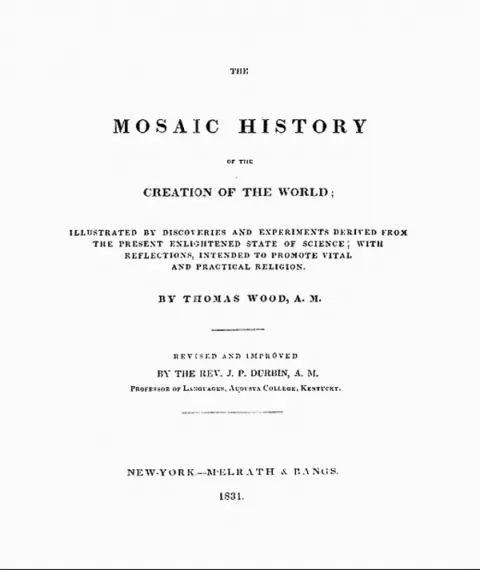
"The Mosaic History of the Creation of the World" by Thomas Wood is a theological treatise written in the early 19th century. The work seeks to illustrate the Biblical account of creation as narrated by Moses, integrating insights from contemporary science while promoting reflections on religion. The aim is to reconcile faith with scientific understanding, intending to enlighten readers on the nature of God and creation." The opening of the book delves into the character of God as revealed in the Scriptures, emphasizing His attributes such as goodness, self-existence, and the concept of the Trinity. Wood presents a discussion on the historical context of how the divine name "Jehovah" offers insights into God's nature, asserting that understanding the creation narrative requires recognizing the unity and plurality embodied within the Godhead. The author lays a theological foundation for exploring the details of creation, ultimately directing the reader to consider the manifestations of God's work in nature and their implications for religious belief and practice.
Introduction adapted from the source catalogue; source summaries may be automatically generated.
Free to read · English · 213,017 words · No account needed
MAKE TIME FOR A GOOD BOOK
On by default. Untick to stop anonymous reading totals. Each page counts after 10 seconds in view. How this works.
Anonymous counting is on unless you have switched it off.
“Winds from all quarters agitate the air
And fit the limpid element for use,
Else noxious. Oceans, rivers, lakes, and streams,
All feel the fresh’ning impulse, and are cleansed
By restless undulation. E’en the oak
thrives by the rude concussion of the storm.
He seems indeed indignant, and to feel
The impression of the blast with proud disdain,
Frowning, as if in his unconscious arm
He held the thunder. But the monarch owes
His firm stability to what he scorns,
More fixed below, the more disturbed above.”
Winds have been measured, and their velocity calculated. The following is Mr. John Smeaton’s table of the rate at which the wind travels:
Wind. Miles in Feet in
an Hour. a Sec.
Hardly perceptible 1 1,47 Just perceptible 2 2,98 3 4,40 Gentle, pleasant 4 5,87 5 7,35 Pleasant brisk gale 10 14,67 15 22,00 Very brisk 20 29,34 25 36,67 High winds 30 44,01 35 51,34 Very high 40 58,68 45 66,01 Storm, tempest 50 73,35 Great storm 60 88,02 Hurricane 80 117,36 ---- that tears up trees, } destroys buildings &c. &c.} 100 146,70[70]
There are some winds that are awfully destructive. In the Gulf of Persia, particularly at Ormus, during the months of June and July, a hot suffocating wind sometimes blows from the west, for a day or two together, which scorches up and destroys any animal exposed to it. On this account the people of Ormus then leave their habitations, and retire to the mountains. Winds similar to this in kind, but not in degree, are sometimes felt on the coast of Coromandel, where they are called terrenos; and likewise on the Malabar coast. On the coast of Africa, north of Cape Verd, during the months of December, January, and February, an easterly wind sometimes blows for a day or two, called by sailors harmattan, so intensely cold, as to be almost as destructive as the west winds at Ormus. The simoon is a hot wind which blows occasionally in the deserts of Arabia, parched by a vertical sun. If inhaled in any quantity, it produces instant suffocation, or at least leaves the unhappy sufferer oppressed with an asthma and lowness of spirits. Its approach is perceived by a redness in the air, well understood by those who are accustomed to journey through the desert; and the only refuge which they have from it, is to fall down with their faces close to the ground, and to continue as long as possible without respiration.[71] Sirocco is a periodical wind which generally blows in Italy and Dalmatia every year about Easter. It blows from the south-east by south; it is attended with heat, but not rain; its ordinary period is twenty days, and it usually ceases at sunset. When the sirocco does not blow in this manner, the summer is almost free from easterly winds, whirlwinds, and storms. This wind is prejudicial to plants, drying and burning up the buds; though it hurts not man any otherwise than by causing in him an extraordinary weakness and lassitude; inconveniences that are fully compensated by a plentiful fishing, and a good crop on the mountains. In the summer time, when the westerly wind ceases for a day, it is a sign that the sirroco will blow the day following, which usually begins with a sort of whirlwind. When St. Paul was sailing close to the shore at Crete, there arose in the north-east, a tempestuous wind, called by the sacred historian, euroclydon; by Pliny, the mariner’s plague; and in modern language, a levanter, which drove the ship from the coast: this not being a point wind, but rather a kind of hurricane, often shifting its quarter, tossed them backward and forward in the Adriatic.
Your reading position is saved on this browser. Take it to another device with a library code. Reading pages adapt to text, rather than matching a printed edition.
BEHIND THE BOOK
This eBook is for the use of anyone anywhere in the United States and most other parts of the world at no cost and with almost no restrictions whatsoever. You may copy it, give it away or re-use it under the terms of the Project Gutenberg License included with this eBook or online at www.gutenberg.org. If you are not located in the United States, you will have to check the laws of the country where you are located before using this eBook. Read the source licence.
The original source file, including credits and licence, is retained by this library. Request an original-format copy at no charge. Please include the book title and Project Gutenberg identifier #44636.
KEEP YOUR CURIOSITY GOING
David Patterson (Spirit) Hatch

David Patterson (Spirit) Hatch

David Patterson (Spirit) Hatch
Cécile Tormay

Moritz Busch
Coulson Kernahan