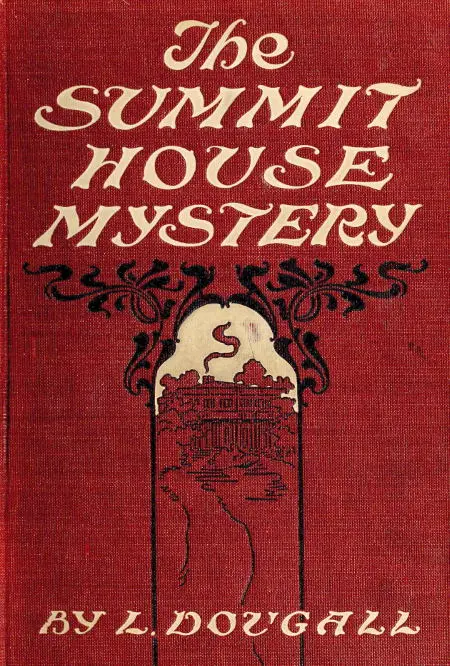
The Summit House Mystery; Or, The Earthly Purgatory
L. (Lily) Dougall
THE CLASSIC COLLECTION · 1899
"The Mormon Prophet" by Lily Dougall is a historical novel written in the late 19th century. The book explores the life and experiences surrounding the early days of Mormonism, focusing on key figures like Joseph Smith and his followers while also delving into societal misconceptions about the religion. The narrative appears to particularly highlight the complex dynamics between faith, personal beliefs, and societal pressures during a time of religious upheaval in America. The opening of the novel presents a vivid backdrop of the early 19th century and introduces us to the Croom family, particularly the intellectual and studious Ephraim Croom, who finds himself at odds with the religious fervor surrounding him. As discussions about Joseph Smith and Mormonism unfold within the family, Ephraim's curiosity and skepticism clash with his mother’s fervent beliefs. At the same time, we meet Susannah, a beautiful and impetuous niece who brings a fresh perspective into the Croom household. As their stories intertwine with the growing religious movement, the complexities of belief, love, and societal judgment set the stage for a gripping exploration of faith in the midst of turmoil.
Introduction adapted from the source catalogue; source summaries may be automatically generated.
Free to read · English · 98,722 words · No account needed
MAKE TIME FOR A GOOD BOOK
On by default. Untick to stop anonymous reading totals. Each page counts after 10 seconds in view. How this works.
Anonymous counting is on unless you have switched it off.
The broad river, milk-white under a dappled sky, stretched south and west. The other side was dim and blue in the faint vapour of the relaxing frost. The air was sweet and still. The sunbeams, imprisoned in eastern vapour, shone through the white veil with soft glow that cast no shadow but comforted the earth with hope.
Susannah had a further thought in her mind now, but she felt no haste or impatience of excitement.
The boy was of an active, restless disposition or he would hardly have been out so early. Lithe and idle, he sat see-sawing in the floating end of the boat, uncertain how to amuse himself. He returned Susannah's greeting with a lively flow of talk.
"You don't know how to row," said Susannah.
She showed no eagerness, for she felt none. The hope she had just formed was most uncertain, for it appeared not at all likely that she could escape in this way without being molested.
"I bet I can row," said the boy, "as well as any man in town."
"That isn't saying much," said Susannah. "The men about here have very few boats, and they are most of them afraid to go on anything smaller than the steamer."
"I could row t'other side and back," bragged the boy. "I could row t'other side and back three times in the day."
"You couldn't."
"I couldn't! What will you bet?"
"I suppose your father wouldn't allow you to go, anyway."
He was a fresh-faced, mischievous, eager young rascal, and he found Susannah's manner pleasant and provoking.
"Will you lay five dollars on it?" he cried. "Pap is away down to Quincy. If you'll lay five dollars on it I'll do it."
"But I won't."
The gambling spirit of the young pioneer was aroused.
"What will you lay on it, then?"
"I don't believe you could row once to the other side."
He bragged loudly and with much exaggeration of what he had done and what he could do, and began pushing off the boat to show her his speed.
The boat was a rude craft, unpainted, flat-bottomed, but light enough, and not badly formed for speed. Susannah stepped into it without much hope, scarcely caring what she did, but still provoking the young boatman to attempt the crossing.
"I shan't give you any money," she said, "but you can row me a bit if you like till I see how fast you can go. You don't understand the currents, I am sure."
"Currents!" said the boy, "I guess I understand all there is to know
about them."
Your reading position is saved on this browser. Take it to another device with a library code. Reading pages adapt to text, rather than matching a printed edition.
BEHIND THE BOOK
This eBook is for the use of anyone anywhere in the United States and most other parts of the world at no cost and with almost no restrictions whatsoever. You may copy it, give it away or re-use it under the terms of the Project Gutenberg License included with this eBook or online at www.gutenberg.org. If you are not located in the United States, you will have to check the laws of the country where you are located before using this eBook. Read the source licence.
The original source file, including credits and licence, is retained by this library. Request an original-format copy at no charge. Please include the book title and Project Gutenberg identifier #17279.
KEEP YOUR CURIOSITY GOING
Cécile Tormay

Moritz Busch
Coulson Kernahan
John L. Ransom

Maurice Baring
Frances Wright