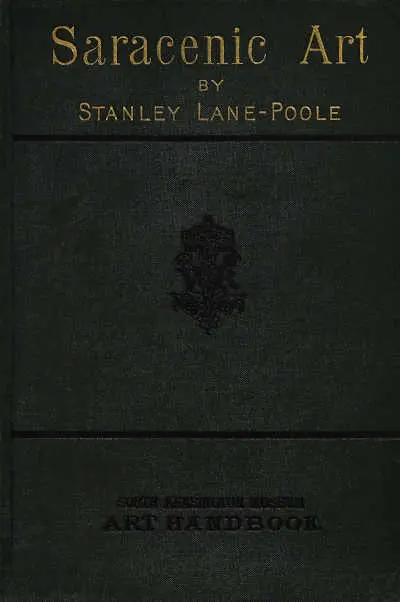
The art of the Saracens in Egypt
Stanley Lane-Poole

THE CLASSIC COLLECTION · 1893
"The Moors in Spain" by Stanley Lane-Poole is a historical account written in the late 19th century. The book explores the rich history and cultural legacy of the Moors in Spain, detailing their contributions to art, science, and architecture during their nearly eight centuries of rule over the Iberian Peninsula. It aims to present an unbiased view of their impact on Spanish civilization, contrasting their time of enlightenment with the subsequent period of decline after their expulsion. The opening of the book contextualizes the arrival of the Moors in Spain, beginning with the account of Tarik's invasion and the downfall of the Visigoths. Lane-Poole discusses the deterioration of the kingdom under Roderick, highlighting the corrupt and depraved state of society that allowed for the quick subjugation by the Muslims. The narrative introduces key characters and events leading to the significant battle at the Guadalete, where the Moors defeated the Spanish forces led by Roderick, setting the stage for their conquest and the transformation of Spain into a beacon of culture and knowledge during the Middle Ages. This early section lays the foundation for understanding the complexities and dynamics between the conquering Moors and the native populations they ruled.
Introduction adapted from the source catalogue; source summaries may be automatically generated.
Free to read · English · 64,540 words · No account needed
MAKE TIME FOR A GOOD BOOK
On by default. Untick to stop anonymous reading totals. Each page counts after 10 seconds in view. How this works.
Anonymous counting is on unless you have switched it off.
A man so fertile in expedients would not find much difficulty in getting rid of Gh[=a]lib. He first began a series of army reforms, by which he reduced the influence of individual commanders and gained for himself the devotion which had previously been bestowed upon captains of divisions. This he accomplished by drawing his recruits from Africa and from among the Christians of the north, who were of course without any prejudice in favour of any particular Moslem leader, and soon became attached to Almanzor, when they understood his liberality, and were convinced by repeated proofs of his military genius. He was a stern commander, and had been known to cut a man's head off with the culprit's own sword, because the same weapon had been seen gleaming in the dressed ranks when it should have been in its scabbard. But while a martinet in matters of drill and discipline, he was a father to his soldiers so long as they fought well and maintained order. His influence was unbounded. Once, when he sat in camp and saw his men in panic, running in, with the Christians at their heels, he threw himself from his throne, flung his helmet away, and sat down in the dust. The soldiers understood the despairing gesture of their general, and, suddenly turning about, fell upon the Christians, routed them, and pursued them even into the streets of Leon. Moreover, no one could lead them to such vast stores of booty as the man who made more than fifty successful campaigns against the princes of the north. The army thus formed of new levies became devoted to their master, and Gh[=a]lib and his veterans of the frontier were speedily beaten; Gh[=a]lib himself died in an engagement. One other leader, Ja'far, the Prince of Z[=a]b, threatened the peace of Almanzor by his extreme popularity with the troops; and he was presently invited to the minister's hall, made very drunk, and assassinated on his way home. This was by no means a solitary instance of Almanzor's treachery and bloodguiltiness; such acts deprive him of the title of hero to which his many brilliant qualities almost attain, and it is impossible to like him. Yet, with all his sternness and unscrupulousness, Almanzor brought Andalusia to a pitch of glory such as even the great Khalif, Abd-er-Rahm[=a]n III., had hardly contemplated. While keeping such hostile factions as remained in Cordova tranquil and powerless; whilst conciliating the people by making splendid additions to the great mosque of Cordova, when he found that they were beginning to grow indignant at the seclusion in which their young Khalif was kept, and were listening to the insinuations of Aurora and the palace party, who had grown tired or jealous of Almanzor; whilst overawing the Khalif himself by his personal influence; whilst keeping a watchful eye, that nothing escaped, upon every department of the administration, and devoting no little time to the cultivation of literature and poetry--amid all these various employments, this indefatigable man waged triumphant war in Africa and spread the dominion of the Khalif along the Barbary coast; and twice a year, in spring and autumn, led his troops, as a matter of course, against the Christians of Leon and Castile. Like a man of culture, he took his books along with his sword--his books were the poets who always accompanied his campaigns. Never was a general so constantly victorious. Supported by his hardy foreigners, and also by many Christians who were attracted by his pay and the sure prospect of booty, he carried fire and sword through the lands of the north. He captured Leon, and razed its massive walls and towers to the ground; he seized Barcelona; and, worst of all, he even ventured into the passes of Galicia, and levelled to the ground the splendid church of Santiago de Campostella, which was the focus of countless pilgrimages and almost formed the Kaaba of Europe. The shrine of St. James, however, where numerous miracles attested the presence of the saint's relics, was spared. It is said that when the conqueror entered the deserted city he found of all its inhabitants but a solitary monk, who still prayed before the holy shrine. "What doest thou here?" demanded Almanzor. "I am at my prayers," replied the old monk. His life was immediately spared, and a guard was set round the tomb to protect him and it from the violence of the soldiery, who proceeded to destroy everything else in the city. Almanzor well deserved his title of "Victorious," which was assumed after one of these campaigns. So long as his armies made their half-yearly expeditions, the Christian princes were paralysed, and Leon and the neighbouring country became a mere tributary province of the kingdom of Cordova. Castile, Barcelona, and Navarre were repeatedly defeated. He had taken the very capitals--Leon, Pamplona, Barcelona, and even Santiago de Campostella. Once he had brought the King of Navarre to his knees simply because the uncompromising Minister learned that there remained one captive Moslem woman in his kingdom. She was instantly delivered up, and many apologies were tendered for the inadvertence. Another time Almanzor found himself and his army cut off by the Christians, who had occupied an impregnable position in his rear, and barred his return to Cordova. Nothing daunted, he ordered his troops to foray the country round about, and collect materials for sheds, and implements of husbandry. Soon the Christians, who dared not attack, but believed they held the Moslems in their grasp, perceived them deliberately setting up barracks, and contentedly tilling the soil and preparing for the various operations of agriculture. Their astonished inquiries were answered by the cool reply, "We do not think it is worth while to go home, as the next campaign will begin almost immediately; so we are making ourselves comfortable for the interval!" Filled with consternation at the prospect of a permanent Moslem occupation, the Christians not only abandoned their strong position and allowed the enemy to go scot free, laden with booty, but even supplied them with baggage mules to carry off the spoils!
Your reading position is saved on this browser. Take it to another device with a library code. Reading pages adapt to text, rather than matching a printed edition.
Stanley Lane-Poole
Stanley Lane-Poole

Stanley Lane-Poole & J. D. Jerrold (James Douglas Jerrold) Kelley
BEHIND THE BOOK
This eBook is for the use of anyone anywhere in the United States and most other parts of the world at no cost and with almost no restrictions whatsoever. You may copy it, give it away or re-use it under the terms of the Project Gutenberg License included with this eBook or online at www.gutenberg.org. If you are not located in the United States, you will have to check the laws of the country where you are located before using this eBook. Read the source licence.
The original source file, including credits and licence, is retained by this library. Request an original-format copy at no charge. Please include the book title and Project Gutenberg identifier #37223.
KEEP YOUR CURIOSITY GOING
Cécile Tormay

Moritz Busch
John L. Ransom
Frances Wright
Cécile Tormay

Mabel Potter Daggett