THE CLASSIC COLLECTION✦The haunts of menCLASSIC FREE BOOKS
The haunts of men
Robert W. (Robert William) Chambers
THE CLASSIC COLLECTION · 1919
"The Moonlit Way: A Novel" by Robert W. Chambers is a fictional narrative written in the early 20th century. The story unfolds in an enchanting, moonlit setting, primarily in Constantinople, where intrigues of European nobility and a captivating dancer named Nihla Quellen intertwine with themes of love, betrayal, and ambition. The plot hints at layers of complex relationships against a backdrop of rising political tensions and the glamour of the East. At the start of the novel, the atmosphere is rich with vivid imagery of the moonlit Bosphorus, inviting the reader into the opulence of a gathering at the German Embassy, where various characters discuss their fascination with Nihla, a beautiful dancer who has just made a striking entrance. Set among a cast of diplomats and socialites, we are introduced to Count d’Eblis, who is eager to make Nihla the center of attention while Ferez Bey, an influential figure, schemes behind the scenes. As the prologue unfolds, Nihla is revealed as not just an alluring performer but also a pawn in a complex game of power and desire, setting the stage for her dramatic entanglements that echo themes of fate and the quests for personal gain.
Introduction adapted from the source catalogue; source summaries may be automatically generated.
Free to read · English · 105,024 words · No account needed
MAKE TIME FOR A GOOD BOOK
On by default. Untick to stop anonymous reading totals. Each page counts after 10 seconds in view. How this works.
Anonymous counting is on unless you have switched it off.
"Well, then," he said gaily, "why not give a party for them? That
ought to amuse you, Dulcie."
The child still smiled; Barres walked on past her a pace or two, halted, turned irresolutely, arrived at some swift decision, and came back, suddenly understanding that he need seek no further--that he had discovered his guest of the evening at his very elbow.
"Did you and your father have your supper, Dulcie?"
"My father went out to eat at Grogan's."
"How about you?"
"I can find something."
"Why not dine with me?" he suggested.
The child stared, bewildered, then went a little pale.
"Shall we have a dinner party for two--you and I, Dulcie? What do you
say?"
She said nothing, but her big grey eyes were fixed on him in a passion
of inquiry.
"A real party," he repeated. "Let the people get their own mail and packages until your father returns. Nobody's going to sneak in, anyway. Or, if that won't do, I'll call up Grogan's and tell your father to come back because you are going to dine in my studio with me. Do you know the telephone number? Very well; get Grogan's for me. I'll speak to your father."
Dulcie's hand trembled on the receiver as she called up Grogan's; Barres bent over the transmitter:
"Soane, Dulcie is going to take dinner in my studio with me. You'll have to come back on duty, when you've eaten." He hung up, looked at Dulcie and laughed.
"I wanted company as much as you did," he confessed. "Now, go and put on your prettiest frock, and we'll be very grand and magnificent. And afterward we'll talk and look at books and pretty things--and maybe we'll turn on the Victrola and I'll teach you to dance--" He had already begun to ascend the stairs:
"In half an hour, Dulcie!" he called back; "--and you may bring the Prophet if you like.... Shall I ask Mr. Westmore to join us?"
"I'd rather be all alone with you," she said shyly.
He laughed and ran on up the stairs.
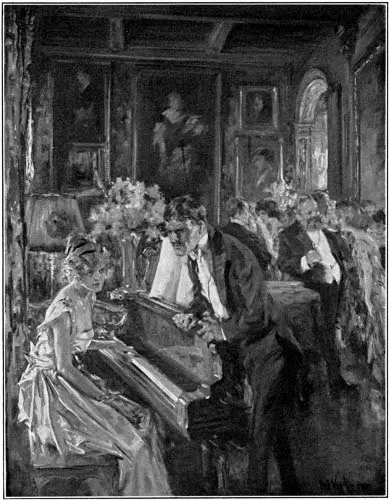
In half an hour the electric bell rang very timidly. Aristocrates, having been instructed and rehearsed, and, loftily condescending to his role in a kindly comedy to be played seriously, announced: "Miss Soane!" in his most courtly manner.
Barres threw aside the evening paper and came forward, taking both hands of the white and slightly frightened child.
"Aristocrates ought to have announced the Prophet, too," he said
gaily, breaking the ice and swinging Dulcie around to face the open
door again.
The Prophet entered, perfectly at ease, his eyes of living jade shining, his tail urbanely hoisted.
Your reading position is saved on this browser. Take it to another device with a library code. Reading pages adapt to text, rather than matching a printed edition.
Robert W. (Robert William) Chambers
Robert W. (Robert William) Chambers

Robert W. (Robert William) Chambers
Robert W. (Robert William) Chambers
BEHIND THE BOOK
This eBook is for the use of anyone anywhere in the United States and most other parts of the world at no cost and with almost no restrictions whatsoever. You may copy it, give it away or re-use it under the terms of the Project Gutenberg License included with this eBook or online at www.gutenberg.org. If you are not located in the United States, you will have to check the laws of the country where you are located before using this eBook. Read the source licence.
The original source file, including credits and licence, is retained by this library. Request an original-format copy at no charge. Please include the book title and Project Gutenberg identifier #33557.
KEEP YOUR CURIOSITY GOING
Coulson Kernahan

Maurice Baring
Frances Wright
Cécile Tormay

Frederic Jesup Stimson

W. H. P. (William Henry Pope) Jarvis