THE CLASSIC COLLECTION✦The haunts of menCLASSIC FREE BOOKS
The haunts of men
Robert W. (Robert William) Chambers
THE CLASSIC COLLECTION · 1919
"The Moonlit Way: A Novel" by Robert W. Chambers is a fictional narrative written in the early 20th century. The story unfolds in an enchanting, moonlit setting, primarily in Constantinople, where intrigues of European nobility and a captivating dancer named Nihla Quellen intertwine with themes of love, betrayal, and ambition. The plot hints at layers of complex relationships against a backdrop of rising political tensions and the glamour of the East. At the start of the novel, the atmosphere is rich with vivid imagery of the moonlit Bosphorus, inviting the reader into the opulence of a gathering at the German Embassy, where various characters discuss their fascination with Nihla, a beautiful dancer who has just made a striking entrance. Set among a cast of diplomats and socialites, we are introduced to Count d’Eblis, who is eager to make Nihla the center of attention while Ferez Bey, an influential figure, schemes behind the scenes. As the prologue unfolds, Nihla is revealed as not just an alluring performer but also a pawn in a complex game of power and desire, setting the stage for her dramatic entanglements that echo themes of fate and the quests for personal gain.
Introduction adapted from the source catalogue; source summaries may be automatically generated.
Free to read · English · 105,024 words · No account needed
MAKE TIME FOR A GOOD BOOK
On by default. Untick to stop anonymous reading totals. Each page counts after 10 seconds in view. How this works.
Anonymous counting is on unless you have switched it off.
Dulcie was the first to reappear and descend the stairs of the north wing--a willowy white shape in the early dusk, slim as a young spirit in the lamplit silence.
Nobody else had come down; a maid was turning up a lamp here and there; the plebeian family cat came out of the shadows from somewhere and made advances as though divining that this quiet stranger was a friend to cats.
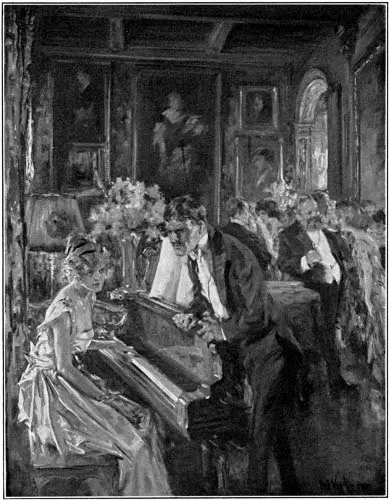
So Dulcie stooped to pet her, then wandered on through the place and finally into the music room, where she seated herself at the piano and touched the keys softly in the semi-dusk.
Among the songs--words and music--which her mother had left in manuscript, was one which she had learned recently,--"Blue Eyes"--and she played the air now, seated there all alone in the subdued lamp light.
Presently people began to appear from above--Mrs. Barres, who motioned her not to rise, and who seated herself near, watching the girl's slender fingers moving on the keys; then Lee, who came and stood beside her, followed in a few moments by Thessalie and the two younger men.
"What is that lovely little air you are playing?" inquired Mrs.
Barres.
"It is called 'Blue Eyes,'" said Dulcie, absently.
"I have never before heard it."
The girl looked up:
"No, my mother wrote it."
After a silence:
"It is really exquisite," said Mrs. Barres. "Are there words to it?"
Some people had come into the entrance hall beyond; there was the low whirring of an automobile outside.
"Yes, my mother made some verses for it," replied Dulcie.
"Will you sing them for me after dinner?"
"Yes, I shall be happy to."
Mrs. Barres turned to welcome her new guests, now entering the music room convoyed by Barres senior, who was arrayed in the dreaded "stiff shirt" and already indulging in "table talk."
"They took," he was explaining, "a midge-fly with no hackle--Claire, here are the Gerhardts and Mr. Skeel!" And while his wife welcomed them and introductions were effected, he continued explaining the construction of the midge to anybody who listened.
At the first mention of Murtagh Skeel's name, the glances of Westmore, Garry and Thessalie crossed like lightning, then their attention became riveted on this tall, graceful, romantic looking man of early middle age, who was being lionised at Northbrook.
The next moment Garry stepped back beside Dulcie Soane, who had turned
white as a flower and was gazing at Skeel as though she had seen a
ghost.
"Do you suppose he can be the same man your mother knew?" he
whispered, dropping his arm and taking her trembling hand in a firm
clasp.
Your reading position is saved on this browser. Take it to another device with a library code. Reading pages adapt to text, rather than matching a printed edition.
Robert W. (Robert William) Chambers
Robert W. (Robert William) Chambers

Robert W. (Robert William) Chambers
Robert W. (Robert William) Chambers
BEHIND THE BOOK
This eBook is for the use of anyone anywhere in the United States and most other parts of the world at no cost and with almost no restrictions whatsoever. You may copy it, give it away or re-use it under the terms of the Project Gutenberg License included with this eBook or online at www.gutenberg.org. If you are not located in the United States, you will have to check the laws of the country where you are located before using this eBook. Read the source licence.
The original source file, including credits and licence, is retained by this library. Request an original-format copy at no charge. Please include the book title and Project Gutenberg identifier #33557.
KEEP YOUR CURIOSITY GOING
Coulson Kernahan

Maurice Baring
Frances Wright
Cécile Tormay

Frederic Jesup Stimson

W. H. P. (William Henry Pope) Jarvis