
Astronomy in a nutshell
Garrett Putman Serviss
THE CLASSIC COLLECTION · 1907
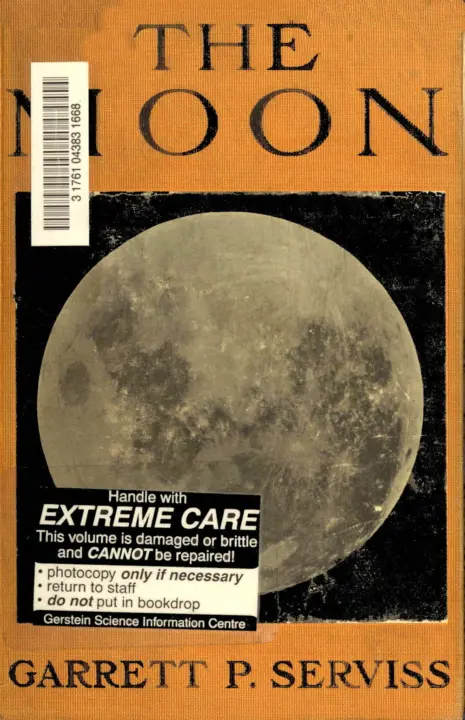
"The Moon: A Popular Treatise" by Garrett Putman Serviss is a scientific publication written in the early 20th century. This work explores our closest celestial neighbor, the Moon, utilizing a conversational format to explain its characteristics, phases, and various geological features in a way that is accessible to the general reader. The book includes a series of lunar photographs that document the Moon’s appearance over a complete lunation and aims to present essential astronomical facts without overwhelming readers with technical jargon. At the start of the treatise, the author engages in a conversation with a friend who is curious about the Moon and its mysteries. This dialogue sets the stage for a broader discussion on the Moon's origin, its physical properties (such as size and distance from Earth), and some fundamental astronomical concepts like the phases of the Moon and the phenomena of eclipses. Serviss conveys a sense of wonder and excitement about astronomical discoveries while inviting readers to visualize the Moon's beauty and complexity, establishing an informative yet engaging tone for the exploration that follows.
Introduction adapted from the source catalogue; source summaries may be automatically generated.
Free to read · English · 54,883 words · No account needed
MAKE TIME FOR A GOOD BOOK
On by default. Untick to stop anonymous reading totals. Each page counts after 10 seconds in view. How this works.
Anonymous counting is on unless you have switched it off.
“Oh, yes, but the distinctness of view would be nothing like so great as if you were looking at the same objects on the earth. Still, if we could obviate the atmospheric and other difficulties, a magnifying power of one million would certainly enable us to discover the works of the moon’s inhabitants—their houses, their fields, their plantations, their great establishments of art and industry. But I assure you that a telescope of such power is a mere dream. It could never be constructed without some fundamentally new and unheard-of discovery in optics. We shall do better to turn once more to our photographs which, at least, have no deceptions. Dropping No. 12, we shall take up No. 13, which brings us practically to the Full Moon phase. The moon’s age at the time this photograph was made was nearly fourteen and one-half days. You see that its whole eastward face is now lying in the sunlight. The march of day across its surface has been completed, and on the western edge of the moon the sun is about to set, while on the eastern edge it is just rising. Among the new things that have come into view is a conspicuous dark oval, shaped like Plato, but very much larger, near the eastern edge. This is a walled plain named Grimaldi, and it enjoys the distinction of being the darkest on the moon. Near it on the northeast and consequently closer to the limb is another walled plain, which I promised some time ago to point out to you because it bears the name of the astronomer Riccioli, the great bestower of names on the moon, and upon whose lack of imagination you have so severely commented. But, as you have already learned, the time of Full Moon is not the best for studying the mountains and rings, because then the light strikes too nearly vertical upon them and they cast no shadows. But it is the best time for seeing the broad general features of the lunar surface. Turn the picture upside down again, thus bringing the disk into its natural position as seen with the naked eye, and this photograph shows the moon very much as it appears with a small pocket telescope, or with a powerful binocular. The new prism binoculars that have come into use within the past few years are excellent for general views of the moon. Their defining powers are superb, and one who has never seen the moon with such a glass is always greatly surprised and delighted with the view which it affords. You see now that Tycho forms a blazing brooch, resting on the Maiden’s neck, while its rays extend across her profile, and the long one lying over the Mare Serenitatis bears some resemblance to a pin displayed in her hair, with the crater ring, Menelaus, glittering at its lower end. The other bright point, to the left of Menelaus (we will henceforth keep the picture reversed), is a ring mountain named Manilius. After the detailed study which we have given to the various ‘seas’ and formations you should be able to recognize them with the picture in this position, and I wish that you should do so because, as I have just remarked, this is the position of the Full Moon as it is always seen with the naked eye or with a simple binocular, for the latter does not reverse it, as does a telescope. The western edge is now at the right hand, and the north at the top. All the mares are clearly visible. On the right the Mare Crisium, the Mare Fœcunditatis, the Mare Nectaris and the Mare Tranquillitatis; in the center, above, the Mare Serenitatis; on the left the Mare Imbrium, the Mare Vaporum, the Mare Nubium, the Mare Humorum, and the Oceanus Procellarum. The two bright spots on the right, lower than the Mare Fœcunditatis, are Petavius and a neighboring ring. Vendelinus forms a less brilliant spot at the western edge of an extension of the Mare Fœcunditatis, and Langrenus is distinctly seen on the western shore of the main body of that mare. Proclus and the remarkable diamond of the ‘Marsh of a Dream’ are very plain just under the large oval of the Mare Crisium. The mountains and cliffs encircling the Mare Imbrium on the west, north, and east you will recognize at a glance. The dark Plato is conspicuous in the lighter mountainous area north of this ‘sea,’ and the semicircle of the ‘Bay of Rainbows’ is sharply defined. Farther north is the long, dark Mare Frigoris, whose eastern end merges into the broad Oceanus Procellarum. Aristarchus appears as a very bright point in this ‘ocean,’ and far to the right of Aristarchus, toward the center of the disk, Copernicus, with its splatter of irregular rays, is conspicuous. Following the eastern limb round toward the south we see again the dark oval of Grimaldi, beyond which the bright mountainous region broadens as we approach the South Pole.
Your reading position is saved on this browser. Take it to another device with a library code. Reading pages adapt to text, rather than matching a printed edition.
Garrett Putman Serviss
Garrett Putman Serviss
Garrett Putman Serviss
Garrett Putman Serviss
BEHIND THE BOOK
This eBook is for the use of anyone anywhere in the United States and most other parts of the world at no cost and with almost no restrictions whatsoever. You may copy it, give it away or re-use it under the terms of the Project Gutenberg License included with this eBook or online at www.gutenberg.org. If you are not located in the United States, you will have to check the laws of the country where you are located before using this eBook. Read the source licence.
The original source file, including credits and licence, is retained by this library. Request an original-format copy at no charge. Please include the book title and Project Gutenberg identifier #66510.
KEEP YOUR CURIOSITY GOING

John Muir

Asa Gray
Asa Gray

Florence Nightingale
Elizabeth Robins Pennell
Denison Olmsted