Astronomy in a nutshell
Garrett Putman Serviss
THE CLASSIC COLLECTION · 1907
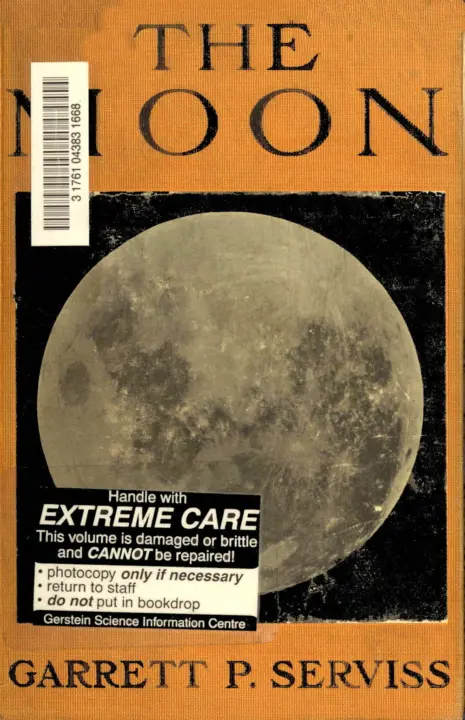
"The Moon: A Popular Treatise" by Garrett Putman Serviss is a scientific publication written in the early 20th century. This work explores our closest celestial neighbor, the Moon, utilizing a conversational format to explain its characteristics, phases, and various geological features in a way that is accessible to the general reader. The book includes a series of lunar photographs that document the Moon’s appearance over a complete lunation and aims to present essential astronomical facts without overwhelming readers with technical jargon. At the start of the treatise, the author engages in a conversation with a friend who is curious about the Moon and its mysteries. This dialogue sets the stage for a broader discussion on the Moon's origin, its physical properties (such as size and distance from Earth), and some fundamental astronomical concepts like the phases of the Moon and the phenomena of eclipses. Serviss conveys a sense of wonder and excitement about astronomical discoveries while inviting readers to visualize the Moon's beauty and complexity, establishing an informative yet engaging tone for the exploration that follows.
Introduction adapted from the source catalogue; source summaries may be automatically generated.
Free to read · English · 54,883 words · No account needed
MAKE TIME FOR A GOOD BOOK
On by default. Untick to stop anonymous reading totals. Each page counts after 10 seconds in view. How this works.
Anonymous counting is on unless you have switched it off.
Path of moon about sun, 16-17, Note.
Petavius, 62, 123.
Phases of moon explained, 13-16.
Phlægrean Fields, 60.
Photographs, lunar, 47-49.
in series, 57.
peculiar tone of, 145.
why they are reversed, 52.
Photometry, lunar, 153-154.
Piccolomini, 72, 200.
Pickering, Prof. William H., observations of Linné by, 233.
on effects of earth’s shadow on moon, 28.
opinion of, regarding changes in Plato, 226.
theory of Tycho’s rays by, 126.
Pico, 231.
Pitatus, 186, 195.
Plato, 105, 114, 132, 225.
changes observed in, opinion of Prof. William H. Pickering regarding,
226.
vegetation in, 227.
Plinius, 224.
Poetry of the moon, 96.
Posidonius, 224.
Prism binoculars for viewing moon, 122.
Proclus, 68.
remarkable brilliance of, 90.
Projectile force on moon, 37.
Promontorium Ænarium, 189.
Promontory Acherusia, 224.
Promontory Heraclides, 109.
Promontory Laplace, 109.
Ptolemæus, 98.
Pytheas, 216.
Rabbi Levi, 202.
Reinhold, 217.
Riccioli, nomenclature of, for lunar objects, 69.
Rings, ranges of, on moon, 97-98.
Riphæan Mountains, 190.
Rotation of moon “braked” by tides, 20.
Rotation of moon, illustrated, 19-20.
Sacrobosco, 206.
Schickard, 115.
Schmidt, observation of Linné by, 233.
Schröter, “lunar city” discovered by, 218.
“Seas,” lunar, character of beds of, 142.
Shadow of moon during eclipse, 40.
length of, 40.
Shadows on moon, topography revealed by, 100-101.
used to measure heights on moon, 63.
Sidereal revolution of moon, 11.
Sinus Æstuum, 103.
Sinus Iridum, 109.
Sinus Medii, 103.
Sinus Roris, 159.
Size of moon, 8.
Sky as seen from moon, 29.
Snow, can it exist on the moon? 69.
Snow, non-existence of, on moon, 69.
South polar region of moon, 77.
South pole of moon, 106.
Stadius, 218.
Stöfler, 75.
row of rings near, 204.
“Straight wall,” 187.
Strait between Apennines and Caucasus, 234.
Sulpicius Gallus, 222.
Sunrise, slow progress of, on moon, 94.
Sunshine, effects of, when vertical on moon, 100.
Surface of moon, nature of, 9.
size of, 9.
Synodic revolution of, 11-12.
Tacitus, 200.
Telescopic power, limits of, 120.
Teneriffe Mountains, 231.
“Terminator,” meaning of, 63.
Theætetus, 225.
Theophilus, 71, 138, 198, 206.
crater pits near, 211.
grandeur of appearance of, when highly magnified, 207.
great mountain fold near, 207-208.
what would be seen from wall of, near sunset, 208.
Tidal attraction, forcing moon away in reaction of, 6.
“Tidal friction,” 20.
Tides, causing of, by moon and sun, 21.
effect of earth’s rotation on, 25.
service rendered by, 22.
simultaneous occurrence of, on opposite sides of earth, 23.
when highest, 21.
when lowest, 22.
Twilight, why none on moon, 64.
Tycho, 10, 98, 106, 146, 191.
longest ray of, 93, 221.
ray system of, 124.
rays of, 99.
theory of Nasmyth, 124-125.
theory of Pickering, 126.
Vegetation on moon, 32, 115, 142, 144, 227.
Vendelinus, 59, 123.
Venus seen by daylight, 149.
Verne, Jules, “Trip to the Moon,” 4.
Volcanic craters on moon, 60.
Volcanoes, lunar, 54.
contrasted with those of earth, 84.
effects of gravitation on size of, 86.
Water on the moon, 53.
“Weathering” on the moon, 197.
Weight on the moon, 36.
Werner, 78, 205.
Wilhelm I., 102, 195.
Zagut, 202.
=Other Worlds.=
Their Nature, Possibilities, and Habitability in the Light of the Latest Discoveries. Illustrated. 12mo. Cloth, $1.20 net; postage, 11 cents additional.
Your reading position is saved on this browser. Take it to another device with a library code. Reading pages adapt to text, rather than matching a printed edition.
Garrett Putman Serviss
Garrett Putman Serviss
Garrett Putman Serviss
Garrett Putman Serviss
BEHIND THE BOOK
This eBook is for the use of anyone anywhere in the United States and most other parts of the world at no cost and with almost no restrictions whatsoever. You may copy it, give it away or re-use it under the terms of the Project Gutenberg License included with this eBook or online at www.gutenberg.org. If you are not located in the United States, you will have to check the laws of the country where you are located before using this eBook. Read the source licence.
The original source file, including credits and licence, is retained by this library. Request an original-format copy at no charge. Please include the book title and Project Gutenberg identifier #66510.
KEEP YOUR CURIOSITY GOING

John Muir

Asa Gray
Asa Gray

Florence Nightingale
Elizabeth Robins Pennell
Denison Olmsted