Astronomy in a nutshell
Garrett Putman Serviss
THE CLASSIC COLLECTION · 1907
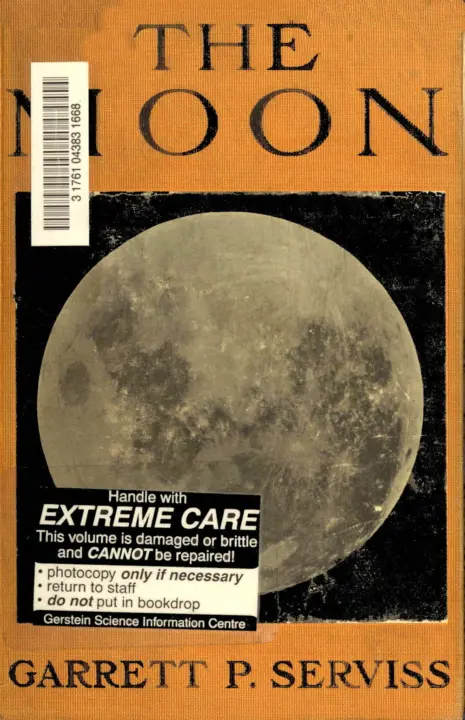
"The Moon: A Popular Treatise" by Garrett Putman Serviss is a scientific publication written in the early 20th century. This work explores our closest celestial neighbor, the Moon, utilizing a conversational format to explain its characteristics, phases, and various geological features in a way that is accessible to the general reader. The book includes a series of lunar photographs that document the Moon’s appearance over a complete lunation and aims to present essential astronomical facts without overwhelming readers with technical jargon. At the start of the treatise, the author engages in a conversation with a friend who is curious about the Moon and its mysteries. This dialogue sets the stage for a broader discussion on the Moon's origin, its physical properties (such as size and distance from Earth), and some fundamental astronomical concepts like the phases of the Moon and the phenomena of eclipses. Serviss conveys a sense of wonder and excitement about astronomical discoveries while inviting readers to visualize the Moon's beauty and complexity, establishing an informative yet engaging tone for the exploration that follows.
Introduction adapted from the source catalogue; source summaries may be automatically generated.
Free to read · English · 54,883 words · No account needed
MAKE TIME FOR A GOOD BOOK
On by default. Untick to stop anonymous reading totals. Each page counts after 10 seconds in view. How this works.
Anonymous counting is on unless you have switched it off.
“As to life on the moon, I find that I cannot be satisfied with a mere grass theory. I am so well convinced that there must be something more, that I no longer relegate my lunarians to an age antedating the volcanoes. On the contrary, as soon as I get my telescope I am going to look for signs of them and their doings in the present day, and willy nilly, sir, you have got to aid me in the search.”
DATES, and age of the moon, when the twenty-one serial photographs were made at the Yerkes Observatory, by Mr. Wallace, with the 12-inch telescope and a special color filter constructed by him:
No. 1, February 19, 1904; Moon’s Age 3.85 Days No. 2, September 24, 1903; Moon’s Age 3.87 Days No. 3, July 29, 1903; Moon’s Age 5.54 Days No. 4, November 24, 1903; Moon’s Age 5.74 Days No. 5, July 1, 1903; Moon’s Age 6.24 Days No. 6, November 26, 1903; Moon’s Age 7.75 Days No. 7, July 2, 1903; Moon’s Age 7.24 Days No. 8, August 31, 1903; Moon’s Age 9.22 Days No. 9, August 2, 1903; Moon’s Age 8.97 Days No. 10, November 30, 1903; Moon’s Age 11.78 Days No. 11, December 1, 1903; Moon’s Age 12.98 Days No. 12, September 4, 1903; Moon’s Age 13.27 Days No. 13, September 5, 1903; Moon’s Age 14.40 Days No. 14, August 26, 1904; Moon’s Age 15.65 Days No. 15, August 28, 1904; Moon’s Age 17.41 Days No. 16, August 29, 1904; Moon’s Age 18.62 Days No. 17, October 10, 1903; Moon’s Age 20.06 Days No. 18, September 29, 1904; Moon’s Age 20.50 Days No. 19, August 16, 1903; Moon’s Age 23.81 Days No. 20, August 17, 1903; Moon’s Age 24.84 Days No. 21, August 19, 1903; Moon’s Age 26.89 Days
Abenezra, 205.
Abulfeda, 200.
Air on the moon, 230.
Albategnius, 78.
Aliacensis, 78, 205.
Almamon, 205.
Alps, 97.
remarkable valley in, 225.
Altai Mountains, 72, 200.
chain of small craters near, 200.
Animal life on the moon, 228.
Apennines, 10, 96, 104, 137, 143, 222, 232.
Apennines and Caucasus, strait between, 234.
Apianus, 205.
Archimedes, 143, 232.
Aristarchus, 117, 153.
astonishing brilliance of, 112.
cause of brilliance of, 155.
possible composition of, 113.
Aristoteles, 76, 138.
Atlas, 70.
Atmosphere, lunar, 31.
disappearance of, 228.
what has become of it, 32.
Atmospheres, how they may grow or decrease, 230.
Azophi, 205.
Barry, 189.
“Bay of Rainbows,” 109, 111, 142, 157, 158.
Bessel, 221.
Bianchini, 110.
Birt, 188.
Blancanus, 78, 194.
Bonpland, 189.
Bubbles on the moon, 186.
Bullialdus, 180-182, 183.
mountains near, 183.
Byrgius, 147.
Calippus, 223.
Campanus, 185.
Capuanus, 185, 196.
Carpathian Mountains, 215.
Cassini, 225.
Catharina, 72, 138, 199, 206.
remarkable valleys near, 199-200.
Caucasus Mountains, 97, 223.
Caucasus and Apennines, strait between, 234.
“Cavern life” on moon, 229.
Cichus, 185, 196.
Clavius, 99, 101, 146, 192.
length of great wall of, 193.
Cleft near shore of Mare Nubium, 186.
Clefts on moon, resemblance of, to geological “faults,” 187.
Cleomedes, 56.
Color on moon, 155.
Colorado Cañon, possible likeness of, to cleft on moon, 118.
Copernicus, 102, 211.
an argument for the volcanic theory, 212.
buried ring near, 217-218.
crater pits near, 213.
hexagonal form of, 212.
Craters, lunar, formation of, ascribed to falling masses, 201. theory of, advanced by W. K. Gilbert, 200.
Cyrillus, 72, 138, 199, 206, 210.
“Dark woman” in moon, 133.
Darwin, Prof. George, 6.
Dawes, 224.
Day and night on moon, 63.
Day on moon, length of, 95.
Your reading position is saved on this browser. Take it to another device with a library code. Reading pages adapt to text, rather than matching a printed edition.
Garrett Putman Serviss
Garrett Putman Serviss
Garrett Putman Serviss
Garrett Putman Serviss
BEHIND THE BOOK
This eBook is for the use of anyone anywhere in the United States and most other parts of the world at no cost and with almost no restrictions whatsoever. You may copy it, give it away or re-use it under the terms of the Project Gutenberg License included with this eBook or online at www.gutenberg.org. If you are not located in the United States, you will have to check the laws of the country where you are located before using this eBook. Read the source licence.
The original source file, including credits and licence, is retained by this library. Request an original-format copy at no charge. Please include the book title and Project Gutenberg identifier #66510.
KEEP YOUR CURIOSITY GOING

John Muir

Asa Gray
Asa Gray

Florence Nightingale
Elizabeth Robins Pennell
Denison Olmsted