Astronomy in a nutshell
Garrett Putman Serviss
THE CLASSIC COLLECTION · 1907
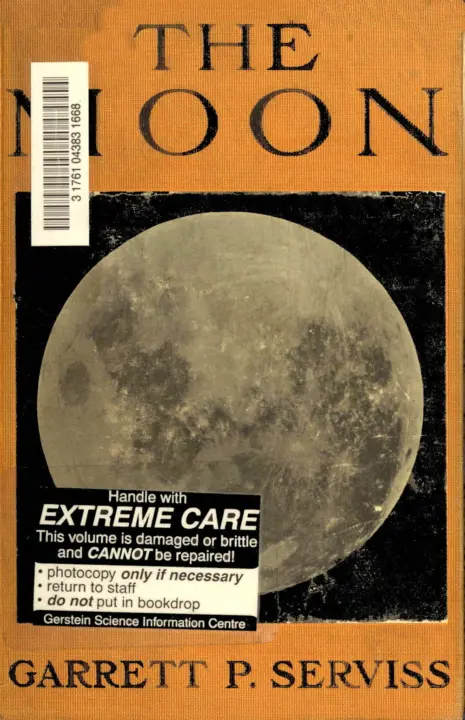
"The Moon: A Popular Treatise" by Garrett Putman Serviss is a scientific publication written in the early 20th century. This work explores our closest celestial neighbor, the Moon, utilizing a conversational format to explain its characteristics, phases, and various geological features in a way that is accessible to the general reader. The book includes a series of lunar photographs that document the Moon’s appearance over a complete lunation and aims to present essential astronomical facts without overwhelming readers with technical jargon. At the start of the treatise, the author engages in a conversation with a friend who is curious about the Moon and its mysteries. This dialogue sets the stage for a broader discussion on the Moon's origin, its physical properties (such as size and distance from Earth), and some fundamental astronomical concepts like the phases of the Moon and the phenomena of eclipses. Serviss conveys a sense of wonder and excitement about astronomical discoveries while inviting readers to visualize the Moon's beauty and complexity, establishing an informative yet engaging tone for the exploration that follows.
Introduction adapted from the source catalogue; source summaries may be automatically generated.
Free to read · English · 54,883 words · No account needed
MAKE TIME FOR A GOOD BOOK
On by default. Untick to stop anonymous reading totals. Each page counts after 10 seconds in view. How this works.
Anonymous counting is on unless you have switched it off.
“The interior of Cyrillus, you will observe, is very different from that of Theophilus. The floor is more irregular and mountainous. The wall, also, is much more complex than that of Theophilus. The broken state of the wall in itself is an indication of the greater age of Cyrillus. On the south an enormous pass in the wall of Cyrillus leads out upon a mountain-edged plateau which continues to the wall of the third of the great rings, Catharina. This formation seems to be of about the same age as Cyrillus, possibly somewhat older. Its wall is more broken and worn down, and the northern third of the inclosure is occupied by the wreck of a large ring. Observe the curious row of relatively small craters, with low mountain ranges paralleling them, which begins at the southwestern corner of Cyrillus and runs, with interruptions, for 150 miles or more. South of this is a broad valley with small craters on its bottom, and then comes an elongated mountainous region with a conspicuous crater in its center, beyond which appears another valley, which passes round the east side of Catharina, where it is divided in the center by a short range of hills. The southeastern side of this valley is bounded by the grand cliffs of the Altai Mountains, which continue on until they encounter the eastern wall of the great ring of Piccolomini, whose interior appears entirely dark in the picture, only a few peaks on the wall indicating the outlines of the ring. The serrated shadow of these mountains, thrown westward by the setting sun, forms one of the most striking features of the photograph. The northeastern end of the chain also terminates at a smaller ring named Tacitus. You see that Riccioli was rather cosmopolitan in his tastes, since he has placed the name of a Roman historian also on the moon. Beginning at a point on the crest of the Altai range, south of Tacitus, is a very remarkable chain of small craters, which extends eastward to the southern side of a beautiful ring plain with a white spot in the center. This ring is named Abulfeda. The chain of small craters or pits to which I have referred continues, though much less conspicuous, across the valley that lies northwest of the Altais. It is a very curious phenomenon, and recalls the theory advocated by W. K. Gilbert, the American geologist, that the moon’s craters were formed not by volcanic eruptions but by the impact of gigantic meteorites falling upon the moon, and originating, perhaps, in the destruction of a ring which formerly surrounded the earth, somewhat as the planet Saturn is surrounded by rings of meteoric bodies, which may eventually be precipitated upon its surface. The moon is more or less pitted with craterlets in all quarters, but there are places where they particularly abound. On inspecting this photograph carefully you will perceive several rows of much larger pits, two or three of them in the upper half of the picture, and one below the center, crossing the little chain of pits that I have just mentioned. The linear arrangement of some of the ring plains is also very striking. In regard to the theory that the lunar craters were formed by the impact of falling masses I may mention that two distinguished French students of the moon, Messrs. Loewy and Puiseux, have lately expressed the opinion that all of the features of the lunar surface are most readily explicable as the result of causes similar to those which have produced the topography of the earth. If that is so there is no need for us to invoke the agency of meteorites in pitting the surface of the moon. South of the Altai Mountains you will see a singular collocation of ring plains and craters which somewhat resemble in their arrangement Theophilus and its neighbors. First comes a large sunken plain just above the mountains. In fact the Altai range constitutes the northwestern wall of this formation, which you may recognize by a conspicuous oval crater near its upper side. Above this broken ring appear three other smaller ones, grouped at the corners of a triangle. The one on the right, with a central pit and a small ring plain on the inside of its western wall, is called Zagut. Its close neighbor on the west with most of its interior in shadow, is Lindenau, remarkable for its depth. The most southerly and largest of the group, with four or five large crater pits forming a curved row across its interior, is named Rabbi Levi. Starting from the east side of Rabbi Levi there is a long row of similar craters rather larger than those in its interior, which runs eastward almost to the edge of the photograph. North of these, parallel with and, in some instances, touching the crater pits, is an equally remarkable row of flat, smooth, walled valleys, which seem to overlap one another on their western sides, and which increase in size the farther east they go. The largest of these, with a very irregular wall, and having a smaller ring with a central peak apparently attached to its northern side, is Gemma Frisius.”
Your reading position is saved on this browser. Take it to another device with a library code. Reading pages adapt to text, rather than matching a printed edition.
Garrett Putman Serviss
Garrett Putman Serviss
Garrett Putman Serviss
Garrett Putman Serviss
BEHIND THE BOOK
This eBook is for the use of anyone anywhere in the United States and most other parts of the world at no cost and with almost no restrictions whatsoever. You may copy it, give it away or re-use it under the terms of the Project Gutenberg License included with this eBook or online at www.gutenberg.org. If you are not located in the United States, you will have to check the laws of the country where you are located before using this eBook. Read the source licence.
The original source file, including credits and licence, is retained by this library. Request an original-format copy at no charge. Please include the book title and Project Gutenberg identifier #66510.
KEEP YOUR CURIOSITY GOING

John Muir

Asa Gray
Asa Gray

Florence Nightingale
Elizabeth Robins Pennell
Denison Olmsted