Astronomy in a nutshell
Garrett Putman Serviss
THE CLASSIC COLLECTION · 1907
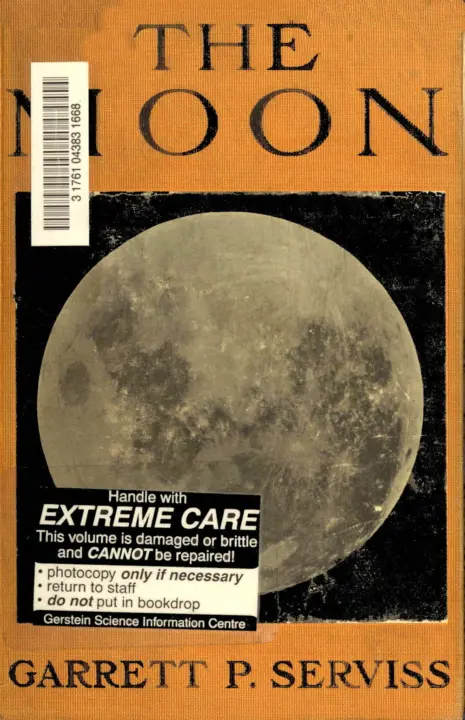
"The Moon: A Popular Treatise" by Garrett Putman Serviss is a scientific publication written in the early 20th century. This work explores our closest celestial neighbor, the Moon, utilizing a conversational format to explain its characteristics, phases, and various geological features in a way that is accessible to the general reader. The book includes a series of lunar photographs that document the Moon’s appearance over a complete lunation and aims to present essential astronomical facts without overwhelming readers with technical jargon. At the start of the treatise, the author engages in a conversation with a friend who is curious about the Moon and its mysteries. This dialogue sets the stage for a broader discussion on the Moon's origin, its physical properties (such as size and distance from Earth), and some fundamental astronomical concepts like the phases of the Moon and the phenomena of eclipses. Serviss conveys a sense of wonder and excitement about astronomical discoveries while inviting readers to visualize the Moon's beauty and complexity, establishing an informative yet engaging tone for the exploration that follows.
Introduction adapted from the source catalogue; source summaries may be automatically generated.
Free to read · English · 54,883 words · No account needed
MAKE TIME FOR A GOOD BOOK
On by default. Untick to stop anonymous reading totals. Each page counts after 10 seconds in view. How this works.
Anonymous counting is on unless you have switched it off.
The series of photographs representing the moon on successive evenings were taken with the 12-inch telescope of the Yerkes Observatory by Mr. James Wallace, who employed a color filter that he constructed specially for this telescope, which possesses a visual and not a photographic objective. The larger scale photographs, representing certain selected regions on the moon, were taken by Mr. Ritchey, now of the Carnegie Solar Observatory at Mount Wilson, California, with the great 40-inch telescope of the Yerkes Observatory. It is unnecessary to speak of the extraordinary quality of these photographs, which have been admired by astronomers in all lands.
It should, perhaps, be added that while the director of the Yerkes Observatory has shown confidence in the author by intrusting to him the use of these photographs, yet, neither Professor Frost, nor Messrs. Wallace and Ritchey are in any way responsible for the statements made in this book. The author has taken pains to be accurate, but if any errors of fact or opinion have crept in, he alone must be blamed for them.
CÔTE D’OR, FRANCE, June, 1907.
Copernicus and the Carpathian Mountains Frontispiece
PAGE No. 1, February 19, 1904; Moon’s Age 3.85 Days 50 No. 2, September 24, 1903; Moon’s Age 3.87 Days 56 No. 3, July 29, 1903; Moon’s Age 5.54 Days 66 No. 4, November 24, 1903; Moon’s Age 5.74 Days 72 No. 5, July 1, 1903; Moon’s Age 6.24 Days 74 No. 6, November 26, 1903; Moon’s Age 7.75 Days 78 No. 7, July 2, 1903; Moon’s Age 7.24 Days 90 No. 8, August 31, 1903; Moon’s Age 9.22 Days 94 No. 9, August 2, 1903; Moon’s Age 8.97 Days 102 No. 10, November 30, 1903; Moon’s Age 11.78 Days 106 No. 11, December 1, 1903; Moon’s Age 12.98 Days 112 No. 12, September 4, 1903; Moon’s Age 13.27 Days 118 No. 13, September 5, 1903; Moon’s Age 14.40 Days 122 No. 14, August 26, 1904; Moon’s Age 15.65 Days 132 No. 15, August 28, 1904; Moon’s Age 17.41 Days 134 No. 16, August 29, 1904; Moon’s Age 18.62 Days 138 No. 17, October 10, 1903; Moon’s Age 20.06 Days 142 No. 18, September 29, 1904; Moon’s Age 20.50 Days 144 No. 19, August 16, 1903; Moon’s Age 23.81 Days 150 No. 20, August 17, 1903; Moon’s Age 24.84 Days 158 No. 21, August 19, 1903; Moon’s Age 26.89 Days 168
Bullialdus and the Mare Nubium 182
Tycho, Clavius, and their Surroundings 192
The Great Southwest on the Moon 198
The Giant Ring Mountain Theophilus and its 206
Neighbors.
Two Great Lunar “Seas”—the Mare Serenitatis and 218 a Part of the Mare Imbrium
Phases and Rotation of the Moon 14
The Moon’s Path with Respect to the Sun and the 17
Earth
The Moon and the Tides 23
Effect of Moon, Varying Velocity in Orbit 58 Producing Libration in Longitude
Lunar Volcano, in Section 85
Terrestrial Volcano, in Section 85
Diagram Showing Why the Winter Moon Runs High 170
Diagram Showing Why Moon Rises Later Every Night 173
Diagram Illustrating the Harvest Moon 174
Your reading position is saved on this browser. Take it to another device with a library code. Reading pages adapt to text, rather than matching a printed edition.
Garrett Putman Serviss
Garrett Putman Serviss
Garrett Putman Serviss
Garrett Putman Serviss
BEHIND THE BOOK
This eBook is for the use of anyone anywhere in the United States and most other parts of the world at no cost and with almost no restrictions whatsoever. You may copy it, give it away or re-use it under the terms of the Project Gutenberg License included with this eBook or online at www.gutenberg.org. If you are not located in the United States, you will have to check the laws of the country where you are located before using this eBook. Read the source licence.
The original source file, including credits and licence, is retained by this library. Request an original-format copy at no charge. Please include the book title and Project Gutenberg identifier #66510.
KEEP YOUR CURIOSITY GOING

John Muir

Asa Gray
Asa Gray

Florence Nightingale
Elizabeth Robins Pennell
Denison Olmsted