THE CLASSIC COLLECTION✦An outlaw’s diary: the CommuneCLASSIC FREE BOOKS
An outlaw’s diary: the Commune
Cécile Tormay
THE CLASSIC COLLECTION · 1905
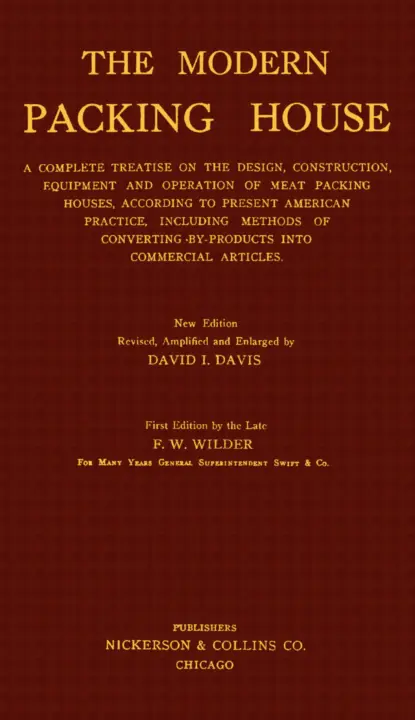
"The Modern Packing House" by David I. Davis is a scientific publication that appears to have been written in the early 20th century. This comprehensive treatise serves as a detailed guide on the design, construction, equipment, and operation of meat packing houses, specifically reflecting American practices of the time. The book emphasizes modern methods of efficiently utilizing by-products of meat processing and ensuring quality control throughout various stages of meat production. The opening of the treatise introduces the background and significance of the modern packing house industry, highlighting its rapid growth and the innovative shifts that brought it to prominence. It discusses the importance of concentration and conservation in meat processing, detailing how centralized slaughtering practices evolved from earlier methods. Moreover, the text outlines key operational components such as chilling and refrigeration, stressing their vital role in maintaining product quality and the economic benefits gained from the effective management of by-products. This sets the stage for a deeper exploration of the complexities and necessities involved in running a meat packing plant throughout the subsequent chapters.
Introduction adapted from the source catalogue; source summaries may be automatically generated.
Free to read · English · 123,820 words · No account needed
MAKE TIME FOR A GOOD BOOK
On by default. Untick to stop anonymous reading totals. Each page counts after 10 seconds in view. How this works.
Anonymous counting is on unless you have switched it off.
The above comparison shows that theory and practice approach very closely to a common line, although in the calculation the factor of specific heat of the meat is ignored, and in practice this may well be left out, as specific heat of meats at various temperatures has by no means been accurately established.
=Chilling Lard.=--The chilling of lard is a severe task on refrigerating equipment owing to the very heavy duty imposed in a short time. For example, with an eight-foot lard roll turning off 4,000 pounds per hour and changing the temperatures of the lard from 90° to 50° F. requires a very large compressor capacity per hour.
=Summary--Computations.=--Assuming the killing of 100 cattle and 250 hogs per day; making 10,000 pounds of lard, fifteen tons ice; maintaining a freezer of 100,000 cubic feet and the small work connected with the establishment:
For 100 cattle killed daily, and storage of 400 hanging, about 6,500 square feet area of cooler would be required; the height of this with the lofts would be about twenty-two feet or a capacity of 143,000 cubic feet.
For 250 hogs daily or 750 total hanging, there would be required
3,000 square feet of floor area and a height of 18 feet or 54,000 cu.
ft.
The above number of hogs daily would also require a storage or cellar capacity based upon one hundred pounds meat sent to cellar for a turn over in sixty days equal to storing 1,500,000 pounds of product, or 15,000 to 20,000 square feet of floor area, requiring 200,000 cubic feet of building space.
Ten thousand pounds lard daily in four hours running would require the extraction of about two tons of duty, but by reason of the heat transmission and the low temperature brine necessary would require twelve tons duty while applied.
Fifteen tons daily ice making capacity requires about 30 tons refrigerating duty, allowing for radiation and other losses.
A freezer capacity of 100,000 cubic feet which would store 1,500,000 pounds would not appear excessive. From known results this would require about one ton refrigerating duty for 3,000 cubic feet of space or thirty-five tons machine duty. We have then:
Tons
143,000 cubic feet beef cooler space ÷ 10,000 14.3
100 cattle daily 500 pounds = 50,000 pounds 50,000 pounds meat chilled 70° or 70 B.t.u. per pound 50,000 × 70 = 3,500,000 ÷ 288,000 B.t.u. 12.2 54,000 cubic feet hog cooler space ÷ 10,000 5.4
250 hogs 180 pounds each = 45,000 pounds 45,000 × 70 ÷ 288,000 = 10.9 200,000 feet cellar space ÷ 12,000 16.6 15 tons ice × 2 tons refrigerating duty 30.0 10,000 pounds lard cooler 12.0 100,000 cubic feet freezer space 35.0 ----- Total tonnage refrigerating effect 136.4
Your reading position is saved on this browser. Take it to another device with a library code. Reading pages adapt to text, rather than matching a printed edition.
BEHIND THE BOOK
This eBook is for the use of anyone anywhere in the United States and most other parts of the world at no cost and with almost no restrictions whatsoever. You may copy it, give it away or re-use it under the terms of the Project Gutenberg License included with this eBook or online at www.gutenberg.org. If you are not located in the United States, you will have to check the laws of the country where you are located before using this eBook. Read the source licence.
The original source file, including credits and licence, is retained by this library. Request an original-format copy at no charge. Please include the book title and Project Gutenberg identifier #73350.
KEEP YOUR CURIOSITY GOING
Cécile Tormay

Moritz Busch
John L. Ransom
Frances Wright
Cécile Tormay

Mabel Potter Daggett