THE CLASSIC COLLECTION✦An outlaw’s diary: the CommuneCLASSIC FREE BOOKS
An outlaw’s diary: the Commune
Cécile Tormay
THE CLASSIC COLLECTION · 1905
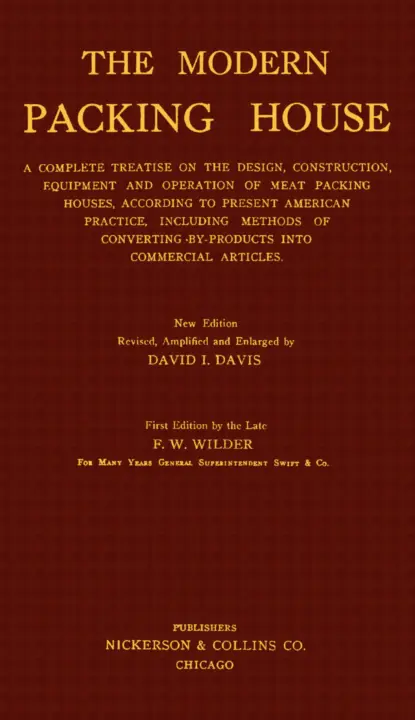
"The Modern Packing House" by David I. Davis is a scientific publication that appears to have been written in the early 20th century. This comprehensive treatise serves as a detailed guide on the design, construction, equipment, and operation of meat packing houses, specifically reflecting American practices of the time. The book emphasizes modern methods of efficiently utilizing by-products of meat processing and ensuring quality control throughout various stages of meat production. The opening of the treatise introduces the background and significance of the modern packing house industry, highlighting its rapid growth and the innovative shifts that brought it to prominence. It discusses the importance of concentration and conservation in meat processing, detailing how centralized slaughtering practices evolved from earlier methods. Moreover, the text outlines key operational components such as chilling and refrigeration, stressing their vital role in maintaining product quality and the economic benefits gained from the effective management of by-products. This sets the stage for a deeper exploration of the complexities and necessities involved in running a meat packing plant throughout the subsequent chapters.
Introduction adapted from the source catalogue; source summaries may be automatically generated.
Free to read · English · 123,820 words · No account needed
MAKE TIME FOR A GOOD BOOK
On by default. Untick to stop anonymous reading totals. Each page counts after 10 seconds in view. How this works.
Anonymous counting is on unless you have switched it off.
Heads and feet delivered on floor ready for picking up by rough
tallow gang.
Blood passing to reservoir ready for pumping or flowing to fertilizer
department.
The killing of cattle cost shall include all labor for washing premises, grinding choppers, filing saws, or mechanic in charge of machinery and equipment other than breakdowns or repairs.
(3) Rough Tallow Department.--Heads, taken from Killing Department, delivery constituting separation from the animal. Perform all labor of separating heads into various parts and delivery to the receiving department of fats, horns, meats, bones, tongues, all meat parts, washed and in proper merchantable or manufacturing condition.
Feet, the picking up of feet and deliver to bone department.
Casing, the delivery of the gut sets to the casing department upon the bench where the casings are cleaned and removed.
Fats, the collection of all fats from killing floor, casing department or where produced and the delivery to the oleo oil or tallow departments.
Paunches, etc., the opening, cleaning and disposal of paunches, reeds, tripe in all their parts.
Plucks, the collection of the heart, liver, lungs and the separation into fats, refuse or meats and the disposal of the parts.
(4) Coolers.--Include expense of chilling beef in chill rooms, spreading for chilling, receiving, chilling and caring for small meats and the labor of packing and shipping to manufacturing departments.
Includes sorting, tagging and loading in cases or on wagons or delivery
to cutting department.
(5) Casing Department.--The expense of removing casing from the entrails and the complete manufacture of rounds, middles, bungs, weasands and bladders whether salted or blown or dried. Complete manufacture includes all work up to and placing in packages and shipping.
(6) Hides.--The labor involved in taking hides from floor where dropped, inspecting, fleshing, splitting ears, washing, dipping, draining, salting and curing. The taking up, packing, loading and delivery to car, conveyance for shipment.
(7) Bone Department.--Includes all labor in manufacturing bone products such as horns, hoofs, manufacturing, bone grinding, bone and neatsfoot oils. The collecting and drying of pizzles and sinews, manufacture includes the packing and shipping of all products.
Per ton handled. Sum of weight received and weight shipped.
(8) Oleo Department.--The expense for manipulating raw fat to make oil, stearin, tierce, pack and ship. Fat is considered as delivered to oleo department when placed in chilling or washing vats. Includes cooperage work occurring in oleo department. The skimming of all catch basins connected with and a part of the oleo department.
(9) Tallow.--Labor for inspecting, products, filling tanks, cooking, pressing and all other work involved in making tallow or grease. Tallow to be tierced for shipment includes all labor for skimming catch basins and collecting the fats.
Your reading position is saved on this browser. Take it to another device with a library code. Reading pages adapt to text, rather than matching a printed edition.
BEHIND THE BOOK
This eBook is for the use of anyone anywhere in the United States and most other parts of the world at no cost and with almost no restrictions whatsoever. You may copy it, give it away or re-use it under the terms of the Project Gutenberg License included with this eBook or online at www.gutenberg.org. If you are not located in the United States, you will have to check the laws of the country where you are located before using this eBook. Read the source licence.
The original source file, including credits and licence, is retained by this library. Request an original-format copy at no charge. Please include the book title and Project Gutenberg identifier #73350.
KEEP YOUR CURIOSITY GOING
Cécile Tormay

Moritz Busch
John L. Ransom
Frances Wright
Cécile Tormay

Mabel Potter Daggett