THE CLASSIC COLLECTION✦An outlaw’s diary: the CommuneCLASSIC FREE BOOKS
An outlaw’s diary: the Commune
Cécile Tormay
THE CLASSIC COLLECTION · 1905
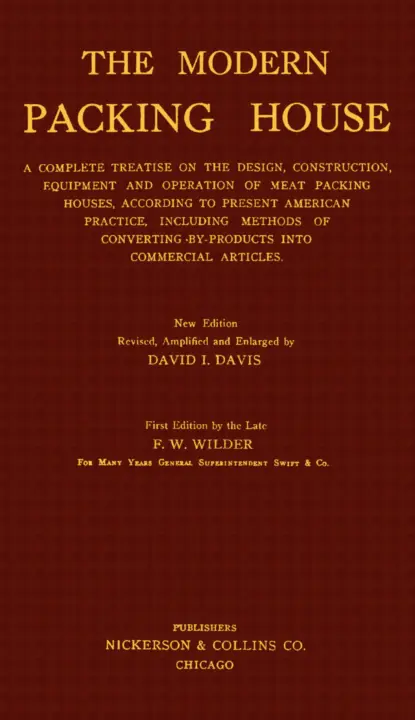
"The Modern Packing House" by David I. Davis is a scientific publication that appears to have been written in the early 20th century. This comprehensive treatise serves as a detailed guide on the design, construction, equipment, and operation of meat packing houses, specifically reflecting American practices of the time. The book emphasizes modern methods of efficiently utilizing by-products of meat processing and ensuring quality control throughout various stages of meat production. The opening of the treatise introduces the background and significance of the modern packing house industry, highlighting its rapid growth and the innovative shifts that brought it to prominence. It discusses the importance of concentration and conservation in meat processing, detailing how centralized slaughtering practices evolved from earlier methods. Moreover, the text outlines key operational components such as chilling and refrigeration, stressing their vital role in maintaining product quality and the economic benefits gained from the effective management of by-products. This sets the stage for a deeper exploration of the complexities and necessities involved in running a meat packing plant throughout the subsequent chapters.
Introduction adapted from the source catalogue; source summaries may be automatically generated.
Free to read · English · 123,820 words · No account needed
MAKE TIME FOR A GOOD BOOK
On by default. Untick to stop anonymous reading totals. Each page counts after 10 seconds in view. How this works.
Anonymous counting is on unless you have switched it off.
Six iron hoops. Head hoops 1³⁄₄ inches wide, No. 18 iron Quarter hoops 1¹⁄₂ inches wide, No. 19 iron Bilge hoops 1³⁄₄ inches wide, No. 18 iron Heads ⁷⁄₈ inch thick Staves ³⁄₄ inch thick
Staves 33³⁄₄ inches long Heads 20¹⁄₄ inches wide Bilge 79¹⁄₂ inches circumference Chime 1¹⁄₈ inches
Hoops: First wooden hoop on bilge; then one iron hoop; then five wooden hoops; then one iron hoop; then one chime hoop on each end.
Staves ³⁄₄ inch Heads ⁷⁄₈ inch
Staves 33¹⁄₂ inches long Heads 20¹⁄₄ inches wide Bilge 79¹⁄₂ inches circumference Chime 1¹⁄₈ inches
Two-thirds of the tierce to be covered with wooden hoops for prime
steam lard.
Staves ³⁄₄ inch Heads ⁷⁄₈ inch
Same specifications as six-hoop tierces, with two more hoops on, that is, one additional hoop on each end, 1¹⁄₂ inches wide. No. 19 iron used for prime steam and export refined lard, two weights for latter; on tierce weighing seventy-seven pounds, figure 17 per cent tare; on tierce weighing seventy-two pounds, figure 16 per cent tare.
Staves 30 inches long by ⁵⁄₈ inch thick Heads 17¹⁄₂ inches wide by ⁷⁄₈ inch thick Bilge 69 inches circumference Chime 1 inch
Six iron hoops, No. 18 iron. Head hoops 1¹⁄₂ inches Quarter hoops 1¹⁄₄ inches Bilge hoops 1¹⁄₂ inches
Just the same as iron-hoop pork barrels, but covered with wooden hoops--no iron hoops--in two and four series.
Same specifications as iron-bound pork barrels put up bound with both wood and iron, wood being most expensive.
Staves 22 inches by ⁷⁄₁₆ inch Head 14³⁄₄ inches wide by ¹⁄₂ inch thick Bilge 56 inches circumference
Three wooden hoops on bilge, then one-quarter hoop, then one iron collar hoop (No. 20 iron, 1 inch wide), then one wood chime hoop at each end.
Staves 36 inches long by ³⁄₄ inches thick Head 22¹⁄₄ inches wide by ⁷⁄₈ inch thick Bilge 86 inches in circumference Chime 1¹⁄₈ inches
One head; one bilge hoop of No. 18 iron, 1³⁄₄ inches wide; one quarter hoop, 1¹⁄₂ inches wide, No. 18 iron, at each end; one chime hoop 1³⁄₄ inches wide No. 18 iron; balance, wooden hoops.
Staves 30 inches long Head 18 inches wide Bilge 75 inches in diameter
Three patent wooden hoops on each end.
Staves 35 inches long Heads 23³⁄₄ inches wide Bilge 89¹⁄₂ inches Chime ³⁄₄ inch
Two patent wood hoops on each end, and two on each bilge.
Staves 31 inches by ³⁄₄ inch Heads 20¹⁄₄ inches by ⁷⁄₈ inch Bilge 79¹⁄₂ inches in circumference Chime 1¹⁄₄ inches
Two iron collar hoops (No. 18 iron, 1¹⁄₂ inches wide); twelve wooden
chime hoops.
Staves 19³⁄₄ inches long Heads 1¹⁄₄ inches wide Bilge 49 inches Chime ³⁄₄ inch
Three wooden hoops on each bilge and three on each head.
Your reading position is saved on this browser. Take it to another device with a library code. Reading pages adapt to text, rather than matching a printed edition.
BEHIND THE BOOK
This eBook is for the use of anyone anywhere in the United States and most other parts of the world at no cost and with almost no restrictions whatsoever. You may copy it, give it away or re-use it under the terms of the Project Gutenberg License included with this eBook or online at www.gutenberg.org. If you are not located in the United States, you will have to check the laws of the country where you are located before using this eBook. Read the source licence.
The original source file, including credits and licence, is retained by this library. Request an original-format copy at no charge. Please include the book title and Project Gutenberg identifier #73350.
KEEP YOUR CURIOSITY GOING
Cécile Tormay

Moritz Busch
John L. Ransom
Frances Wright
Cécile Tormay

Mabel Potter Daggett