THE CLASSIC COLLECTION✦An outlaw’s diary: the CommuneCLASSIC FREE BOOKS
An outlaw’s diary: the Commune
Cécile Tormay
THE CLASSIC COLLECTION · 1905
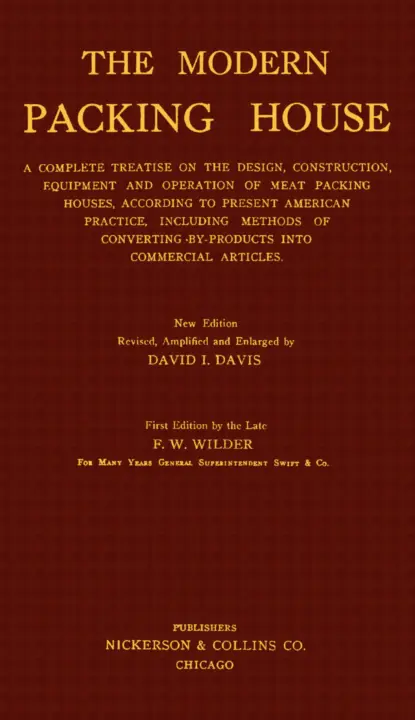
"The Modern Packing House" by David I. Davis is a scientific publication that appears to have been written in the early 20th century. This comprehensive treatise serves as a detailed guide on the design, construction, equipment, and operation of meat packing houses, specifically reflecting American practices of the time. The book emphasizes modern methods of efficiently utilizing by-products of meat processing and ensuring quality control throughout various stages of meat production. The opening of the treatise introduces the background and significance of the modern packing house industry, highlighting its rapid growth and the innovative shifts that brought it to prominence. It discusses the importance of concentration and conservation in meat processing, detailing how centralized slaughtering practices evolved from earlier methods. Moreover, the text outlines key operational components such as chilling and refrigeration, stressing their vital role in maintaining product quality and the economic benefits gained from the effective management of by-products. This sets the stage for a deeper exploration of the complexities and necessities involved in running a meat packing plant throughout the subsequent chapters.
Introduction adapted from the source catalogue; source summaries may be automatically generated.
Free to read · English · 123,820 words · No account needed
MAKE TIME FOR A GOOD BOOK
On by default. Untick to stop anonymous reading totals. Each page counts after 10 seconds in view. How this works.
Anonymous counting is on unless you have switched it off.
Wt. Per Packed lbs. cent. Twenty-three tcs. dry packed 449 lbs. each, marked weight 440 lbs. each 1,127 pcs. 10,327 Twenty-three tcs. dumped to smoke, actual weights 1,127 pcs. 10,215 ------ Pounds loss while in storage 112 Per cent loss while in storage .0128
Culls not smoked 44 pcs. 235 Actual weights to smoke 1,083 pcs. 9,980 Smoked weights 1,083 pcs. 7,099 ----- Shrinkage in smoking 2,881 Per cent shrinkage in smoking .2887
Smoked 108 hours, temperature 112° to 128° F.
Wt. Per Packed lbs. cent. Sixteen tcs. dry packed, 449 lbs. each, marked weight 440 lbs. each 497 pcs. 7,184 Sixteen tcs. dumped to smoke, actual weights 497 pcs. 7,027 ----- Pounds loss in storage 157 Per cent loss in storage .02119
Culls not smoked 8 pcs. 73 Actual weights to smoke 489 pcs. 6,954 Smoked weights 489 pcs. 5,351 ----- Shrinkage in smoking 1,603 Per cent shrinkage in smoking .2304
Smoked ninety-six hours, temperature 112° to 124° F.
Wt. Per Packed lbs. cent. Eight tcs. dry packed 408 lbs. each, marked weight 400 lbs. each 389 pcs. 3,264 Eight tcs. dumped to smoke, actual weights 389 pcs. 3,190 ----- Pounds loss in storage 74 Per cent loss in storage .0227
Culls not smoked 1 pc. 4 Actual weights to smoke 388 pcs. 3,186 Smoked weights 388 pcs. 2,388 ----- Shrinkage in smoking 798 Per cent shrinkage in smoking .2505
Smoked ninety-four hours, temperature 112° to 128° F.
=Glass Jar Beef.=--A great deal of dried beef is put up in glass jars under a vacuum, as well as in tin cans. Beef handled in this manner is cured by formulas given, but in smoking it is handled somewhat differently, being smoked less and dried more, it being necessary to have all the pickle and moisture evaporated from the meats to insure keeping.
After the meat has been handled as described it is generally put in smoke houses equipped with steam coils, the heat brought up to 110° to 120° F., and left to dry from three to four days. It then shows a shrinkage anywhere from 35 to 42 per cent. It is necessary to dry beef in this manner in order to make it keep satisfactorily when put in cans.
The following test will show the shrinkage of this product when smoked in the manner described above for canning purposes:
Wt. Packed lbs. Pct. Thirty-two tcs. beef hams, four months old, weight to smoke 1,461 pcs. 12,542 Smoked weight 1,461 pcs. 7,254 ------ Shrinkage in smoking 5,287 Per cent shrinkage in smoking 42.15 Smoked eleven hours; temperature 112 degrees F.; hanging in house to dry, seventy-two hours.
=Beef Trimmings.=--In the slaughtering of live stock in large numbers there is an accumulation of trimmings which has to be cured for the sausage room or canning department, as the case may be. The following formula will serve for the curing of beef, pork and sheep cheek meat and hearts, hanging tenderloins and other meats for sausage and canning purposes:
Your reading position is saved on this browser. Take it to another device with a library code. Reading pages adapt to text, rather than matching a printed edition.
BEHIND THE BOOK
This eBook is for the use of anyone anywhere in the United States and most other parts of the world at no cost and with almost no restrictions whatsoever. You may copy it, give it away or re-use it under the terms of the Project Gutenberg License included with this eBook or online at www.gutenberg.org. If you are not located in the United States, you will have to check the laws of the country where you are located before using this eBook. Read the source licence.
The original source file, including credits and licence, is retained by this library. Request an original-format copy at no charge. Please include the book title and Project Gutenberg identifier #73350.
KEEP YOUR CURIOSITY GOING
Cécile Tormay

Moritz Busch
John L. Ransom
Frances Wright
Cécile Tormay

Mabel Potter Daggett