THE CLASSIC COLLECTION✦An outlaw’s diary: the CommuneCLASSIC FREE BOOKS
An outlaw’s diary: the Commune
Cécile Tormay
THE CLASSIC COLLECTION · 1905
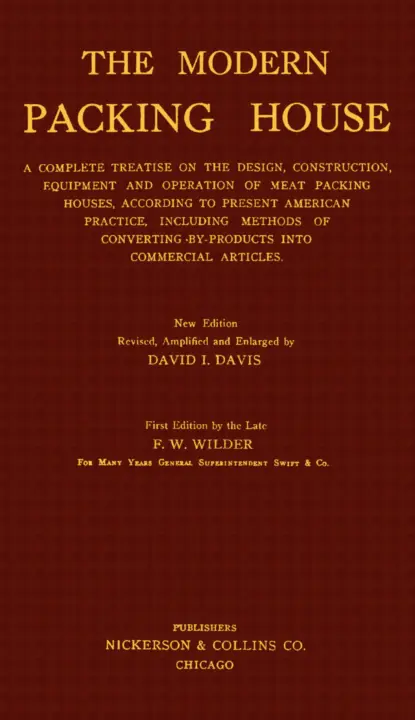
"The Modern Packing House" by David I. Davis is a scientific publication that appears to have been written in the early 20th century. This comprehensive treatise serves as a detailed guide on the design, construction, equipment, and operation of meat packing houses, specifically reflecting American practices of the time. The book emphasizes modern methods of efficiently utilizing by-products of meat processing and ensuring quality control throughout various stages of meat production. The opening of the treatise introduces the background and significance of the modern packing house industry, highlighting its rapid growth and the innovative shifts that brought it to prominence. It discusses the importance of concentration and conservation in meat processing, detailing how centralized slaughtering practices evolved from earlier methods. Moreover, the text outlines key operational components such as chilling and refrigeration, stressing their vital role in maintaining product quality and the economic benefits gained from the effective management of by-products. This sets the stage for a deeper exploration of the complexities and necessities involved in running a meat packing plant throughout the subsequent chapters.
Introduction adapted from the source catalogue; source summaries may be automatically generated.
Free to read · English · 123,820 words · No account needed
MAKE TIME FOR A GOOD BOOK
On by default. Untick to stop anonymous reading totals. Each page counts after 10 seconds in view. How this works.
Anonymous counting is on unless you have switched it off.
Stick Rolls.--Fig. 74 shows a standard twin stick roll. This equipment is made of two cast iron rolls built when new to sustain 50 lbs. pressure. The stick is deposited in a pan beneath and the revolving roll collects a film of substance which is dried as the roll revolves and is sliced from the surface of the roll by a close fitting scraper, being removed in a powdered form.
Drying with Tankage.--The practice now generally adopted is the mixing of the stick with tankage and drying in the standard fertilizer dryer, using a fifteen foot dryer with stationary shell and revolving shaft, with arms cylindrical type, usually known as the “Smith” dryer. The usual charge is 4,000 lbs. pressed tankage and 1,200 lbs. stick, agitating while the stick is being admitted so as to assist in equal mixing. The stick should be at a temperature of 190° F., or near thereto when used. The heated substance seems to produce less tailings, or small balls requiring milling.
=Value of Tankage.=--To appreciate the value of the substances to be collected in this manner, we refer to copy of test, made by an expert, on a plant handling about 5,000 cattle and 5,000 hogs per week, as follows:
=======+=======================================+=======+======= | | | Av. Tank | Product |Gallons|gallons -------+---------------------------------------+-------+------- No. 1 |Prime tallow (cutting room bones, etc.)| 1,445 | No. 1 |Prime tallow (cutting room bones, etc.)| 1,734 | 1,589 | +-------+ No. 2 |Prime tallow (bed fat, etc.) | 1,645 | No. 2 |Prime tallow (bed fat, etc.) | 1,365 | No. 3 |Prime tallow (bed fat, etc.) | 1,426 | No. 3 |Prime tallow (bed fat, etc.) | 1,827 | 1,566 | +-------+ No. 4 |No. 2 tallow (catch basin stuff) | 668 | No. 6 |Pluck tank | 905 | No. 9 |Pluck tank | 562 | No. 10 |Pluck tank | 624 | No. 10 |Pluck tank | 847 | 735 | +-------+ No. 11 |Prime steam lard | 1,382 | No. 11 |Prime steam lard | 1,248 | 1,315 | +-------+ -------+---------------------------------------+-------+-------
No.
Product. Tanks
Prime tallow with cutting room bones 6
Prime tallow with bed fat, etc. 10
No. 2 tallow 6
Pluck tanks 13
Prime steam lard 6
--
Total 41
======+========+========+========+======+========+======= | Average| Total | Solids |Total | | Units No. of|contents|contents|per gal.|solids|Per cent| of Tanks| gals. | gals. | lbs. | lbs. |Ammonia |Ammonia ------+--------+--------+--------+------+--------+------- 6 | 1,589 | 9,534 | 0.88 | 8,390| 16.76 | 1,406 10 | 1,566 | 15,660 | 1.03 |16,130| 16.89 | 2,724 6 | 668 | 4,008 | .399 | 1,599| 14.59 | 233 13 | 735 | 9,555 | .763 | 7,290| 16.85 | 1,228 6 | 1,315 | 7,890 | .0481 | 380| 16.00 | 61 ------+--------+--------+--------+------+--------+------- | ... | 46,647 | ... |33,789| 16.73 | 5,652 ------+--------+--------+--------+------+--------+-------
Total units of ammonia per tank, 5,652. Average units of ammonia per tank, 16.73. 8 per cent of moisture, dry basis.
This production at $1.66 per unit would be worth $27.77 per ton, or the yearly production would bring $24,396.32.
Your reading position is saved on this browser. Take it to another device with a library code. Reading pages adapt to text, rather than matching a printed edition.
BEHIND THE BOOK
This eBook is for the use of anyone anywhere in the United States and most other parts of the world at no cost and with almost no restrictions whatsoever. You may copy it, give it away or re-use it under the terms of the Project Gutenberg License included with this eBook or online at www.gutenberg.org. If you are not located in the United States, you will have to check the laws of the country where you are located before using this eBook. Read the source licence.
The original source file, including credits and licence, is retained by this library. Request an original-format copy at no charge. Please include the book title and Project Gutenberg identifier #73350.
KEEP YOUR CURIOSITY GOING
Cécile Tormay

Moritz Busch
John L. Ransom
Frances Wright
Cécile Tormay

Mabel Potter Daggett