The White Wampum
E. Pauline Johnson
THE CLASSIC COLLECTION · 1913
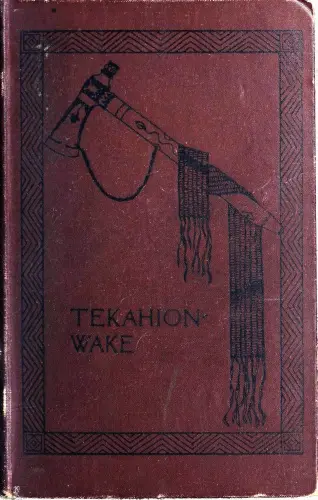
"The Moccasin Maker" by E. Pauline Johnson is a collection of prose works published in the early 20th century. It highlights the experiences and reflections of the author, who was of Mohawk descent, and explores themes of identity, heritage, and the intersection of Indigenous and settler cultures in Canada. The main narrative follows the life of Lydia Bestman, an English girl who navigates a challenging upbringing and ultimately marries George Mansion, a Mohawk Indian chief, as they embrace both their cultures. At the start of the collection, the introductory remarks set the stage for Johnson’s exploration of her mother’s life experiences, filled with both hardship and resilience. The opening chapter depicts young Lydia’s poignant feelings as she departs from England, leaving behind her early home and family dynamics shaped by severity. This backstory lays the groundwork for her journey into the New World, where she encounters George, whose character exemplifies a blend of Indigenous nobility and the struggles against colonial challenges. As the narrative unfolds, readers are introduced to the relationships and dynamics that define Lydia’s life as she reconciles her English heritage with her deepening connection to Indigenous identity through marriage and motherhood.
Introduction adapted from the source catalogue; source summaries may be automatically generated.
Free to read · English · 54,278 words · No account needed
MAKE TIME FOR A GOOD BOOK
On by default. Untick to stop anonymous reading totals. Each page counts after 10 seconds in view. How this works.
Anonymous counting is on unless you have switched it off.
Soon afterwards the steamer touched an obscure little harbor, and Maarda, who was to join her husband there, left me, with a happy good-night. As she was going below, she faltered, and turned back to me. "I think sometimes," she said, quietly, "the Great Spirit thought my baby would feel motherless in the far Spirit Islands, so He gave her the woman I nursed for a mother; and He knew I was childless, and He gave me this child for my daughter. Do you think I am right? Do you understand?"
"Yes," I said, "I think you are right, and I understand."
Once more she smiled radiantly, and turning, descended the companionway. I caught a last glimpse of her on the wharf. She was greeting her husband, her face a mirror of happiness. About the delicately-woven basket cradle she had half pulled her heavy plaid shawl, beneath which the two rows of black velvet ribbon bordering her skirt proclaimed once more her nationality.
The Derelict
Cragstone had committed what his world called a crime--an inexcusable offence that caused him to be shunned by society and estranged from his father's house. He had proved a failure.
Not one of his whole family connections could say unto the others, "I told you so," when he turned out badly.
They had all predicted that he was born for great things, then to discover that they had over-estimated him was irritating, it told against their discernment, it was unflattering, and they thought him inconsiderate.
So, in addition to his failure, Cragstone had to face the fact that he had made himself unpopular among his kin.
As a boy he had been the pride of his family, as a youth, its hope of fame and fortune; he was clever, handsome, inventive, original, everything that society and his kind admired, but he criminally fooled them and their expectation, and they never forgave him for it.
He had dabbled in music, literature, law, everything--always with semi-success and brilliant promise; he had even tried the stage, playing the Provinces for an entire season; then, ultimately sinking into mediocrity in all these occupations, he returned to London, a hopelessly useless, a pitiably gifted man. His chilly little aristocratic mother always spoke of him as "poor, dear Charles." His brothers, clubmen all, graciously alluded to him with, "deuced hard luck, poor Charlie." His father never mentioned his name.
Then he went into "The Church," sailed for Canada, idled about for a few weeks, when one of the great colonial bishops, not knowing what else to do with him, packed him off north as a missionary to the Indians.
Your reading position is saved on this browser. Take it to another device with a library code. Reading pages adapt to text, rather than matching a printed edition.
E. Pauline Johnson
E. Pauline Johnson
E. Pauline Johnson
E. Pauline Johnson
BEHIND THE BOOK
This eBook is for the use of anyone anywhere in the United States and most other parts of the world at no cost and with almost no restrictions whatsoever. You may copy it, give it away or re-use it under the terms of the Project Gutenberg License included with this eBook or online at www.gutenberg.org. If you are not located in the United States, you will have to check the laws of the country where you are located before using this eBook. Read the source licence.
The original source file, including credits and licence, is retained by this library. Request an original-format copy at no charge. Please include the book title and Project Gutenberg identifier #6600.
KEEP YOUR CURIOSITY GOING
Coulson Kernahan

Maurice Baring
Frances Wright
Cécile Tormay

Frederic Jesup Stimson

W. H. P. (William Henry Pope) Jarvis