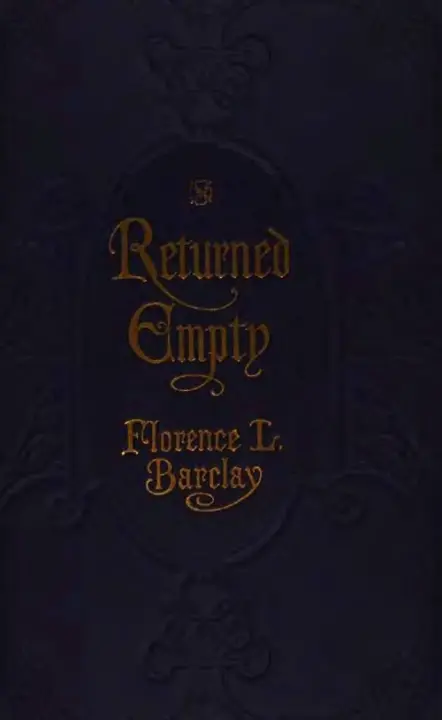
Returned Empty
Florence L. (Florence Louisa) Barclay
THE CLASSIC COLLECTION · 1910
"The Mistress of Shenstone" by Florence L. Barclay is a novel written in the early 20th century. The story revolves around Lady Myra Ingleby, an introspective woman grappling with themes of love, loss, and self-discovery, especially in the wake of her husband's absence due to war. The novel presents a rich exploration of her emotional landscape, illustrating her connection to her beloved toy-poodle, Peter, and the anxieties of her solitary life at the opulent yet desolate Shenstone Park. At the start of the narrative, we find Lady Ingleby walking solemnly along the terrace of her home, reflecting on the arrival of winter and the emotional toll of her husband's absence in battle. Accompanied by Peter, her anxious dog, she receives a telegram from a doctor signaling a visit, which brings her a fleeting sense of joy amidst her loneliness. The opening chapters set the stage for Lady Ingleby’s struggles, revealing her character through her interactions with Peter and the doctor, as well as her introspection about her husband's well-being. As the narrative unfolds, it hints at deeper themes of love and the impacts of war, suggesting a story rich in both emotional depth and the complexities of human relationships.
Introduction adapted from the source catalogue; source summaries may be automatically generated.
Free to read · English · 56,522 words · No account needed
MAKE TIME FOR A GOOD BOOK
On by default. Untick to stop anonymous reading totals. Each page counts after 10 seconds in view. How this works.
Anonymous counting is on unless you have switched it off.
"It must have been Walker," she said. "Michael always considered him a scamp and shifty; but I delighted in him, because he played the banjo quite excellently, and was so useful at parish entertainments. Michael took him abroad; but had to dismiss him on landing. He wrote and told me the fact, but gave no reasons. Poor Walker! I do not wish him punished, because I know Michael would think it was largely my own fault for putting banjo-playing before character. If Walker had written me a begging letter, I should most likely have sent him the money. I have a fatal habit of believing in people, and of wanting everybody to be happy."
Then, as if these last words recalled a momentarily forgotten wound, the stony apathy returned to voice and face.
"If Michael is not coming back," said Lady Ingleby, "I am indeed alone."
The doctor rose, and stood looking down upon her, perplexed and
sorrowful.
"Is there not some one who should be told immediately of this change of affairs, Lady Ingleby?" he asked, gravely.
"No one," she replied, emphatically. "There is nobody whom it concerns intimately, excepting myself. And not many know of the arrival of yesterday's news. I wrote to Jane, and I suppose the boys told it at Overdene. If by any chance it gets into the papers, we must send a contradiction; but no explanation, please. I dislike the publication of wrong doing. It only leads to imitation and repetition. Beside, even a poor worm of a valet should be shielded if possible from public execration. We could not explain the extenuating circumstances."
"I do not suppose the news has become widely known," said the doctor. "Your household heard it, of course?"
"Yes," replied Lady Ingleby. "Ah, that reminds me, I must stop operations in the shrubbery and plantation. There is no object in little Peter having a grave, when his master has none."
This was absolutely unintelligible to the doctor; but at such times he never asked unnecessary questions, for his own enlightenment.
"So after all, Sir Deryck," added Lady Ingleby, "Peter was right."
"Yes," said the doctor, "little Peter was not mistaken."
"Had I remembered him, I might have doubted the telegram," remarked Lady Ingleby. "What can have aroused Billy's suspicions?"
"Like Peter," said the doctor, "Billy had, from the first, felt very sure. Do not mention to him that I told you the doubts originated with him. He is a sensitive lad, and the whole thing has greatly distressed him."
"Dear Billy," said Lady Ingleby.
The doctor glanced at the clock, and buttoned his coat. He had one minute
to spare.
Your reading position is saved on this browser. Take it to another device with a library code. Reading pages adapt to text, rather than matching a printed edition.
Florence L. (Florence Louisa) Barclay
Florence L. (Florence Louisa) Barclay
Florence L. (Florence Louisa) Barclay
Florence L. (Florence Louisa) Barclay
BEHIND THE BOOK
This eBook is for the use of anyone anywhere in the United States and most other parts of the world at no cost and with almost no restrictions whatsoever. You may copy it, give it away or re-use it under the terms of the Project Gutenberg License included with this eBook or online at www.gutenberg.org. If you are not located in the United States, you will have to check the laws of the country where you are located before using this eBook. Read the source licence.
The original source file, including credits and licence, is retained by this library. Request an original-format copy at no charge. Please include the book title and Project Gutenberg identifier #26235.
KEEP YOUR CURIOSITY GOING
Coulson Kernahan

Maurice Baring
Frances Wright
Cécile Tormay

Frederic Jesup Stimson

W. H. P. (William Henry Pope) Jarvis