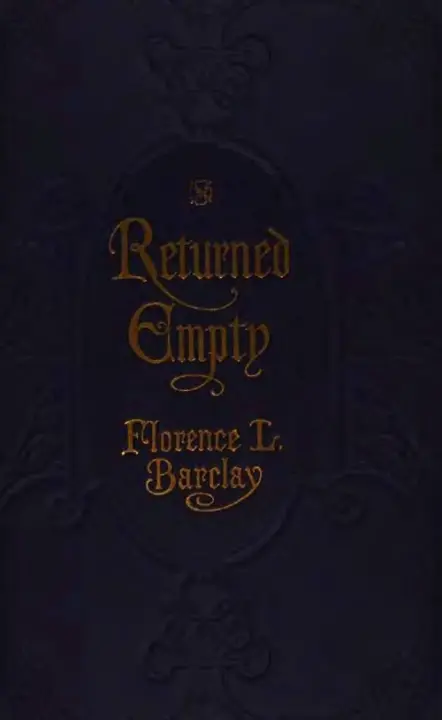
Returned Empty
Florence L. (Florence Louisa) Barclay
THE CLASSIC COLLECTION · 1910
"The Mistress of Shenstone" by Florence L. Barclay is a novel written in the early 20th century. The story revolves around Lady Myra Ingleby, an introspective woman grappling with themes of love, loss, and self-discovery, especially in the wake of her husband's absence due to war. The novel presents a rich exploration of her emotional landscape, illustrating her connection to her beloved toy-poodle, Peter, and the anxieties of her solitary life at the opulent yet desolate Shenstone Park. At the start of the narrative, we find Lady Ingleby walking solemnly along the terrace of her home, reflecting on the arrival of winter and the emotional toll of her husband's absence in battle. Accompanied by Peter, her anxious dog, she receives a telegram from a doctor signaling a visit, which brings her a fleeting sense of joy amidst her loneliness. The opening chapters set the stage for Lady Ingleby’s struggles, revealing her character through her interactions with Peter and the doctor, as well as her introspection about her husband's well-being. As the narrative unfolds, it hints at deeper themes of love and the impacts of war, suggesting a story rich in both emotional depth and the complexities of human relationships.
Introduction adapted from the source catalogue; source summaries may be automatically generated.
Free to read · English · 56,522 words · No account needed
MAKE TIME FOR A GOOD BOOK
On by default. Untick to stop anonymous reading totals. Each page counts after 10 seconds in view. How this works.
Anonymous counting is on unless you have switched it off.
"Scarlet, you mean," amended Billy. "So have I, old chap; but that's another pair o' boots, as you very well know."
"Oh, don't be vulgar," sighed Ronnie, wearily. "Let's cut the whole thing and go to town. Henley begins to-morrow."
But next day they turned up at Shenstone, earlier than usual.
And that morning, Lady Ingleby was feeling strangely restful and at peace; not with any expectations of future happiness; but resigned to the inevitable; and less apart from Jim Airth. She had fallen asleep the night before beset by haunting memories of Cornwall and of their climb up the cliff. At midnight she had awakened with a start, fancying herself on the ledge, and feeling that she was falling. But instantly Jim Airth's arms seemed to enfold her; she felt herself drawn into safety; then that exquisite sense of strength and rest was hers once more.
So vivid had been the dream, that its effect remained with her when she rose. Thus she sat watching the tennis with a little smile of content on her sweet face.
"She is beginning to forget," thought Ronnie, exultant. "My 'vantage!" he shouted significantly to Billy, over the net.
"Deuce!" responded Billy, smashing down the ball with unnecessary
violence.
"No!" cried Ronnie. "Outside, my boy! Game and a 'love' set to me!"
"Stay to lunch, boys," said Lady Ingleby, as the gong sounded; and they all three went gaily into the house.
As they passed through the hall afterwards, their motor stood at the door; so they bade her good-bye, and turned to find their rackets.
At that moment they heard the sharp ting of a bicycle bell. A boy had ridden up with a telegram. Groatley, waiting to see them off, took it; picked up a silver salver from the hall table, and followed Lady Ingleby to her sitting-room.
There seemed so sudden a silence in the house, that Ronald and Billy with one accord stood listening.
"Twenty minutes to two," said Billy, glancing at the clock. "Spirits are
walking."
The next moment a cry rang out from Lady Ingleby's sitting-room--a cry of such mingled bewilderment, wonder, and relief, that they looked at one another in amazement. Then without waiting to question or consider, they hastened to her.
Lady Ingleby was standing in the middle of the room, an open telegram in
her hand.
"Jim," she was saying; "Oh, Jim!"
Her face was so transfigured by thankfulness and joy, that neither Ronald nor Billy could frame a question. They merely gazed at her.
Your reading position is saved on this browser. Take it to another device with a library code. Reading pages adapt to text, rather than matching a printed edition.
Florence L. (Florence Louisa) Barclay
Florence L. (Florence Louisa) Barclay
Florence L. (Florence Louisa) Barclay
Florence L. (Florence Louisa) Barclay
BEHIND THE BOOK
This eBook is for the use of anyone anywhere in the United States and most other parts of the world at no cost and with almost no restrictions whatsoever. You may copy it, give it away or re-use it under the terms of the Project Gutenberg License included with this eBook or online at www.gutenberg.org. If you are not located in the United States, you will have to check the laws of the country where you are located before using this eBook. Read the source licence.
The original source file, including credits and licence, is retained by this library. Request an original-format copy at no charge. Please include the book title and Project Gutenberg identifier #26235.
KEEP YOUR CURIOSITY GOING
Coulson Kernahan

Maurice Baring
Frances Wright
Cécile Tormay

Frederic Jesup Stimson

W. H. P. (William Henry Pope) Jarvis