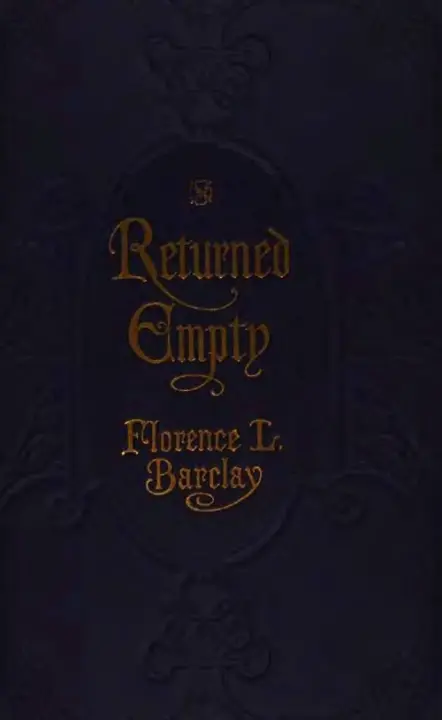
Returned Empty
Florence L. (Florence Louisa) Barclay
THE CLASSIC COLLECTION · 1910
"The Mistress of Shenstone" by Florence L. Barclay is a novel written in the early 20th century. The story revolves around Lady Myra Ingleby, an introspective woman grappling with themes of love, loss, and self-discovery, especially in the wake of her husband's absence due to war. The novel presents a rich exploration of her emotional landscape, illustrating her connection to her beloved toy-poodle, Peter, and the anxieties of her solitary life at the opulent yet desolate Shenstone Park. At the start of the narrative, we find Lady Ingleby walking solemnly along the terrace of her home, reflecting on the arrival of winter and the emotional toll of her husband's absence in battle. Accompanied by Peter, her anxious dog, she receives a telegram from a doctor signaling a visit, which brings her a fleeting sense of joy amidst her loneliness. The opening chapters set the stage for Lady Ingleby’s struggles, revealing her character through her interactions with Peter and the doctor, as well as her introspection about her husband's well-being. As the narrative unfolds, it hints at deeper themes of love and the impacts of war, suggesting a story rich in both emotional depth and the complexities of human relationships.
Introduction adapted from the source catalogue; source summaries may be automatically generated.
Free to read · English · 56,522 words · No account needed
MAKE TIME FOR A GOOD BOOK
On by default. Untick to stop anonymous reading totals. Each page counts after 10 seconds in view. How this works.
Anonymous counting is on unless you have switched it off.
Jim Airth looked up, a gleam of hope in his sad eyes.
Then he looked away, that her appealing loveliness might not too much tempt him, while making his decision. He lifted his eyes; and, alas! they fell on the portrait over the mantelpiece.
He shivered.
"I can never marry Lord Ingleby's widow," he said. "Myra, how can you wish it? The thing would haunt us! It would be evil--unnatural. Night and day, it would be there. It would come between us. Some day you would reproach me----"
"Ah, hush!" cried Myra, sharply. "Not that! I am suffering enough. At least spare me that!" Then, putting aside once more her own pain: "Would it not be happiness to you, Jim?" she asked, with wistful gentleness.
"Happiness?" cried Jim Airth, violently, "It would be hell!"
Lady Ingleby rose, her face as white as the large arum lily in the corner
behind her.
"Then that settles it," she said; "and, do you know, I think we had better not speak of it any more. I am going to ring for tea. And, if you will excuse me for a few moments, while they are bringing it, I will search among my husband's papers, and try to find those you require for your book."
She passed swiftly out. Through the closed door, the man she left alone heard her giving quiet orders in the hall.
He crossed the room, in two great strides, to follow her. But at the door he paused; turned, and came slowly back.
He stood on the hearthrug, with bent head; rigid, motionless.
Suddenly he lifted his eyes to Lord Ingleby's portrait.
"Curse you!" he said through clenched teeth, and beat his fists upon the marble mantelpiece. "Curse your explosives! And curse your inventions! And curse you for taking her first!" Then he dropped into a chair, and buried his face in his hands. "Oh, God forgive me!" he whispered, brokenly. "But there is a limit to what a man can bear."
He scarcely noticed the entrance of the footman who brought tea. But when a lighter step paused at the door, he lifted a haggard face, expecting to see Myra.
A quiet woman entered, simply dressed in black merino. Her white linen collar and cuffs gave her the look of a hospital nurse. Her dark hair, neatly parted, was smoothly coiled around her head. She came in, deferentially; yet with a quiet dignity of manner.
"I have come to pour your tea, my lord," she said. "Lady Ingleby is not well, and fears she must remain in her room. She asks me to give you these papers."
Your reading position is saved on this browser. Take it to another device with a library code. Reading pages adapt to text, rather than matching a printed edition.
Florence L. (Florence Louisa) Barclay
Florence L. (Florence Louisa) Barclay
Florence L. (Florence Louisa) Barclay
Florence L. (Florence Louisa) Barclay
BEHIND THE BOOK
This eBook is for the use of anyone anywhere in the United States and most other parts of the world at no cost and with almost no restrictions whatsoever. You may copy it, give it away or re-use it under the terms of the Project Gutenberg License included with this eBook or online at www.gutenberg.org. If you are not located in the United States, you will have to check the laws of the country where you are located before using this eBook. Read the source licence.
The original source file, including credits and licence, is retained by this library. Request an original-format copy at no charge. Please include the book title and Project Gutenberg identifier #26235.
KEEP YOUR CURIOSITY GOING
Coulson Kernahan

Maurice Baring
Frances Wright
Cécile Tormay

Frederic Jesup Stimson

W. H. P. (William Henry Pope) Jarvis