THE CLASSIC COLLECTION✦The eyes of Max CarradosCLASSIC FREE BOOKS
The eyes of Max Carrados
Ernest Bramah
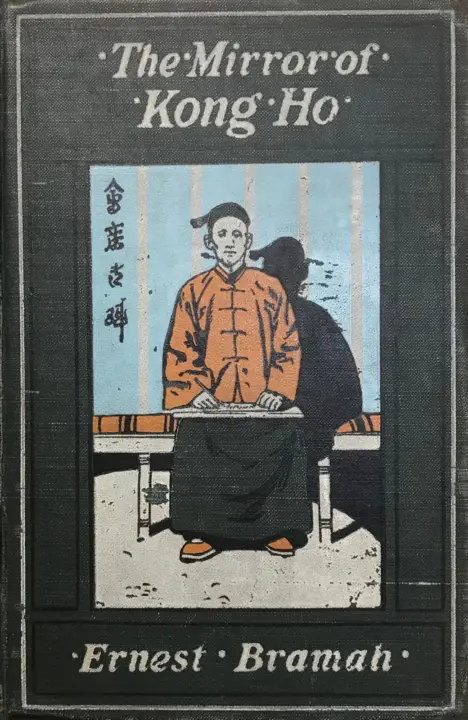
THE CLASSIC COLLECTION · 1905
"The Mirror of Kong Ho" by Ernest Bramah is a novel composed of a lively series of letters written during the early 20th century, depicting the observations of a Chinese gentleman named Kong Ho as he navigates Western life in London. The book presents a humorous and critical exploration of Western culture and customs through the eyes of its protagonist, who views Westerners as "barbarians" and finds much to ponder regarding their lifestyle choices. At the start of the novel, we are introduced to Kong Ho as he embarks on his journey to London. The first letter chronicles his travels and encounters, marked by his attempts to understand peculiar Western inventions like automobiles and the social dynamics he observes around him. He reflects on the chaotic nature of Western transportation, humorously interpreting it as being influenced by "unlawful demons," while also expressing his disdain for the perceived lack of proper dining etiquette among Westerners. His observations are filled with wit, as he recounts his experiences in tea shops, interacts with merchants like Jones Bob-Jones, and navigates the complexities of social interactions with the local populace, including his budding fascination with a particular maiden. This opening portion sets the tone for a thoughtful, satirical critique of cultural differences and highlights Kong Ho's duality as both an amused outsider and a keen observer of human behavior.
Introduction adapted from the source catalogue; source summaries may be automatically generated.
Free to read · English · 50,683 words · No account needed
MAKE TIME FOR A GOOD BOOK
On by default. Untick to stop anonymous reading totals. Each page counts after 10 seconds in view. How this works.
Anonymous counting is on unless you have switched it off.
Behind lay the pagoda (though the fact that this one did admittedly turn round for a period need not be too critically dwelt upon), with three tiers of maidens, some already waving their hands as an encouraging token; on each side a barrier of prickly growth inopportunely presented itself, while in front the eleven kicking crickets stood waiting, and among them lurked the one grasping a doubly-edged blade of a highly proficient keenness.
There are occasional moments in the life of a person when he has the inward perception of retiring for a few paces and looking back in order to consider his general appearance and to judge how he is situated with regard to himself, to review his past life in a spirit of judicial severity, to arrange definitely upon a future composed entirely of acts of benevolence, and to examine the working of destiny at large. In such a scrutiny I now began to understand that it would perhaps have been more harmonious to my love of contemplative repose if I had considered the disadvantages closer before venturing into this barbarian region, or, at least, if I had used the occasion profitably to advance an argument tending towards a somewhat fuller allowance of taels from your benevolent sleeve. Our own virtuous and flower-strewn land, it is true, does not possess an immunity from every trifling drawback. The Hoang Ho--to concede specifically the existence of some of these--frequently bursts through its restraining barriers and indiscriminately sweeps away all those who are so ill-advised as to dwell within reach of its malignant influence. From time to time wars and insurrections are found to be necessary, and no matter how morally-intentioned and humanely conducted, they necessarily result in the violation, dismemberment or extirpation of many thousand polite and dispassionate persons who have no concern with either side. Towns are repeatedly consumed by fire, districts scourged by leprosy, and provinces swept by famine. The storms are admittedly more fatal than elsewhere, the thunderbolts larger, more numerous, and all unerringly directed, while the extremities of heat and cold render life really uncongenial for the greater part of each year. The poor, having no money to secure justice, are evilly used, whereas the wealthy, having too much, are assailed legally by the gross and powerful for the purpose of extorting their riches. Robbers and assassins lurk in every cave; vast hoards of pirates blacken the surface of every river; and mandarins of the nine degrees must make a livelihood by some means or other. By day, therefore, it is inadvisable to go forth and encounter human beings, while none but the shallow-headed would risk a meeting with the countless demons and vampires which move by night. To one who has spent many moons among these foreign apparitions the absence of drains, roads, illustrated message-parchments, maidens whose voices may be heard protesting upon ringing a wire, loaves of conflicting dimensions, persons who strive to put their faces upon every advertisement, pens which emit fountains when carried in the pocket, a profusion of make-strong foods, and an Encyclopaedia Mongolia, may undoubtedly be mentioned as constituting a material deficiency. Affairs are not being altogether reputably conducted during the crisis; it can never be quite definitely asserted what the next action of the versatile and high-spirited Dowager Empress will be; and here it is freely contended that the Pure and Immortal Empire is incapable of remaining in one piece for much longer. These, and other inconveniences of a like nature, which the fastidious might distort into actual hardships, have never been denied, yet at no period of the nine thousand years of our civilisation has it been the custom to lure out the unwary, on the plea of an agreeable entertainment, and then to abandon him into the society of eleven club-bearing adversaries, one of whom may be depicted as in the act of imparting an unnecessary polish to the edge of his already preternaturally acute weapon, while those of his own band offer no protection, and three tiers of very richly-dressed maidens encourage him to his fate by refined gestures of approval.
Your reading position is saved on this browser. Take it to another device with a library code. Reading pages adapt to text, rather than matching a printed edition.
BEHIND THE BOOK
This eBook is for the use of anyone anywhere in the United States and most other parts of the world at no cost and with almost no restrictions whatsoever. You may copy it, give it away or re-use it under the terms of the Project Gutenberg License included with this eBook or online at www.gutenberg.org. If you are not located in the United States, you will have to check the laws of the country where you are located before using this eBook. Read the source licence.
The original source file, including credits and licence, is retained by this library. Request an original-format copy at no charge. Please include the book title and Project Gutenberg identifier #1077.
KEEP YOUR CURIOSITY GOING
Coulson Kernahan

Maurice Baring
Frances Wright
Cécile Tormay
Francis Greenleaf Allinson & Anne C. E. (Anne Crosby Emery) Allinson

Frederic Jesup Stimson