
Last letters from the living dead man
David Patterson (Spirit) Hatch
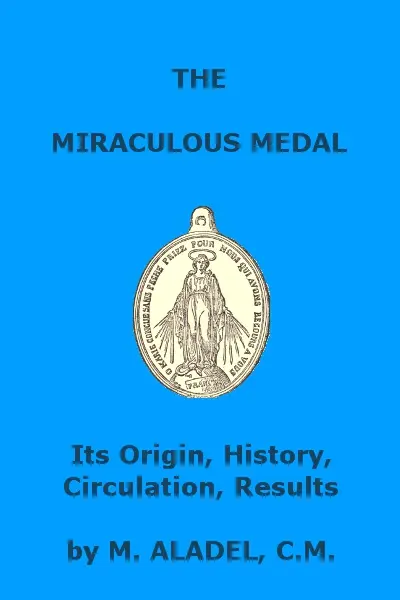
THE CLASSIC COLLECTION · 1880
"The Miraculous Medal: Its Origin, History, Circulation, Results" by Aladel is a historical account written in the late 19th century. The book explores the life of Sister Catherine Labouré, a Daughter of Charity who was favored with visions of the Blessed Virgin Mary, leading to the creation and dissemination of the Miraculous Medal. The text delves into the origins and significance of the medal, highlighting its miraculous effects and the deepening devotion to Mary it inspired among Catholics. At the start of the book, readers are introduced to Sister Catherine's early life and her spiritual journey. The narrative recounts her humble beginnings in rural France, her deep faith, and her unyielding desire to serve God, culminating in her admission into the Daughters of Charity. After a series of divine communications, Sister Catherine receives instructions from the Blessed Virgin to have a medal struck, which becomes a symbol of great hope and grace for many. The opening sets the stage for a story of miraculous events and the profound effect of Mary's intercession on the lives of the faithful, establishing a context for the events that unfold.
Introduction adapted from the source catalogue; source summaries may be automatically generated.
Free to read · English · 93,354 words · No account needed
MAKE TIME FOR A GOOD BOOK
On by default. Untick to stop anonymous reading totals. Each page counts after 10 seconds in view. How this works.
Anonymous counting is on unless you have switched it off.
"A serious fire had broken out in the city of Salonica. The flames soon appeared opposite the Sisters' house, the buildings on the other side of the street, a few yards distant, being seized and devoured by the fire, which the wind continued to fan into activity. Already the Sisters' roof and that of the adjoining house were covered with dense smoke. I cast therein several Miraculous Medals. There was no prospect of human succor, as the rumor of there being powder in the vicinity had caused every one to seek safety in flight. I also retired, deeming it useless to expose myself longer; and besides, I was obliged to go to the assistance of a poor man, who, partially intoxicated, persisted in remaining near the fire. I returned shortly after, expecting to see our houses in flames; I doubted not but they would be wholly consumed. As I approached, a young man stopped me on the way, and said: 'Your property is saved, sir; the Sisters' house is not even in danger.' Only on reaching the scene could I be convinced that he had spoken truly. It would be impossible to express my emotion at the sight. I sent to inform our dear Sisters of the fact and they could scarcely credit this marvellous preservation. It suffices to add, that all Salonica is unanimous in pronouncing it a miracle."[32]
[Footnote 32: Letter of Mr. Turroque, July 16, 1856.]
"In an ambulance crowded with Russians was a young Pole, severely wounded and suffering intolerable pain; he earnestly invoked the sweet and merciful Virgin Mary. By his side lay a Russian Protestant, wounded also, and attacked by violent dysentery. So offensive was the odor from his disease, that both patients and nurses complained. He appeared utterly indifferent to everything concerning religion. He took no notice of the Sister as she passed and repassed; he never even deigned to look at her. The young Pole, on the contrary, called her frequently, and gratefully received her care and consolations. One evening our young Catholic was suffering more than usual; the pain drew tears from his eyes; his groans and cries were incessant. He called the Sister and begged her to help him, saying his patience was exhausted; he was in despair; his sufferings were excruciating. The Polish Sister, consoling and encouraging him, bade him have confidence, and gave him a medal to apply to the wounded limb. The young man followed her suggestion; and laying his hand on the medal to keep it in place, he soon fell asleep. Our Protestant appeared unconscious of what was going on, yet he had seen and examined all. Some days after, he called our Polish Sister to him, (she was the only one who could understand him) and said: 'Sister, please give me what you gave this young man that did him so much good, for I suffer greatly!' 'My friend, she replied, I desire nothing better than to relieve you also; but you lack what effected his cure, faith and confidence. You Protestants deny the power of the Blessed Virgin; you do not acknowledge her as your Queen, your Advocate, your Mother. So what can I do? It was a medal of Mary that so speedily relieved your neighbor, the young Pole.' 'Give me one also, Sister,' he answered; 'I believe all that you tell me; you do good to every one, why should you deceive me?' 'But,' said the Sister, 'have you confidence in Mary, the Mother of God? Do you believe in her mercy and her power?' 'I believe all that you believe, Sister, since Mary hears the prayers of the unfortunate, and brings relief to the suffering, she cannot deceive us!' The Sister, much consoled at hearing these words, gave him a medal, and our admirable talisman effected in his soul most gratifying results. He asked to receive instruction from a priest, and after some days employed in studying the holy doctrines of the Church, and in assiduous prayer to Mary he abjured his errors. As he had been separated from the other patients, on account of the unpleasant odor we have mentioned, he was at full liberty to act as he wished. After his baptism, and the reception of the holy Eucharist, being unable to restrain his transports, he exclaimed: 'Oh! how happy I am! My heart has never known such joy! I am content to die, and I do not regret having been struck on the battlefield! To my wound do I owe my salvation. Oh! how we poor Protestants are deceived! By what lies are we led astray! How good God is to rescue me from error! May the sweet and holy Virgin be known and loved always and everywhere!' And in these beautiful dispositions, he expired."[33]
Your reading position is saved on this browser. Take it to another device with a library code. Reading pages adapt to text, rather than matching a printed edition.
BEHIND THE BOOK
This eBook is for the use of anyone anywhere in the United States and most other parts of the world at no cost and with almost no restrictions whatsoever. You may copy it, give it away or re-use it under the terms of the Project Gutenberg License included with this eBook or online at www.gutenberg.org. If you are not located in the United States, you will have to check the laws of the country where you are located before using this eBook. Read the source licence.
The original source file, including credits and licence, is retained by this library. Request an original-format copy at no charge. Please include the book title and Project Gutenberg identifier #44231.
KEEP YOUR CURIOSITY GOING
David Patterson (Spirit) Hatch

David Patterson (Spirit) Hatch

David Patterson (Spirit) Hatch
Cécile Tormay

Moritz Busch
John L. Ransom