
Last letters from the living dead man
David Patterson (Spirit) Hatch
THE CLASSIC COLLECTION · 1880
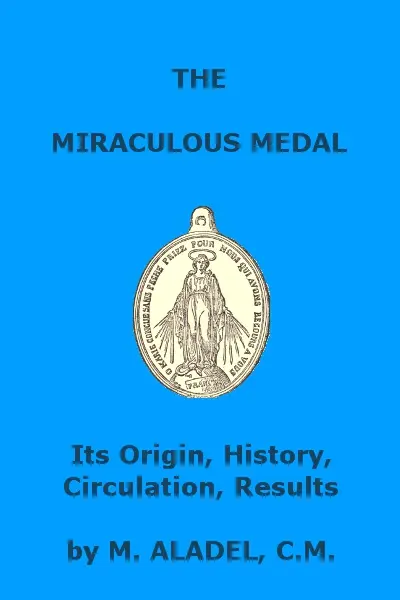
"The Miraculous Medal: Its Origin, History, Circulation, Results" by Aladel is a historical account written in the late 19th century. The book explores the life of Sister Catherine Labouré, a Daughter of Charity who was favored with visions of the Blessed Virgin Mary, leading to the creation and dissemination of the Miraculous Medal. The text delves into the origins and significance of the medal, highlighting its miraculous effects and the deepening devotion to Mary it inspired among Catholics. At the start of the book, readers are introduced to Sister Catherine's early life and her spiritual journey. The narrative recounts her humble beginnings in rural France, her deep faith, and her unyielding desire to serve God, culminating in her admission into the Daughters of Charity. After a series of divine communications, Sister Catherine receives instructions from the Blessed Virgin to have a medal struck, which becomes a symbol of great hope and grace for many. The opening sets the stage for a story of miraculous events and the profound effect of Mary's intercession on the lives of the faithful, establishing a context for the events that unfold.
Introduction adapted from the source catalogue; source summaries may be automatically generated.
Free to read · English · 93,354 words · No account needed
MAKE TIME FOR A GOOD BOOK
On by default. Untick to stop anonymous reading totals. Each page counts after 10 seconds in view. How this works.
Anonymous counting is on unless you have switched it off.
In spite of this positive refusal, she let no occasion pass without enlightening him, were it ever so little, upon some of the truths of religion. One day, showing him a Miraculous Medal, she told him he would confer a great favor on her by reciting the little invocation: "O Mary! conceived without sin, pray for us who have recourse to thee!" "What, Sister! a Catholic prayer! that is impossible, I cannot!" She said no more, but slipped the medal under his pillow, and there it remained untouched for several days, during which time she redoubled her attentions to the physical necessities of the poor patient, who gradually grew weaker. At last, one evening she said to him: "Well, Henry, are you not going to do what I asked you?" "Yes, Sister, I most earnestly desire to become a Catholic." The chaplain was called immediately; he had barely time to administer Baptism and Extreme Unction, ere the dying man's regenerated soul was carried by angels to the abode of the blessed.
St. Louis (United States), 1865.
A young man, a Methodist, arrived at the hospital in an extremely weak condition. The physician at once pronounced his case hopeless, and said he had but a few days to live. Consequently, the Sister's first care was for his soul. Questioning him, she soon learned that he believed neither in the efficacy nor necessity of Baptism, and all her efforts to induce him to receive this Sacrament were unavailing. He had no desire for any conversation on the subject, and his invariable reply to all her arguments was: "I believe in Jesus, that suffices; I am sure of being saved." The Sister redoubled her prayers, for in them lay her only hope, and time was precious. A good priest visited him every day; once, after a much longer visit than usual, he told the Sister on leaving the room it was impossible to do anything with that man, unless God wrought a miracle in his favor, and they must entreat Him to do so. The poor man persisted, indeed, in refusing all spiritual succor, though receiving gratefully the attentions bestowed upon his body. His strength diminished day by day, and he calmly awaited death; one thought alone disquieted him, that of never seeing his mother and dying afar from her. Perceiving himself on the brink of the grave, he called one of his companions whom he begged to be with him at that fearful moment, and write the particulars of it to his mother. Whilst he made this request, the Sister slipped a Miraculous Medal under his pillow, confidently believing that Mary would not let this soul entrusted to her perish; yet he was already in his agony. Two Sisters watched beside his bed till midnight, when obliged to retire, they left him in charge of an infirmarian and the young man who had promised to be with him at the hour of death. Apparently he had not more than half an hour to live, so next morning when the infirmarian came to meet the Sister, she was prepared for news of the patient's death, but to her astonishment the infirmarian exclaimed: "Come Sister, come see him, he is restored to life!" He then told her that the patient, to all appearances, had been dead an hour; that the friend and himself had rendered all the last duties to the body, having washed and dressed and prepared it for the grave; then the young man went to bed, and he alone remained with the corpse. After watching near it some time, he approached to bandage the jaws, but what was his fright whilst thus engaged, to see the dead man open his eyes! The Sister heard no more, but eagerly hastened to the spot, and found the man still breathing. With a great effort he said: "Oh! what a blessing that you have come!" In reply, she exhorted him to receive Baptism, and told him that he was indebted to the Blessed Virgin for this prolongation of his life. "I wish to be baptized," said he, and when the Sister replied that the priest would come, "Oh! that will be too late!" was his pitiful answer. The other patients now joined their entreaties to his, and the Sister, after reciting aloud the acts of faith, hope, charity and contrition, which the dying man endeavored to repeat, with hands clasped and eyes raised to Heaven, baptized him. Whilst the regenerating waters flowed upon his soul, transports of love and thanksgiving escaped his lips. Half an hour later, he closed his eyes, never to open them here below. All that the infirmarian related of his first death, was confirmed in the most positive manner, by the Protestant friend who had assisted in preparing him for the grave.
Your reading position is saved on this browser. Take it to another device with a library code. Reading pages adapt to text, rather than matching a printed edition.
BEHIND THE BOOK
This eBook is for the use of anyone anywhere in the United States and most other parts of the world at no cost and with almost no restrictions whatsoever. You may copy it, give it away or re-use it under the terms of the Project Gutenberg License included with this eBook or online at www.gutenberg.org. If you are not located in the United States, you will have to check the laws of the country where you are located before using this eBook. Read the source licence.
The original source file, including credits and licence, is retained by this library. Request an original-format copy at no charge. Please include the book title and Project Gutenberg identifier #44231.
KEEP YOUR CURIOSITY GOING
David Patterson (Spirit) Hatch

David Patterson (Spirit) Hatch

David Patterson (Spirit) Hatch
Cécile Tormay

Moritz Busch
John L. Ransom