
Last letters from the living dead man
David Patterson (Spirit) Hatch
THE CLASSIC COLLECTION · 1880
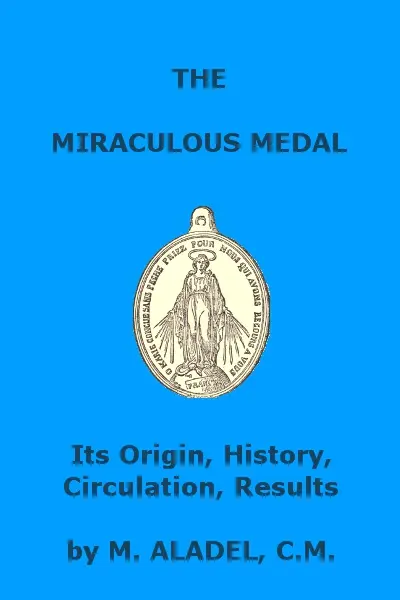
"The Miraculous Medal: Its Origin, History, Circulation, Results" by Aladel is a historical account written in the late 19th century. The book explores the life of Sister Catherine Labouré, a Daughter of Charity who was favored with visions of the Blessed Virgin Mary, leading to the creation and dissemination of the Miraculous Medal. The text delves into the origins and significance of the medal, highlighting its miraculous effects and the deepening devotion to Mary it inspired among Catholics. At the start of the book, readers are introduced to Sister Catherine's early life and her spiritual journey. The narrative recounts her humble beginnings in rural France, her deep faith, and her unyielding desire to serve God, culminating in her admission into the Daughters of Charity. After a series of divine communications, Sister Catherine receives instructions from the Blessed Virgin to have a medal struck, which becomes a symbol of great hope and grace for many. The opening sets the stage for a story of miraculous events and the profound effect of Mary's intercession on the lives of the faithful, establishing a context for the events that unfold.
Introduction adapted from the source catalogue; source summaries may be automatically generated.
Free to read · English · 93,354 words · No account needed
MAKE TIME FOR A GOOD BOOK
On by default. Untick to stop anonymous reading totals. Each page counts after 10 seconds in view. How this works.
Anonymous counting is on unless you have switched it off.
It is one o'clock; M. De Bussière must repair to the church of St. Andrew delle Fratte to make some arrangements for the funeral ceremonies of M. De La Ferronays, which take place on the morrow. He sets out, and on the way happily meets M. Ratisbonne, who joins him, with the intention of taking one of their usual walks, when M. De Bussière had fulfilled the imperative duty that required his immediate attention.... But the moment of grace has come. They enter the church, where various decorations already announce the morrow's ceremonies; the Israelite inquires the meaning of them, and M. De Bussière, having replied that they were for the funeral obsequies of M. De La Ferronays, the intimate friend he had just lost, begs him to wait there an instant, whilst he goes into the house to execute a commission with one of the monks. M. Ratisbonne then glances coolly around the church, seeming to say by his air of indifference, that it is not worth his attention. We must remark that he was then at the epistle side of the altar. M. De Bussière returns after an absence of about twelve minutes, and is surprised at not seeing his young companion. Could he have grown weary of waiting in a place that inspired only repugnance and disgust?... He knew not, and sought M. Ratisbonne. What was his astonishment at finding him on the left hand side of the church, kneeling, and apparently wrapt in devotion!... He could scarcely believe his eyes, and yet it was no mistake.... It was in the chapel of the archangel St. Michael that the prince of darkness had just been crushed.... A great victory already rejoiced all Heaven.... The young Jew was vanquished.
M. De Bussière approaches, but he is not heard; he touches his friend, but he cannot distract him; he touches him again, but still no response; he repeats it a third or fourth time, and at last M. Ratisbonne turns to answer, and his tearful countenance, his utter inability to express what has passed, his hands clasped most fervently, partly reveal the heavenly secret. "Oh! how M. De La Ferronays has prayed for me!" he exclaims. This is all he says. Never did M. De Bussière enjoy a more consoling surprise. The bandage of error blinding the young Israelite had fallen, and M. De Bussière's heart was filled with the most lively gratitude to God.... He raises his young friend, who was completely overcome by this celestial visitation; he takes him and almost carries him out of the church.... He is all eagerness to know the details.... He asks M. Ratisbonne to reveal the mystery, and begs him to say where he wishes to go. "Lead me," replies the new Paul, completely vanquished, "lead me where you will.... After what I have seen, I obey." ... And not being able to say more, he draws forth the unknown treasure he had been wearing upon his heart for four days. He takes the dear medal in his hands, he covers it with kisses, he waters it abundantly with tears of joy, and amidst his sobs escape a few words expressive of his happiness, but which a profound emotion almost prevents his articulating. "How good is God! What a plentitude of gifts! What joy unknown! Ah! how happy I am, and how much to be pitied are they who do not believe!" And continuing to shed torrents of tears over the miseries of those whom Faith has never enlightened, he already feels the holy desire of seeing the kingdom of Jesus Christ extended throughout the world. He can scarcely himself understand such a transformation, and amidst the various feelings surging through his heart, he interrupts his tears, his exclamations and his silence, to ask M. De Bussière if he does not think him crazy.... Then answering his own question, "No," he continues: "I am not crazy.... I know well what I think and what passes within me.... I know that I am in my right mind.... Moreover, everybody knows that I am not crazy!" By degrees, these first transports of emotion give place to a more composed frame of mind; he can at last express his new desires, his new belief, and he asks to be conducted to the feet of a priest, for he craves the grace of holy baptism.... Already favored with the most lively Faith, he aspires after the happiness of confessing his Divine Master in the midst of torments and recalling the sufferings of the martyrs he had seen represented upon the walls of St. Étienne le Rond; he wishes to shed his blood in attestation of his Faith as a disciple of Jesus Christ.... Meanwhile, he has told M. De Bussière nothing of the sudden blow that vanquished him, and he refuses to tell except in the presence of God's minister; "for what he saw he ought not, he could not reveal except on his knees."
Your reading position is saved on this browser. Take it to another device with a library code. Reading pages adapt to text, rather than matching a printed edition.
BEHIND THE BOOK
This eBook is for the use of anyone anywhere in the United States and most other parts of the world at no cost and with almost no restrictions whatsoever. You may copy it, give it away or re-use it under the terms of the Project Gutenberg License included with this eBook or online at www.gutenberg.org. If you are not located in the United States, you will have to check the laws of the country where you are located before using this eBook. Read the source licence.
The original source file, including credits and licence, is retained by this library. Request an original-format copy at no charge. Please include the book title and Project Gutenberg identifier #44231.
KEEP YOUR CURIOSITY GOING
David Patterson (Spirit) Hatch

David Patterson (Spirit) Hatch

David Patterson (Spirit) Hatch
Cécile Tormay

Moritz Busch
John L. Ransom