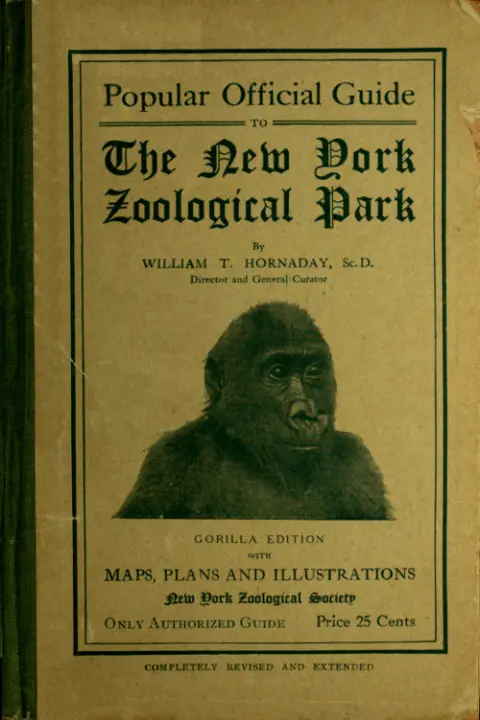
Popular Official Guide to the New York Zoological Park (September 1915) Thirteenth Edition
William T. (William Temple) Hornaday
THE CLASSIC COLLECTION · 1922
"The Minds and Manners of Wild Animals: A Book of Personal Observations" by William T. Hornaday is a scientific exploration written in the early 20th century. The work delves into the intelligence and behavior of wild animals, providing personal insights and observations that reflect on their mental capacities, moral traits, and social interactions. Hornaday, who served as the Director of the New York Zoological Park, advocates for a deeper understanding and respect for the natural behaviors and rights of wild animals, seeking to distinguish their unique characteristics from those of domestic species. The opening of the book sets the stage for a detailed inquiry into animal intelligence, emphasizing that the study of wild animals is a vast and largely unexplored field. Hornaday discusses the historical context of human perception of animal intelligence and the observations that form the foundation of his inquiry. He posits that animals exhibit complex behaviors reflective of their reasoning abilities, addressing concepts such as instinct, education, and the importance of observing animals in their natural habitats. Additionally, he critiques conventional methodologies used to study animal behavior, supporting a more personalized and observational approach. The introduction serves as an invitation to readers to consider the fascinating mental lives of wild animals, arguing that understanding their minds can enrich human experiences and promote wildlife conservation.
Introduction adapted from the source catalogue; source summaries may be automatically generated.
Free to read · English · 103,840 words · No account needed
MAKE TIME FOR A GOOD BOOK
On by default. Untick to stop anonymous reading totals. Each page counts after 10 seconds in view. How this works.
Anonymous counting is on unless you have switched it off.
The black and common leopards are nervous and combative,
irreconcilable and dangerous.
The snow leopard is sanguine, optimistic and peace-loving. The puma is sanguine, good natured, quiet and peaceful.
The wolves are sanguine, crafty, dangerous and cruel.
The foxes are hysterical, timid and full of senseless fear.
The lynxes are sanguine, philosophic, and peaceful.
The mustelines are either nervous or hysterical, courageous,
savage, and even murderous.
The bears are so very interesting that it is well worth while to consider the leading species separately. Possibly our conclusions will reveal some unsuspected conditions.
BEAR TEMPERAMENTS, BY SPECIES. The polar bears are sanguine, but in captivity they are courageous, treacherous and dangerous.
The Alaskan brown bears in captivity are sanguine, courageous,
peaceful and reliable, but in the wilds they are aggressive and
dangerous.
The grizzlies are nervous, keen, cautious, and seldom wantonly
aggressive.
The European brown bears are sanguine, optimistic and good-
natured.
The American black bears are sanguine and quiet, but very
treacherous.
The sloth bears of India are nervous or hysterical, and uncertain.
The Malay sun bears are hysterical, aggressive and evil-tempered.
The Japanese black bears are nervous, cowardly and aggressive.
To those who form and maintain large collections of bears, involving much companionship in dens, it is necessary to keep a watchful eye on the temperament chart.
THE DEER. In our Zoological Park establishment there is no collection in which both the collective and the individual equation is more troublesome than the deer family. In their management, as with apes, monkeys and bears, it is necessary to take into account the temperament not only of the species, but also of each animal; and there are times when this necessity bears hard upon human nerves. The proneness of captive deer to maim and to kill themselves and each other calls for the utmost vigilance, and for heroic endurance on the part of the deer keeper.
Even when a deer species has a fairly good record for common sense, an individual may "go crazy" the instant a slightly new situation arises. We have seen barasingha deer penned up between shock-absorbing bales of hay seriously try to jump straight up through a roof skylight nine feet from the floor. We have seen park-bred axis deer break their own necks against wire fences, with 100 per cent of stupidity.
The white-tailed deer is sanguine, but in the fall the bucks are very aggressive and dangerous, and to be carefully avoided. The mule deer is sanguine, reasonable and not particularly dangerous.
The elk is steady of nerve, and sanguine in temperament, but in the rutting season the herd-masters are dangerous.
Your reading position is saved on this browser. Take it to another device with a library code. Reading pages adapt to text, rather than matching a printed edition.
William T. (William Temple) Hornaday
William T. (William Temple) Hornaday
William T. (William Temple) Hornaday & W. J. (William Jacob) Holland
William T. (William Temple) Hornaday
BEHIND THE BOOK
This eBook is for the use of anyone anywhere in the United States and most other parts of the world at no cost and with almost no restrictions whatsoever. You may copy it, give it away or re-use it under the terms of the Project Gutenberg License included with this eBook or online at www.gutenberg.org. If you are not located in the United States, you will have to check the laws of the country where you are located before using this eBook. Read the source licence.
The original source file, including credits and licence, is retained by this library. Request an original-format copy at no charge. Please include the book title and Project Gutenberg identifier #6052.
KEEP YOUR CURIOSITY GOING

John Muir

Asa Gray
Asa Gray

Florence Nightingale
Elizabeth Robins Pennell
Denison Olmsted